
When a president reaches for a domestic deployment tool, the immediate legal fight is often not about tactics on the ground. It is about a threshold judicial question: how much should a court defer to the president’s version of the facts?
That word, deference, can determine whether statutory limits operate as enforceable rules, or instead leave the president broad room to decide whether the statutory conditions have been met.
Join the Discussion
What deference means
In plain English, deference is the amount of leeway a court gives the executive branch when it applies a statute to disputed or uncertain facts. If a statute says the president may deploy forces when a certain condition exists, the court has two broad choices.
- Low deference: the judge independently checks whether the condition is actually met.
- High deference: the judge largely accepts the president’s determination when assessing whether the facts satisfy the statute’s criteria.
There is also a baseline point that matters here: the baseline in statutory interpretation is no deference. Legislatures pass laws and courts interpret them. When the executive exceeds a statute’s authorization as interpreted by the judiciary, courts rule the action unlawful. Deference is something that must be justified, not assumed.
How statutes signal deference
Statutes do not just grant power. They can also signal who gets to make the crucial judgment calls. One of the clearest signals is language that explicitly assigns discretion to the president, with words like “judges,” “considers,” “deems,” “determines,” or “finds.”
The Supreme Court has treated that kind of wording as a strong signal that Congress meant to give the president room to maneuver. In Trump v. Hawaii, for example, the Court said the relevant immigration statute “exudes deference to the President” because it authorizes action whenever the president “finds” that entry would be detrimental to U.S. interests.
This is not a grammar exercise. It reflects a choice Congress can make about whether the president gets the first and often decisive word.
Guard cases and a quiet statute
The recent litigation over domestic deployments has put a spotlight on an obscure federal statute: 10 U.S.C. § 12406. It permits federalizing the National Guard in cases of (a) invasion, (b) rebellion, or (c) the president’s inability, with the regular forces, to execute the laws of the United States.
That statute became the vehicle in disputes over the federalization of Guard units in Los Angeles, Portland, and Chicago. On October 23, in Newsom v. Trump, the Ninth Circuit struck down President Donald Trump’s June 2025 federalization of the National Guard in Los Angeles. The court said it would be, in its words, “highly deferential” when reviewing the president’s determinations in this context, and it used the same approach in its decision on federalizing the Guard in Portland. The Seventh Circuit similarly said it would give “great deference” in the Chicago litigation, and the Supreme Court blocked the Guard deployment in Chicago last December in Trump v. Illinois.
But there is a tension right in the text: § 12406 does not use the classic discretion-conferring words. The Ninth Circuit acknowledged that the statute “does not include express language making the President the sole judge of whether a required exigency exists.” The court added that “if we were considering the text of § 12406 alone, we might conclude that the President’s exigency determination is subject to review like certain other factual findings that are preconditions for executive action under a statute.”
Nonetheless, the Ninth Circuit adopted a “highly deferential” standard by pointing to two things: the history of Congress’s statutory delegations of its calling-forth power and a line of cases beginning with Martin v. Mott. On the statutory-history point, the Ninth Circuit treated the evolution of the Insurrection Act as the principal analogue for understanding the statutory history of domestic deployments, even though the case was formally about § 12406.
The Insurrection Act stakes
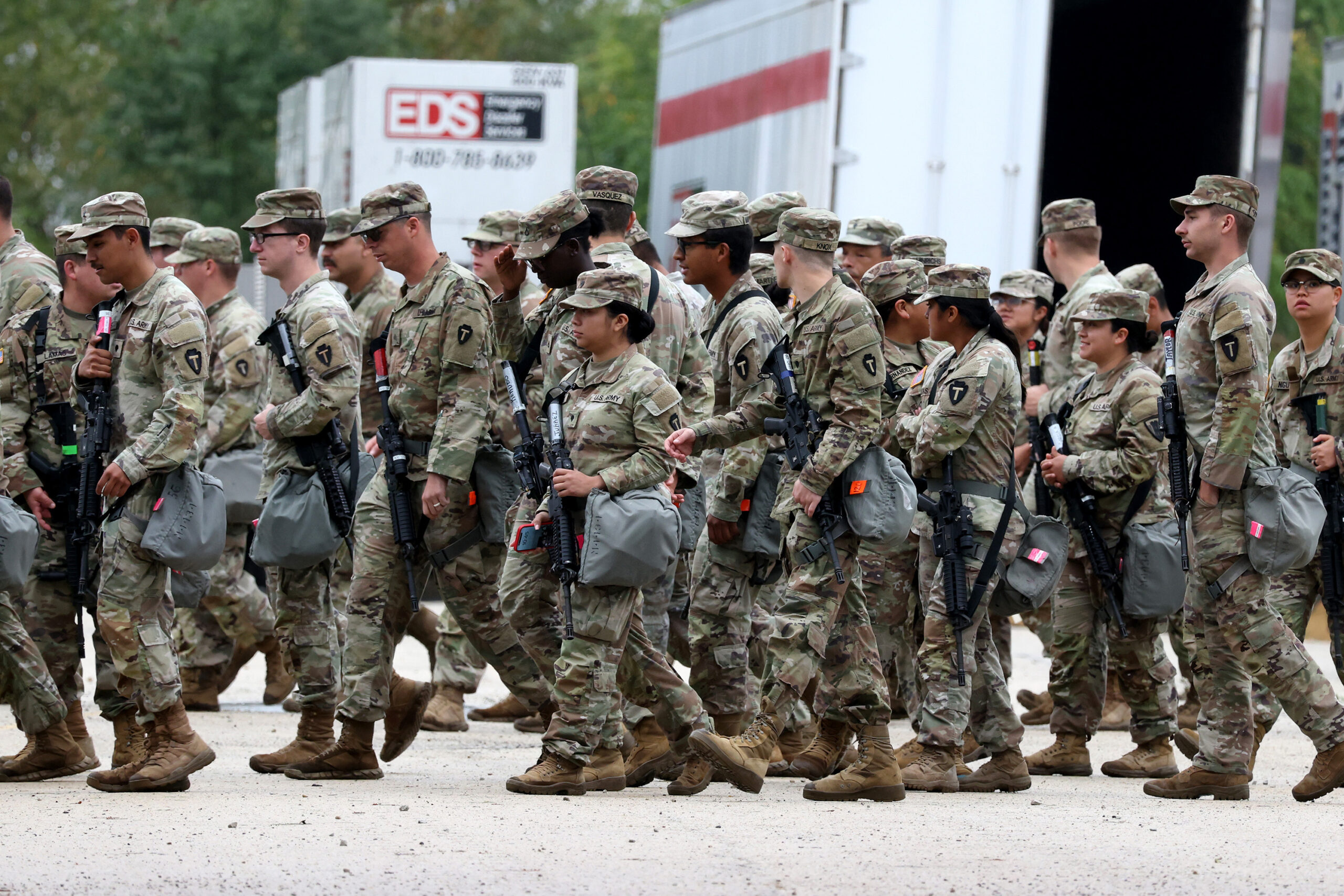
The larger question raised by the Guard cases is whether courts should defer to a president when the president invokes the Insurrection Act, the main and most fearsome statute for domestic deployment of the military.
After the Supreme Court blocked the Guard deployment in Chicago last December, some called the decision a “pyrrhic victory.” Jack Goldsmith wrote that the Insurrection Act still “lie[s] in the wings.” In Goldsmith’s view, the Insurrection Act is “much more robust” than § 12406, and the “power authorized here is astounding,” in large part because of the “greater claim to presidential deference” under the Insurrection Act. Goldsmith and Bob Bauer wrote: “The president will receive very significant deference from courts in his determination that an Insurrection Act predicate is satisfied.”
That is why the deference reasoning in § 12406 cases matters. The debate is not just about one statute. It is also about what framework courts carry into Insurrection Act fights.
Insurrection Act history and limits
Today’s Insurrection Act has four triggers, or conditions for domestic deployment. The key textual point is simple: the Act confers express deference in only one of the four triggers, because the statute sometimes uses the term “considers” and sometimes does not. The one trigger with deference-conferring language is what has been described as the judicial-proceedings trigger.
The statutory history reinforces that distribution. Congress did not write blanket, across-the-board discretion into the framework. It made targeted choices.
1792: Congress rejects “in his opinion”
In 1792, the Second Congress considered language that would have allowed the president to call out the militia “as the exigence may, in his opinion, require, to execute the laws of the Union, suppress insurrections, and repel invasions.” Those three words, “in his opinion,” would have attached presidential discretion to every trigger.
Representative William Vans Murray led the opposition. He warned that the proposal would leave “the time, the cause, and the place” to “the discretion of one man,” betraying what he called the Constitution’s promise of “a Government of definition, and not of trust and discretion.” The House rejected the amendment. The resulting Calling Forth Act contained no comparable language conferring deference on the president in its triggers.
1861: Deference added, but only to one trigger
In 1861, Congress added the phrase “in the judgment of the President” (language that today is phrased “[w]henever the President considers”), but only to the judicial-proceedings trigger. That change was understood to settle the controversy over President Lincoln’s use of force at the Civil War’s outset, overturning James Buchanan’s argument that the President lacked such authority under the Insurrection Act to fight the Civil War.
1871: New triggers, no deference words
When Congress added two additional triggers in 1871, it did so without inserting comparable discretion-conferring language. The judicial-proceedings trigger remained the sole trigger with express deference language, while the remaining triggers, including “rebellion” and “invasion,” had no deference.
Mott and its limits
Any time deference comes up in this area, one old Supreme Court case often appears: Martin v. Mott (1827). It interpreted the 1795 Calling Forth Act. The Ninth Circuit read Mott as requiring deference to the president. That reading has been contested by John Dehn and Joshua Braver, among others, and the Ninth Circuit addresses some of those objections.
But even setting that dispute aside, statutory history puts pressure on treating Mott as a general deference engine for modern statutes.
- Mott interpreted older statutory text. Congress later amended the Insurrection Act framework substantially, including by adding deference language in 1861 but omitting comparable language when it added new triggers in 1871.
- Two of today’s Insurrection Act triggers were added only in 1871. They postdate Mott by decades, raising a basic question about how far its reasoning can extend.
- Mott addressed the invasion trigger. Invasion is no longer part of the Insurrection Act, but it appears in a portion of § 12406 that was not at issue in Newsom v. Trump. The Ninth Circuit reasoned that if the invasion trigger requires deference, then the other § 12406 triggers should as well. That is a separate question from what level of deference is warranted under the Insurrection Act, where invasion is no longer grouped with the other triggers.
The question courts still face
Courts are wrestling with a blunt democratic question: When Congress sets conditions for domestic military deployment, are those conditions judicially enforceable rules, or do they largely leave the president wide latitude?
The statutory history of the Insurrection Act contains repeated congressional choices about where to place discretion-conferring language and where not to. It points toward a narrower conclusion: unusual deference is warranted for the one trigger where Congress wrote it in, but the baseline rule remains in place for the rest. Congress legislates the conditions for domestic deployment, and courts must judge for themselves whether a president has met those conditions without unusual solicitude to the president’s views on the matter.
A practical takeaway
If you want to understand the next emergency-power lawsuit, do not start with the speech. Start with the verb in the statute.
- If Congress wrote “whenever the President considers”, courts will face a stronger textual argument for stepping back.
- If Congress did not write that language, the baseline remains: Congress makes the law, and courts say what it means.
Representative William Vans Murray’s warning from 1792 remains the enduring tension in the background: whether the country is governed by definition, or by trust and discretion, when troops are on the table.