
Most election coverage treats the House of Representatives like a fixed stage: 435 seats, districts everywhere, and a familiar map every two years. But the map comes after something even more basic happens. First, the Constitution demands a count. Then federal law translates that count into a number: how many representatives each state gets to send to Washington.
That step is called apportionment (or reapportionment when it happens again after a new census). It is not gerrymandering. Gerrymandering is how a state draws lines inside its borders. Apportionment is how the federal government divides the House among the states in the first place.

Join the Discussion
The constitutional hook: counting people on purpose
Apportionment begins in the text of the Constitution. Article I requires an “actual Enumeration” every ten years, and it ties representation in the House to population. The Fourteenth Amendment later refined the rule after the Civil War, replacing the Three-Fifths rule and making clear that representation is based on the whole number of persons in each state (with an additional, rarely invoked penalty provision tied to denying voting rights).
Two foundational ideas sit behind this design:
- Representation tracks population. States with more people get more seats.
- The count is periodic. Power is recalculated every decade, not left to drift indefinitely.
That sounds straightforward until you ask the next question: how does “population” become a specific number of seats when there is a fixed-size House?
What the census does, and what it does not do
The census is the nationwide population count that triggers reapportionment. For apportionment, the legally operative number is each state’s apportionment population: the state’s total resident population, plus certain overseas federal employees (and dependents) allocated back to a home state under federal rules. Those totals are compiled by the Census Bureau and, under statute, transmitted through the President to Congress.
The census does not draw districts. It does not decide whether your neighborhood is in District 4 or District 7. And while the census produces the official counts used for apportionment, the actual allocation of seats is carried out under federal law and then formally communicated to the states.
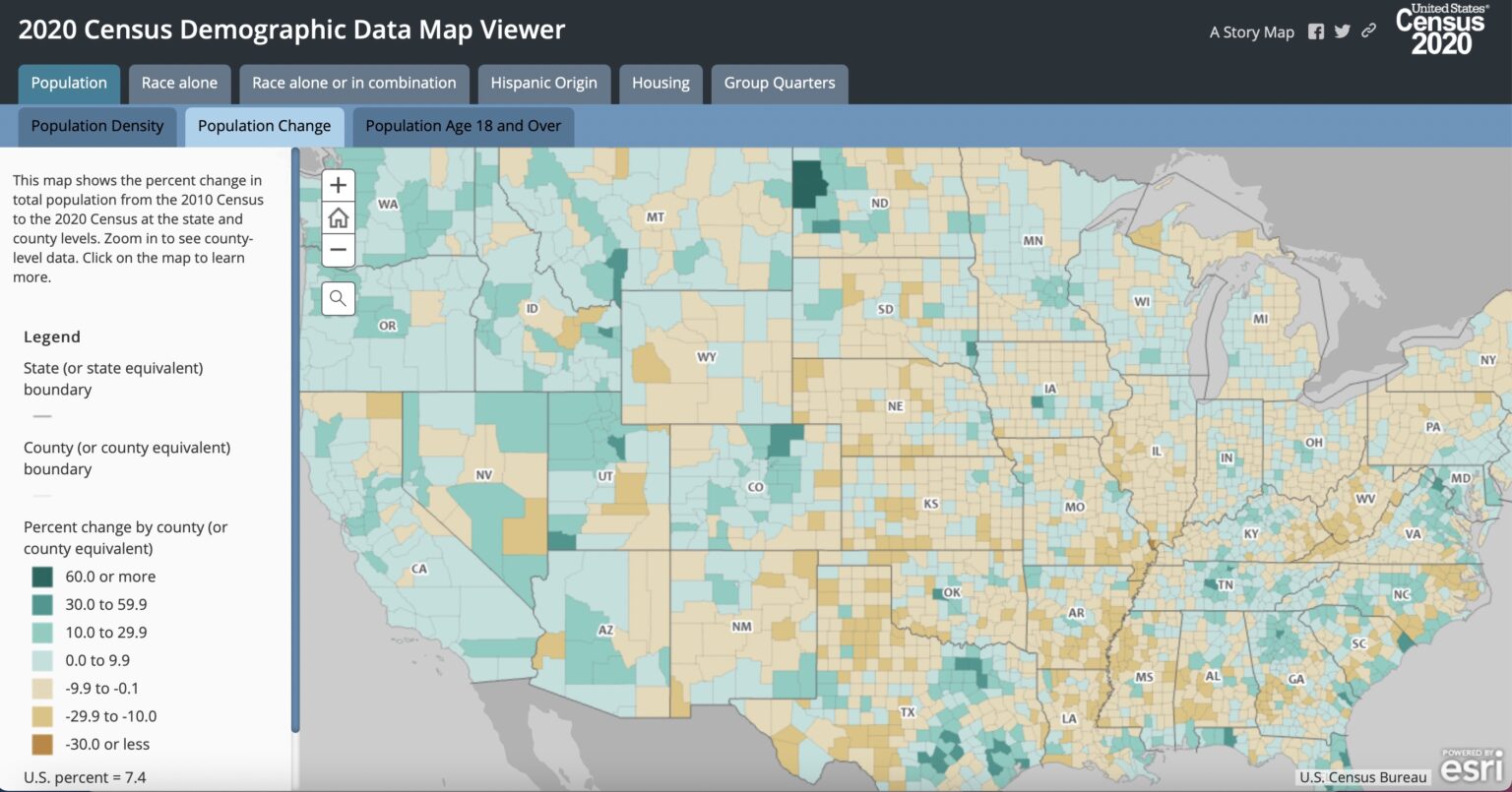
Because apportionment is driven by a single count used for a full decade, census accuracy matters. Undercounts and overcounts do not just affect statistics and funding. They can shift representation itself, moving a seat from one state to another.
Apportionment, reapportionment, and redistricting
These terms get blended together, but they refer to different steps with different decision-makers:
- Apportionment is the national allocation of House seats among the states.
- Reapportionment is apportionment done again after the next census.
- Redistricting is the state-level process of drawing district boundaries to fit the new number of seats.
Apportionment answers: How many seats does Texas get? Redistricting answers: Where, inside Texas, are those seats?
So if you want to understand why a state gained or lost a seat, you are in apportionment territory. If you want to understand why a district looks strangely shaped, you are usually in gerrymandering territory. Same decade. Different mechanics.
Why the House is 435 seats
The Constitution does not set the House at 435 members. It sets rules, not a permanent headcount. Congress has changed the size of the House multiple times in American history as the country grew.
In modern practice, the House has been kept at 435 voting members by federal law, most notably the Permanent Apportionment Act of 1929, following earlier legislation that set the House at 435 beginning in 1913. There was also a brief, practical bump to 437 after Alaska and Hawaii became states, before the next reapportionment returned the House to 435.
That choice matters because apportionment is a zero-sum exercise. When the total is fixed, one state’s gain is usually another state’s loss.
If Congress raised the House size, the “pressure” of the math would change. Smaller states would still be guaranteed at least one seat, but the tradeoffs would be less harsh. Keeping 435 forces sharper competition at the margins.
Two hard rules: one seat minimum and whole seats
Apportionment has to satisfy two practical constraints that sound obvious until you try to do the math:
- Every state gets at least one representative. No state can be reduced to zero.
- Seats are whole numbers. You cannot send 2.6 representatives to Congress.
Those constraints create the central apportionment problem: population shares are fractional, but representation must be discrete.
The math problem, without the headache
Imagine the House were perfectly proportional. You would take the national population, divide it by 435, and get an “ideal” number of people per seat. Then you would assign each state its share.
But shares rarely land on clean integers. Suppose a simplified country has 100 people and 10 seats. State A has 54 people and State B has 46. Perfect proportionality gives A 5.4 seats and B 4.6. If you round both down, you only assign 9 seats. If you round both up, you assign 11. The real system has to choose a consistent way to decide who gets the last seat and who does not.
That is where Congress’s chosen formula comes in.
Equal proportions, in plain language
Today, House seats are apportioned using a formula called the method of equal proportions. It has been used for apportionments beginning with the 1940 census (under legislation adopted in 1941) and is designed to keep representation as proportional as possible across large and small states.
Here is the intuition, without a wall of equations:
- Start by giving every state one seat. This satisfies the constitutional minimum.
- Then hand out the remaining seats one at a time until you reach 435.
- Each next seat goes to the state with the strongest claim based on how much that seat would improve proportional representation.
The “strongest claim” is not political. It is a priority value computed from a state’s population and its current number of seats. In plain terms, the method asks which state should get the next seat so that representation stays as even as possible given the unavoidable rounding.
If you want one mental picture: the formula tries to avoid situations where one state’s representatives are, on average, speaking for dramatically more people than another state’s representatives, beyond what the fixed number of seats makes unavoidable.
What apportionment changes in real life
Apportionment sounds like bookkeeping, but it quietly rearranges power in at least four concrete ways.
1) It changes a state’s House power
More seats means more committee assignments, more potential leadership slots, and more voices in the chamber. Losing a seat can reduce a state’s influence for a full decade.
2) It changes Electoral College strength
A state’s electoral votes equal its House seats plus two senators. When a state gains or loses a House seat, its Electoral College weight typically shifts with it.
3) It reshapes district size and constituent service
When the House size is fixed, the average district population tends to rise over time as the country grows. That can make it harder for a representative’s office to serve constituents and harder for voters to feel personally connected to a member of Congress.
4) It sets the redistricting dominoes in motion
States that gain seats must create new districts. States that lose seats must merge or eliminate districts. Even if the map-drawing is handled fairly, apportionment still forces the basic structural changes.

Common questions
Are House seats based on citizens or residents?
Apportionment uses total population, not just eligible voters. In practice, states’ apportionment populations start with total resident population and include allocated overseas federal personnel. This approach traces to the Constitution’s representation structure and the Fourteenth Amendment’s language tying apportionment to the whole number of persons in each state.
Can Congress pick a different method?
Congress has historically chosen among different apportionment methods by statute. The Constitution requires apportionment tied to the census, but it does not lock in a single modern formula by name.
Could the House be expanded?
Yes, by federal law. The Constitution sets a floor that each state has at least one representative and establishes the overall framework, but Congress controls the House’s size.
Why this matters
Apportionment is one of the Constitution’s most practical promises: representation will be revisited, recalculated, and redistributed as the nation changes. It is an attempt to make political power responsive to population shifts without rewriting the Constitution every decade.
And it is a reminder that representation is not just a philosophical idea. It is a math problem with constitutional stakes. When we argue about who counts, how accurately we count them, and whether the House should stay fixed at 435, we are not arguing around the edges of democracy. We are arguing about how the Constitution translates people into power.