
Sequestration is one of those Washington words that sounds technical on purpose. And it mostly is. But the idea behind it is simple: when Congress sets budget rules for itself and then breaks them, sequestration is the enforcement mechanism that can kick in automatically.
It is not a government shutdown. It is not a vote. It is not a policy program with a public-facing name. It is a set of across-the-board reductions that happen because prior laws told the executive branch what to do if lawmakers fail to meet certain deficit or spending targets.
Also important: “across-the-board” only applies within the pool that is legally sequesterable. Exemptions and special rules mean some big programs are fully protected, while the cuts concentrate elsewhere.
Join the Discussion
What sequestration means
In federal budgeting, sequestration is an automatic cancellation of budgetary resources. That can mean:
- Lowering budget authority for agencies and programs
- Reducing certain mandatory payments by a uniform percentage
- Limiting how much can be spent even if Congress already enacted a law that would otherwise spend more
Sequestration exists because Congress has repeatedly tried to solve a constitutional reality: the Constitution gives Congress the power of the purse, but it does not force Congress to be fiscally consistent. Sequestration is the statutory attempt to create consequences when Congress is not.
The constitutional hook
The Constitution does not mention sequestration. What it does provide is the framework that makes sequestration possible.
- Article I, Section 9: “No Money shall be drawn from the Treasury, but in Consequence of Appropriations made by Law.” Congress decides what money can be spent.
- Article II: the President must “take Care that the Laws be faithfully executed.” If a law requires an automatic reduction, the executive branch is supposed to carry it out.
So sequestration is not a President choosing to cut spending. It is Congress writing a rule in advance that says, in effect: if we do not do X later, then Y will happen automatically.
Three sequestration tracks
When people say “sequestration,” they are often mixing together related but different mechanisms that can all produce automatic cuts. The clean way to think about it is three tracks: discretionary caps enforcement, statutory PAYGO, and BCA-era mandatory sequestration that still echoes in places like Medicare provider payments.
| Track | Core idea | What triggers cuts | Where it mostly hits |
|---|---|---|---|
| Discretionary caps | Set legal limits on annual discretionary spending | Appropriations exceed the cap (or a penalty cap is imposed by law) | Discretionary accounts (defense and nondefense, depending on the cap structure) |
| Statutory PAYGO | New laws cannot increase the deficit overall | Congress enacts deficit-increasing legislation without offsets and does not later zero or waive the scorecard | Selected mandatory spending programs, subject to major exemptions |
| BCA-style mandatory sequester (BBEDCA) | Automatic mandatory spending reductions set by statute | Sequester order required under the governing law and year, as modified by later statutes | Selected mandatory spending, including Medicare provider payment reductions that are commonly capped at 2% |
All three rely on scorekeeping and calculations. This is where CBO, OMB, and the sometimes maddening math of “budget baselines” come in.
One practical anchor: caps fights show up in appropriations seasons; PAYGO shows up after big tax or entitlement bills; BCA-style mandatory sequestration shows up in Medicare payment headlines because it is one of the few big, visible pieces that can keep running year after year.
Why “sequestration” spiked in 2013
The modern cultural memory of sequestration comes from the Budget Control Act of 2011 (BCA). It was born from a moment when Washington combined two high-stakes fights into one: raising the debt limit and promising deficit control.
What the BCA did
- Created (and enforced) discretionary spending caps.
- Set up the “supercommittee” process for further deficit reduction.
- Included a fallback sequestration if deficit reduction targets were not met.
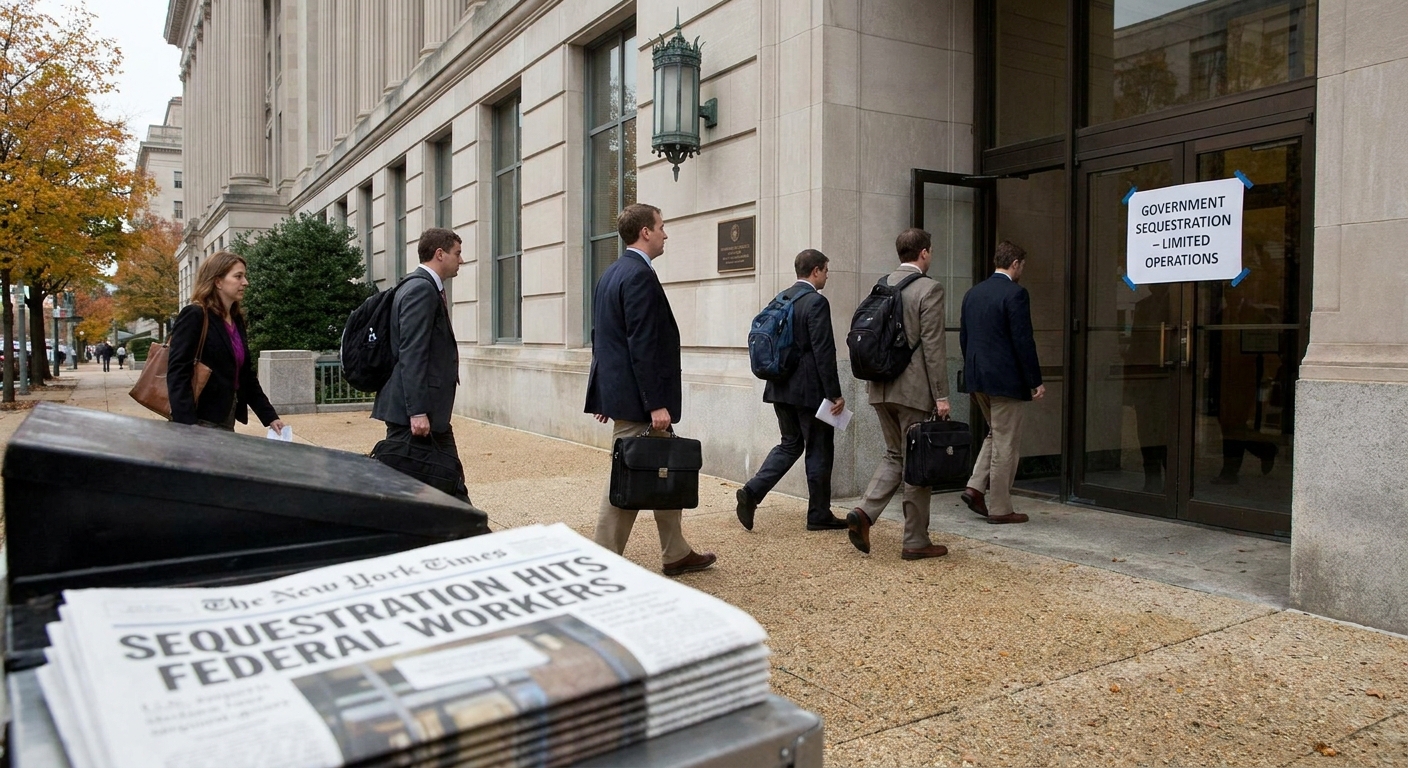
When the supercommittee failed, the fallback hit. In 2013, large, visible reductions rolled through defense and nondefense discretionary spending and certain other accounts. That is why “sequester” became a headline noun.
The evergreen lesson is this: the BCA’s sequestration was a consequence baked into the statute. It was designed to be unattractive enough that Congress would rather compromise than let the automatic cuts happen.
Is BCA sequestration still a thing?
The specific BCA-era discretionary cap regime that dominated 2011 to 2013 was later modified repeatedly by bipartisan budget deals and eventually expired. So the 2013 episode is largely a historical reference point.
But sequestration as a tool did not vanish, and two modern realities are worth saying out loud:
- BCA-style mandatory sequestration has persisted in narrower, high-profile forms through extensions and adjustments in later laws. The Medicare piece people cite most often is not “benefits get cut,” it is provider payments get reduced, and the commonly referenced maximum reduction has been 2% under that framework.
- Discretionary caps are back under newer law. The Fiscal Responsibility Act of 2023 (FRA) reinstated statutory discretionary spending limits and added enforcement features, including a 1% penalty mechanism tied to reliance on continuing resolutions in certain circumstances. In other words, the modern version of “caps plus consequences” is not stuck in 2011.
The key question is not “is the 2011 law still running the show,” but rather:
- Are there current-law discretionary caps that can be breached or tightened by a penalty?
- Is Statutory PAYGO generating a debit that must be offset, unless Congress later wipes it away?
- Did Congress include a sequestration instruction in a newer fiscal law?
Sequestration is the budget system’s muscle memory. Once Congress has written the automatic consequence into law, it takes new law to stop it.
PAYGO, in plain English
PAYGO stands for “pay as you go.” The concept is straightforward: if Congress wants to increase spending or cut taxes, it should offset the cost so the deficit does not rise.
But there are two “PAYGOs” that people confuse:
- Congressional PAYGO rules: internal House and Senate rules that can be waived.
- Statutory PAYGO: a federal law (enforced by the executive branch) that can lead to sequestration if deficit effects are not offset.
One real-world wrinkle: statutory PAYGO is a real enforcement mechanism, but Congress has often acted to prevent it from biting by zeroing out scorecards or waiving the requirement in later legislation. So it is best understood as a loaded trap that lawmakers frequently unload before it fires.
How statutory PAYGO is tracked
When Congress passes laws affecting taxes or mandatory spending, those changes are recorded on a running scorecard. If the scorecard shows net deficit increases over the relevant window, OMB is required to issue a sequestration order to eliminate the net cost, subject to exemptions and limits.
What triggers cuts now?
Sequestration is not triggered by “the deficit is large” as a general vibe. It is triggered by specific legal conditions that depend on which enforcement regime is in play.
Common modern triggers
- Discretionary caps are exceeded by enacted appropriations, requiring reductions to bring totals back under the cap, or a cap is lowered under a statutory penalty design (such as the FRA’s continuing resolution penalty concept).
- Statutory PAYGO scorecards show a net cost at the end of a session, requiring cuts to certain mandatory programs to offset it, unless Congress intervenes first.
- Mandatory sequesters under BBEDCA-style rules apply to the covered base, producing uniform reductions to certain payment streams (most visibly, Medicare provider payment reductions rather than beneficiary benefit cuts).
- Program-specific enforcement: Congress sometimes writes bespoke sequestration-like backstops into major fiscal laws, especially for trust fund solvency or provider payment constraints.
This is why sequestration tends to resurface when Washington makes big deficit-impacting moves. It is the silent compliance officer for budget laws that were drafted years earlier.
CBO vs OMB
Budget enforcement is a division of labor. People often credit CBO with “ordering” cuts. CBO does not. CBO estimates. The executive branch executes.
| Entity | What it does | Why it matters for sequestration |
|---|---|---|
| CBO (Congressional Budget Office) | Produces cost estimates (“scores”) for legislation; maintains baselines; analyzes budget options | Shapes how Congress understands a bill’s deficit impact and whether offsets are needed |
| JCT (Joint Committee on Taxation) | Estimates revenue effects for tax legislation | Tax cuts and credits drive PAYGO math, so revenue estimates can be decisive |
| OMB (Office of Management and Budget) | Maintains statutory PAYGO scorecards for the executive branch; issues sequestration reports and orders when required | OMB is the entity that translates the law into an actual sequestration order |
| GAO (Government Accountability Office) | Audits and evaluates federal programs | Not the trigger, but often informs oversight when cuts affect performance and compliance |
CBO is the referee’s replay booth. OMB is the one with the whistle.
After an OMB order, agencies still have to do the unglamorous work: allocating the required percentage reduction across accounts, applying exemption rules correctly, and then making operational choices about contracts, grants, hiring, and timing. The percentage is “uniform” on paper, but the consequences can be lumpy on the ground.

What gets cut, what is exempt
The phrase “across-the-board cuts” sounds like everything gets hit equally. It never works out that cleanly. Sequestration statutes typically include exemptions, special rules, and maximum reduction limits for politically sensitive programs.
Common exemptions and protections
| Category | Typical treatment | Why it is designed that way |
|---|---|---|
| Social Security benefits | Generally exempt from sequestration | Political and practical protection for core retirement and disability benefits |
| Many low-income entitlement programs | Often exempt or specially protected depending on the statute | Avoids concentrating cuts on vulnerable populations |
| Medicare | Often protected from full sequestration but subject to capped reductions under certain rules, commonly cited as up to 2% for provider payments (not beneficiary benefits) | Allows “real money” enforcement while limiting direct disruption to beneficiaries |
| Interest on the debt | Statutorily exempt from sequestration | Interest payments are carved out by law |
| Veterans benefits and certain national security accounts | Varies by law and fiscal year | Congress frequently tailors exemptions to current priorities |
Important: exemption lists are statutory and can change. A program can be protected under one sequestration regime and exposed under another. Whenever sequestration is in the news, the real question is: which law’s sequestration are we talking about?
Is it a cut or slower growth?
Both, depending on the program and how it is funded.
- For discretionary programs (appropriations), sequestration can mean fewer dollars than Congress just enacted, which can translate into layoffs, fewer grants, or reduced services.
- For mandatory programs, sequestration often operates as a percentage reduction to payments, or a limitation on the amounts that would otherwise be paid.
And then there is the rhetorical trick: policymakers may describe sequestration as a “cut” or as “slowing spending growth” depending on whether they want you to panic or relax.
The cleanest way to talk about it is this: sequestration changes what the law would otherwise allow to be spent.
Why Congress builds auto punishments
Because sequestration is bargaining leverage disguised as process. Or, more precisely, it often functions that way.
Budget negotiations often fail for a predictable reason: lawmakers can agree that the deficit matters in the abstract, but they disagree intensely about which programs should absorb the pain. Sequestration is the attempt to substitute consensus on ends for consensus on means.
If the automatic cut is unpleasant enough for enough people, it is supposed to force a deal before the deadline.
Sometimes it works. Sometimes Congress just lives with the cut. And sometimes Congress waits until the last possible moment and then passes a bill that cancels, delays, or reshapes the sequester. The existence of that escape hatch does not mean sequestration is fake. It means Congress is still Congress.
Sequestration vs shutdown
These are not interchangeable:
- Government shutdown: happens when appropriations lapse. Agencies lack legal authority to spend for many activities.
- Sequestration: happens when spending is legally reduced under an enforcement mechanism. Agencies still have appropriations, just less of them.
A shutdown is a lights-out problem. Sequestration is a dimmer switch.
How to read the headlines
If you want to read sequestration news like a seasoned budget watcher instead of riding the adrenaline cycle, look for three specifics in any article or press release:
- Which law? Statutory PAYGO, discretionary caps, BBEDCA-style mandatory sequester rules, or a special enforcement provision?
- Which fiscal year? Some enforcement is prospective, some is immediate.
- Which accounts are exempt? That determines who actually feels it.
And then look for the paper trail: CBO estimates and OMB sequestration reports. The argument is usually political. The mechanics are usually in public PDFs.
The bigger civic point
Sequestration is an uncomfortable reminder of how much governing happens through defaults. Not because anyone campaigned on them, but because Congress wrote them into law as a substitute for agreement.
If you care about accountable government, sequestration is worth understanding precisely because it is not dramatic. It is what happens when elected officials outsource hard choices to math, deadlines, and automatic rules, and then act surprised when the rules do what they were designed to do.