The Supreme Court’s term does not end with oral argument. It ends with consequences.
The Court is now in the final stretch of its 2025–2026 term. Oral arguments are over and the merits docket is fully submitted. What remains is the work that actually settles the law: drafting, finalizing, and releasing the opinions that are still outstanding. Those decisions should land later this month or next, since the Court typically wraps up by the end of June.
Below are 11 major cases likely to be decided soon, and the constitutional pressure points they expose. Some may shift policy at the margins. Others may reset the operating assumptions of American government.
Join the Discussion
Immigration and the border
Immigration fights often sound like politics. In court, they turn into something sharper: a dispute over what the law requires the executive branch to do, even when it would rather do something else.
Mullin v. Al Otro Lado
This case centers on what happens when an asylum seeker presents at the U.S. border and asks for protection. May the government refuse entry at the threshold, or must immigration officials inspect that person and route the claim into the asylum system for further processing?
What could change: Depending on how the Court rules, the decision could expand or restrict the government’s ability to turn people away at the border without placing them into the asylum process.
Mullin v. Doe
Temporary Protected Status (TPS) is a humanitarian tool that lets qualifying foreign nationals remain in the United States when returning home would be too dangerous. In Mullin v. Doe, the Court will decide whether the Trump administration improperly removed TPS from Syrian and Haitian nationals.
What could change: The ruling could clarify how much discretion the executive branch has to end TPS protections and how readily courts may review those decisions.
Guns and the Second Amendment
In modern Second Amendment litigation, outcomes often turn on how judges compare contemporary restrictions to historical limits. Two pending cases bring that debate into different contexts: where licensed people may carry, and which categories of people may possess firearms at all.
Wolford v. Lopez
Wolford v. Lopez challenges a Hawaii rule aimed at carry on private property that welcomes the public. The state told licensed concealed-carry holders they cannot bring a handgun onto such property unless the owner has explicitly said yes.
What could change: The Court’s decision could affect how far states may go in setting default rules for carrying firearms on privately owned places that the public routinely enters.
United States v. Hemani
In United States v. Hemani, the justices are weighing a federal firearms ban that applies to people who are illegal users of drugs. The question is whether that prohibition is compatible with the Second Amendment.
What could change: The outcome could influence how lower courts evaluate firearms bans tied to drug-use status under the Court’s current Second Amendment framework.
Transgender athletes
These cases are not only about sports. They are also about how government draws lines based on sex, what constitutional scrutiny applies, and what federal education law does or does not allow.
Little v. Hecox
The petition in Little v. Hecox frames the issue this way: "whether laws that seek to protect women’s and girls’ sports by limiting participation to women and girls based on sex violate the Equal Protection Clause of the Fourteenth Amendment."
What could change: The Court could clarify how it evaluates sex-based eligibility rules under the Equal Protection Clause. That reasoning could matter in other settings where governments rely on sex-based categories.
West Virginia v. B.J.P.
The petition in West Virginia v. B.J.P. frames the issue this way: "whether Title IX prevents a state from consistently designating girls’ and boys’ sports teams based on biological sex determined at birth."
What could change: The ruling could affect how much discretion states and schools have under Title IX when setting eligibility rules for sex-separated teams.

Executive power and agencies
One of the Constitution’s most persistent tensions is also one of its least intuitive: the relationship between presidential control and Congress’s decision to create independent agencies insulated from political firing.
These cases ask what that insulation really means and how firm the limits on presidential removal power are in practice.
Trump v. Slaughter
This case asks whether President Donald Trump may dismiss a Federal Trade Commission (FTC) commissioner for political reasons alone, instead of meeting a statutory "for cause" standard. A Supreme Court decision from 1935 says an FTC commissioner cannot be removed purely for politics, and the justices must decide whether to keep that rule, narrow it, or discard it.
What could change: If the Court loosens removal protections, presidents could gain more direct control over independent regulators. If the Court leaves the 1935 rule standing, that may preserve a measure of insulation for certain agency officials.
Trump v. Cook
Trump v. Cook involves the Federal Reserve Board of Governors and the meaning of "for cause" in practice. Trump says he fired Lisa Cook on legally sufficient grounds; the case asks whether the stated justification actually meets the statutory standard, or whether it functioned as a pretext to mask an unlawful political firing.
What could change: The Court’s reasoning could affect how enforceable statutory job protections are, especially when a president points to a lawful basis for removal but the fight is over the real motive.
Birthright citizenship
Some constitutional disputes are about gray areas. Birthright citizenship is often described as the opposite.
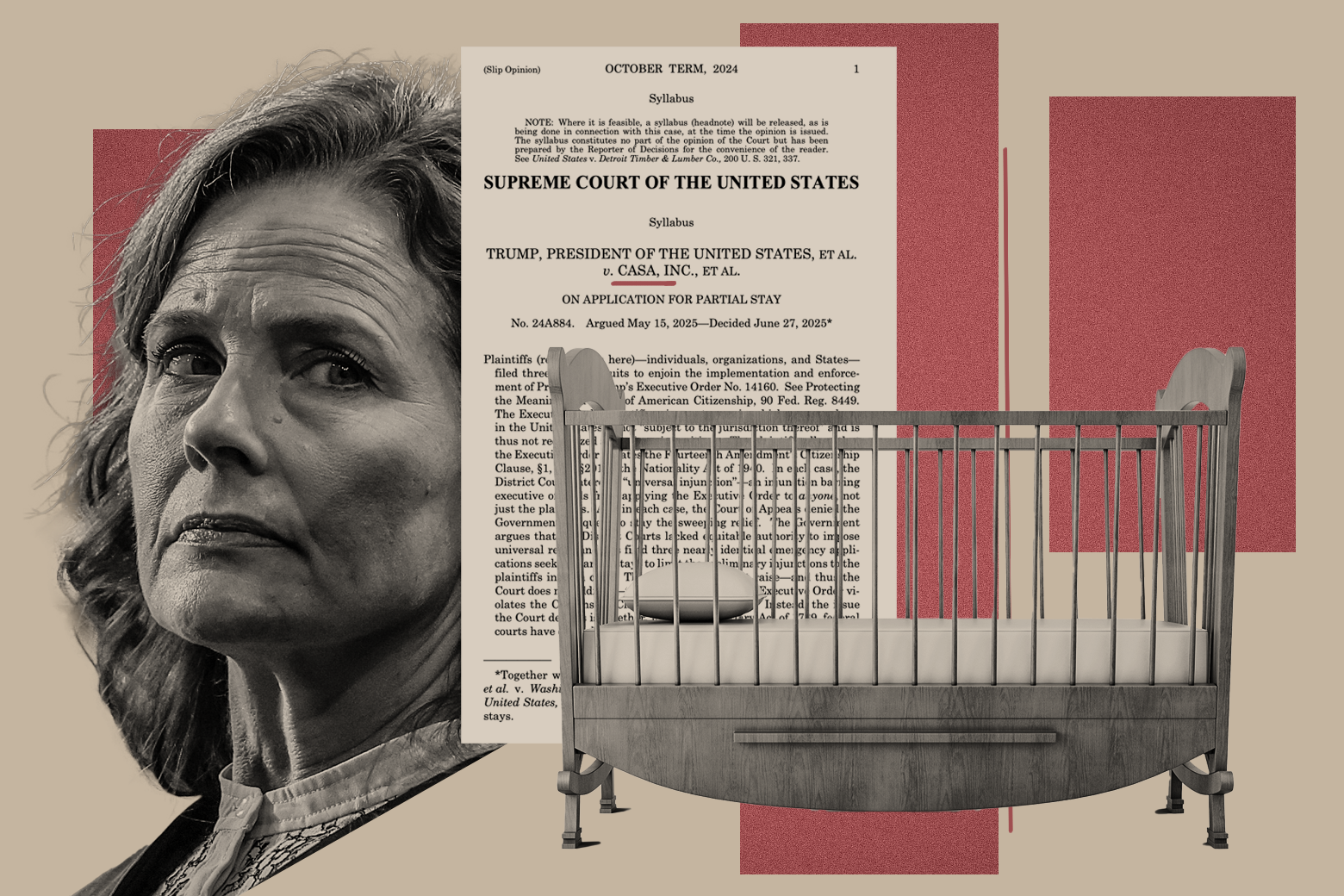
In Trump v. Barbara, the Court is asked to evaluate an executive order that attempts to withhold birthright citizenship from U.S.-born children when their parents are in the country unlawfully or are here lawfully but only as temporary visitors.
What could change: The ruling could clarify how the Court understands the Fourteenth Amendment’s Citizenship Clause in this context, and how much room a president has to pursue that kind of constitutional claim through executive action.
Mail-in ballots
The Constitution gives states the primary role in prescribing the "Times, Places and Manner" of congressional elections, while reserving power for Congress to override state rules. That structure sounds clean until you reach a deceptively simple question: when is Election Day, legally speaking?
Watson v. Republican National Committee
This case targets a timing rule in Mississippi: the state counts certain mail-in ballots that were sent by Election Day, even if they arrive afterward. The legal issue is whether that approach conflicts with the federal statute that set a single nationwide date for federal elections.
What could change: The Court could determine whether states may treat Election Day as a postmark deadline for mail-in ballots in federal elections, or whether federal law requires something closer to a receipt-by deadline.
Fourth Amendment and geofences
The Fourth Amendment was written for a world of doors, drawers, and paper. We live in a world of location trails.
Chatrie v. United States
Chatrie v. United States grows out of a bank-robbery investigation and a digital dragnet. Investigators instructed Google to comb through location-history data and identify which devices were in the relevant area at the relevant time. The Court must decide what the Fourth Amendment allows when the government demands location data in bulk.
What could change: The Court could address whether broad location-history searches fit within the Fourth Amendment’s demands of particularity and reasonableness. The ruling could shape how easily investigators may use geofence-style demands and what protections apply to people whose data is swept in despite not being suspects.

All 11 cases
- Mullin v. Al Otro Lado
- Mullin v. Doe
- Wolford v. Lopez
- United States v. Hemani
- Little v. Hecox
- West Virginia v. B.J.P.
- Trump v. Slaughter
- Trump v. Cook
- Trump v. Barbara
- Watson v. Republican National Committee
- Chatrie v. United States
Why they matter
- They test constitutional boundaries, not just policy preferences. Immigration processing, election timing, and agency independence raise recurring questions about who has lawful authority to act and under what constraints.
- They define who decides. Several disputes are really about whether Congress, the president, states, or courts get the final say.
- They can shape daily life quietly. A geofence rule can change how police investigate. A mail ballot rule can change how votes are counted. A removal-power rule can change how regulators behave when the White House changes hands.
The Constitution rarely changes in text. It changes in meaning through answers to questions like these. That is why end-of-term Supreme Court decisions deserve attention. They are where theory becomes tomorrow morning.