
Much political money is not actually hidden. It is tracked, reported, searchable. You can pull up a campaign finance report, see who wrote the checks, and follow the trail.
Dark money is what happens when that trail ends on purpose, or ends at an intermediary.
It is political spending that influences elections or public policy while keeping the original donors out of public view. The ad has a sponsor name on it. The sponsor may file election spending reports and run legally required ad disclaimers. But the people who funded the sponsor are often not publicly disclosed. And in modern American politics, “not disclosed” can be the entire point.

Join the Discussion
Dark money, defined
Dark money generally refers to money spent to influence politics by organizations that are not required to publicly disclose their donors.
In practice, the term is usually aimed at nonprofit groups organized under the tax code, especially:
- 501(c)(4) “social welfare” organizations
- 501(c)(6) trade associations
These groups can spend significant amounts on politics without listing their donors in the way candidate campaigns and most political committees must. They can pay for advertising, fund ballot measure efforts, and support or oppose candidates, often through messages that feel like campaign ads but are structured to fit within legal categories.
The word “dark” does not necessarily mean illegal. It means the public cannot reliably see who is behind the spending.
Dark money vs. PACs vs. super PACs
Political finance is a tangle because the rules depend on what kind of group you are and what kind of spending you do. Here is the simplest way to separate the most common players.
Candidate campaigns
Candidate committees have strict contribution limits and must disclose donors. If you give to a candidate, your name usually becomes part of a public record.
PACs (traditional political action committees)
PACs can contribute directly to candidates (within limits) and must disclose donors. Their money is not “dark” in the disclosure sense.
Super PACs
Super PACs can raise unlimited funds and spend unlimited amounts independently of candidates, and they must disclose donors to the FEC. In other words, super PAC money is typically “big,” not “dark.”
The caveat is that super PAC disclosure does not always reveal the ultimate source of funds. A super PAC can report a nonprofit or an LLC as the donor, and the public may still be unable to see who originally financed that entity.
Nonprofit groups (common dark money vehicles)
Certain nonprofits can spend on politics and, unlike PACs and super PACs, they generally do not have to publicly reveal their donors. When these groups are the original source of funds used to shape an election, the public sees the group name and not the underlying funders.
One helpful boundary: 501(c)(3) charities are generally prohibited from supporting or opposing candidates. They can do limited lobbying and a range of civic education work, but they cannot be candidate-election machines.
How dark money moves
Dark money is less a single tactic than a set of pathways. The mechanics look different depending on the goal, but a common pattern is:
- A donor gives money to a nonprofit that does not publicly disclose donors.
- The nonprofit spends directly on political messaging, or transfers funds to another group.
- The public sees the spender’s name, but not the donor who financed it.
One of the most criticized features is layering, where money passes through multiple entities so that even investigators have to work to figure out where it began.
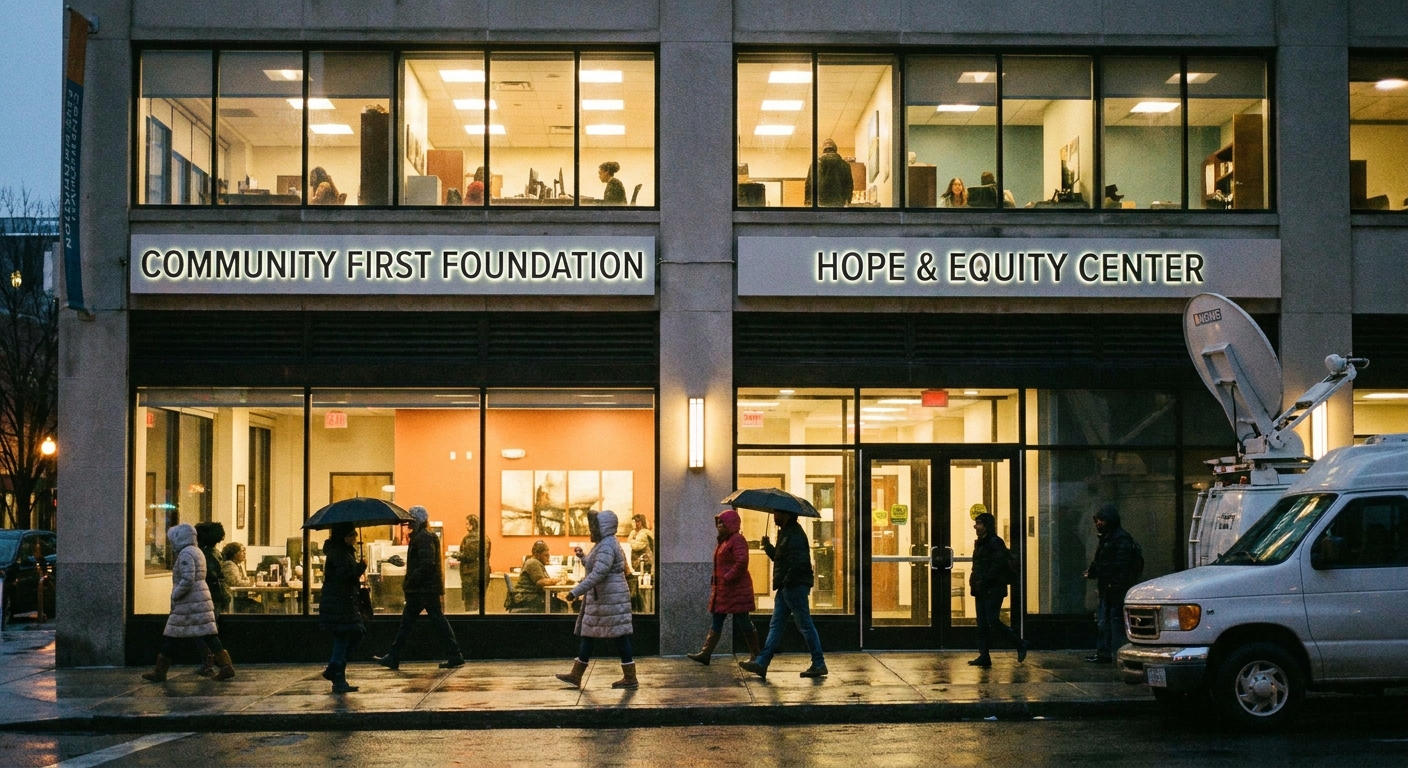
A concrete example (generic, not partisan): a 501(c)(4) raises money from a small set of wealthy donors, then gives a large grant to another nonprofit that runs ads urging voters to “call Senator X” about a hot-button issue two weeks before Election Day. Viewers see an organization name on the disclaimer. Reporters may see spending totals in filings. But the donor list stays offstage.
Why donors stay hidden
The key is that disclosure requirements are not the same across all types of political activity and all types of organizations.
There are two overlapping systems that confuse people:
- Tax law (IRS): many nonprofits file Form 990, but donor names are generally not made public for most donor-disclosing schedules. So the public can see an organization’s finances in broad strokes, while still not seeing who funded it.
- Election law (FEC and states): reporting usually attaches to specific election-related triggers. Groups may report spending while still not reporting their underlying donors, depending on the legal category and the jurisdiction.
Nonprofits like 501(c)(4) groups are not created as election machines. Under IRS “primary purpose” guidance, they are supposed to be primarily focused on social welfare. But “primarily” leaves room, and there is no bright-line percentage in the statute or regulations. A group can do substantial political work and still claim compliance depending on how activities are categorized and reported.
Separately, campaign finance disclosure laws focus most intensely on:
- contributions to candidates
- spending that explicitly advocates the election or defeat of a candidate
But it is not only about “magic words.” Federal law also covers electioneering communications, a category created by the Bipartisan Campaign Reform Act (BCRA) that can trigger reporting and disclaimer requirements for certain broadcast ads close to an election, depending on timing, targeting, and other conditions.
That still leaves space for issue ads, public messaging, and other political activity that shapes voter beliefs without fitting neatly into the most disclosure-heavy boxes. The legal borders have shifted over time, but the basic idea remains: disclosure often attaches to specific triggers, and sophisticated groups plan around those triggers.
Citizens United
No modern discussion of money in politics can avoid Citizens United v. FEC (2010). The case is usually summarized as “corporations can spend unlimited money on elections,” but that is an incomplete description.
What the Court did was strike down limits on independent expenditures by corporations and unions, treating that kind of spending as protected political speech under the First Amendment.
Two points matter for dark money:
- Citizens United did not create nonprofits. Those structures already existed.
- Citizens United upheld disclosure requirements in principle. The opinion praised disclosure as a way for voters to evaluate messages and speakers.
So why did dark money rise after 2010? Because the broader ecosystem shifted. Independent spending became central to elections, and groups that could raise large sums without donor transparency became especially valuable tools.
Speech vs. disclosure
Dark money is not just a policy dispute. It is a constitutional argument about what the First Amendment protects.
Supporters of donor anonymity often invoke two related ideas:
- Freedom of speech, including the right to fund speech
- Freedom of association, including protection against compelled exposure of membership or donors
The Supreme Court has recognized that compelled disclosure can chill participation, especially where disclosure creates a realistic threat of harassment or retaliation. A landmark example is NAACP v. Alabama (1958), where the Court protected the NAACP from being forced to reveal its membership lists.
Transparency advocates answer with a different constitutional claim: that disclosure supports democracy by giving voters context, deterring corruption, and helping enforce other election rules. In Citizens United, the Court accepted the legitimacy of disclosure regimes, even while expanding independent spending rights.
That tension has not resolved. It keeps resurfacing in cases about donor disclosure, campaign finance reporting, and the scope of government power to demand transparency.
Is it legal?
Often, yes. The legality depends on what the group is, what it is spending on, and whether it crosses lines like:
- coordinating spending with a candidate (which can trigger stricter rules)
- misreporting the purpose of spending
- violating contribution limits through indirect arrangements
The most important point for readers is this: “dark” is not a criminal label. It is a disclosure label. The spending may be lawful under current statutes and regulations while still being opaque to voters.
Why it matters
The Constitution does not contain a neat, explicit rule for campaign finance transparency. We build disclosure systems through statutes, regulatory agencies, and court decisions. That means the balance can change.
Dark money matters because it tests two democratic commitments that pull against each other:
- Accountability: voters want to know who is trying to influence them and why.
- Liberty: citizens want to speak and organize without fear that government or a hostile public will punish them for their views.
When donor identity is hidden, accountability weakens. When disclosure is too broad, participation can shrink. The hard part is that both risks are real, and neither is solved by slogans.
Common questions
Is dark money the same as foreign money?
No. Foreign nationals are generally prohibited from making contributions or expenditures in connection with U.S. elections. But “foreign money” is a broader phrase than “foreign nationals,” and enforcement can get complicated in the real world, including questions about ownership and control of entities that spend.
Dark money refers to hidden donor identity, not donor nationality. Still, opaque structures can make detection and enforcement harder.
Can states require more disclosure than the federal government?
Sometimes. States have their own election and disclosure laws, especially for state races and ballot initiatives. But state rules still have to survive First Amendment challenges, and litigation is common.
Does disclosure always win in court?
No. Courts sometimes uphold disclosure as a legitimate anti-corruption or voter-information tool, and sometimes strike it down as too burdensome or insufficiently tailored, especially when it sweeps in groups that are not meaningfully election focused.
Where to look
If you want to track political money yourself, start here, and keep the limits in mind:
- FEC filings: candidate committees, PACs, and super PACs report contributions and spending. Useful, searchable, and often detailed.
- IRS Form 990: can show a nonprofit’s revenue, major contractors, and broad spending categories, but usually not the public donor list.
- State disclosure databases: especially important for gubernatorial races, legislatures, attorneys general, and ballot measures.
The limitation is the point: pass-through entities and layered transfers can mean you see money moving, but not where it started.
What to watch next
If you are trying to understand where dark money is heading, focus less on any single headline and more on these structural pressure points:
- How courts define “coordination” between campaigns and outside spenders
- How legislatures define “electioneering”, including issue ads and electioneering communications
- Whether disclosure laws target donors, spenders, or both
- How aggressively regulators enforce existing rules
Dark money thrives in the gaps. And in American constitutional law, gaps are where the arguments live.