
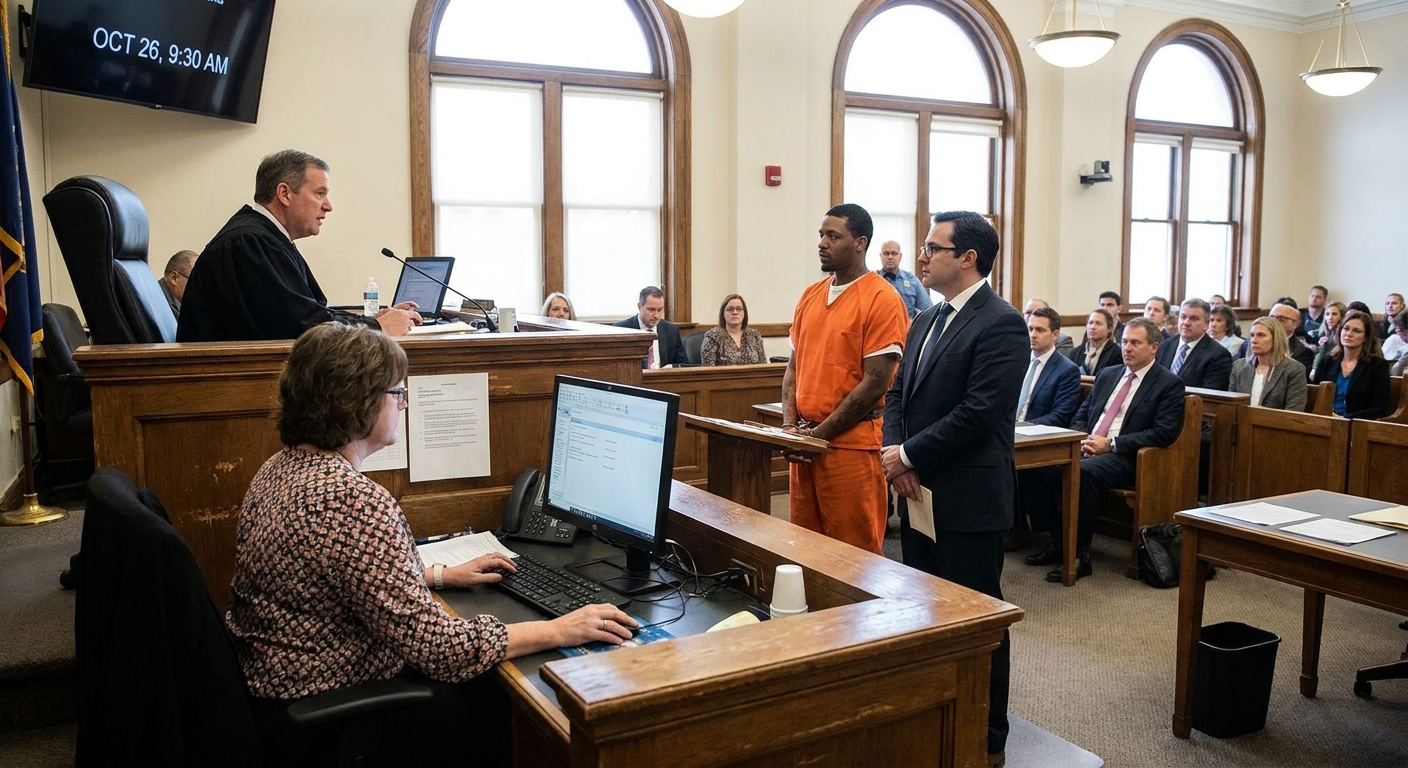
An arraignment hearing is the moment the criminal justice system stops being a blur of handcuffs, paperwork, and holding cells and becomes a case with a name, a number, and constitutional rules attached.
It is often the first time a judge addresses you directly after an arrest or after charges are filed. The court tells you what you are accused of, confirms that you understand your basic rights, and decides what happens next while the case moves forward. In many jurisdictions, it also sets the first conditions of release and creates the timeline that will shape the entire prosecution.
One important caveat: procedures vary widely by state and even by county. Some places have a separate “first appearance” or bond hearing before a formal arraignment, and some arraignments happen by video. This article is general U.S. information, not legal advice.
Join the Discussion
Arraignment in plain English
Think of arraignment as the system’s first formal checkpoint. Police can arrest you on suspicion. Prosecutors can file charges. But arraignment is where a judge brings the case into open court and puts the accusation on the record.
In a typical arraignment, the judge will:
- State the charges (or confirm the charging document)
- Make sure you have a lawyer, or explain how to get one
- Advise you of key rights
- Ask for a plea (often “not guilty” at this stage)
- Address release, bail, or conditions like no-contact orders
- Set the next court date
Arraignments can be fast. Some last a few minutes. That does not mean they are minor. A five-minute hearing can lock in bail you cannot afford, restrict who you can talk to, and define what the state claims it can prove.
Why the Constitution matters here
Arraignment is not in the U.S. Constitution by name. But the hearing exists to satisfy constitutional demands that the government cannot ignore once it has accused and restrained a person.
Notice of the accusation
The Sixth Amendment guarantees that an accused person has the right “to be informed of the nature and cause of the accusation.” Arraignment is one common way courts satisfy that requirement, especially in state systems where the early stages can otherwise feel opaque.
Counsel and “critical stages”
The Sixth Amendment right to counsel, applied to the states through the Fourteenth Amendment, becomes concrete early in the case. After Gideon v. Wainwright (1963), states must provide counsel to indigent defendants in felony cases. Later cases clarified that counsel is required in any case that can result in actual incarceration and that the right applies at “critical stages” of a prosecution, which can include arraignment depending on what happens there (Argersinger v. Hamlin, Scott v. Illinois, Alabama v. Shelton).
Practically, arraignment is often when the court appoints a public defender, confirms you have retained an attorney, or sets the process for getting one.
Bail, due process, and limits
The Eighth Amendment prohibits “excessive bail.” It does not create an automatic right to release, but it does impose a constitutional ceiling: bail should not be set higher than necessary to serve legitimate purposes like ensuring a court appearance and addressing authorized safety risks.
Preventive detention, where allowed, must follow statutory and constitutional procedures. In the federal system, for example, the Bail Reform Act’s preventive detention framework was upheld in United States v. Salerno (1987). State systems vary, but the same basic due process idea applies: the government needs lawful procedures to keep someone jailed pretrial.

What happens at arraignment
1) The court calls the case
The clerk announces your name and case number. The prosecutor appears for the state. You appear with your lawyer, or the court addresses representation immediately if you do not have one.
2) The charges are read or summarized
The judge will state the offense(s) you are charged with. Depending on the court, this can be a detailed reading or a short summary, with the written complaint, information, or indictment doing the heavier work.
If you are thinking, “I was arrested for one thing and now I am charged with another,” you are not alone. Arrest decisions and charging decisions are related but not identical. Prosecutors can add, reduce, or change charges after they review evidence.
3) The court addresses counsel and rights
The judge may advise you of rights such as:
- The right to an attorney, including appointed counsel if you qualify
- The right to remain silent, and that statements can be used against you
- The right to a trial, including (in many cases) a jury trial
- The right to confront witnesses and call witnesses
This advisement is not just ceremonial. It helps protect the legitimacy of everything that follows. A system that does not tell you what is happening cannot credibly claim you had a fair chance to defend yourself.
4) A plea is entered
In many cases, the initial plea is “not guilty,” even if negotiations are underway. This is normal. It preserves defenses and forces the state to prove its case. Plea bargaining typically happens later, after discovery and early motions.
Some courts allow guilty pleas at arraignment, especially in minor cases. But pleading guilty early can waive rights and accelerate sentencing. It can also trigger collateral consequences that do not feel “minor,” like immigration problems, loss of professional licenses, housing issues, firearm restrictions, and employment fallout. This is a major reason having counsel at arraignment matters.
5) Release, bail, and conditions are decided
For many defendants, this is the most consequential part of the hearing.
The judge may decide to:
- Release you on your own recognizance (no money bail)
- Set money bail (cash, bond, or surety bond depending on the jurisdiction)
- Impose conditions, such as travel limits, check-ins, sobriety monitoring, or electronic monitoring
- Issue protective or no-contact orders
- Order pretrial detention, where authorized and justified
Judges typically consider factors like risk of missing court, public safety as defined by law, ties to the community, the seriousness of the alleged offense, and prior failures to appear. The exact factors depend on state law and local rules.
6) The court sets the next date
The judge schedules what comes next, such as a preliminary hearing, status conference, motion hearing, or trial date. The next step depends on whether the case is a misdemeanor or felony and whether the jurisdiction uses indictments, informations, or complaints.
Arraignment vs. other early hearings
People often use “arraignment” as a catch-all for the first time they are in court. But criminal cases have multiple early checkpoints, and the labels vary across states.
Arraignment vs. first appearance
In some jurisdictions, a first appearance is primarily about bail and counsel, and the arraignment happens later when charges are formally entered and a plea is taken. Elsewhere, the first appearance and arraignment are combined into one hearing.
Arraignment vs. probable cause review
If you were arrested without a warrant, the Constitution requires a prompt judicial determination of probable cause. That requirement comes from Gerstein v. Pugh (1975), with timing guidance in County of Riverside v. McLaughlin (1991), which generally treats a determination within about 48 hours as presumptively prompt (with exceptions and litigation over delays).
Important detail: the Gerstein and McLaughlin probable-cause determination is not always the arraignment. In some places it happens at a separate hearing, or through a paper review, and arraignment comes later.
Arraignment vs. preliminary hearing
A preliminary hearing is usually about probable cause in felony cases: whether there is enough evidence for the case to move forward. Arraignment is about notice, counsel, plea, and pretrial release decisions. If the preliminary hearing is the state showing it has a reason to proceed, arraignment is the state formally telling you what it is proceeding on.
Arraignment vs. indictment
An indictment is a charging document issued by a grand jury (in jurisdictions that use them). A defendant can be arraigned on an indictment. The arraignment is the courtroom step; the indictment is the document that frames the accusation.

Common questions
Do I have to speak at arraignment?
Usually, your lawyer does most of the speaking. The judge may ask you to confirm your name, whether you understand the charges, and how you plead. In some courts, you can “stand mute” and the court enters a not guilty plea for you.
You do not have to explain your side of the story. Arraignment is not the time to argue facts. Anything you say can become evidence.
Is arraignment the same as trial?
No. There is no jury, no witness testimony, and no verdict. Arraignment is procedural. It sets the stage for later litigation and negotiation.
Can the charges change after arraignment?
Yes. Prosecutors can amend charges, add counts, or dismiss counts depending on evidence, negotiations, and legal rulings. But changes are constrained by due process, notice, and the procedural rules of the jurisdiction. In some systems, certain felony charges or major changes require a grand jury indictment or a new filing process.
Will the judge decide guilt at arraignment?
No. The judge is not deciding whether you did it. The judge is ensuring the case is properly initiated and deciding the immediate pretrial questions like release conditions.
Do I need a lawyer for arraignment?
It is strongly recommended. Even a short arraignment can produce long-term consequences, especially around bail, protective orders, and anything that gets said on the record.
Can arraignment happen by video?
Yes, in some jurisdictions. Video arraignments can move quickly and can limit the time you have to consult privately with counsel. If you are unsure you understand what is happening, it is reasonable to ask to speak with your lawyer before a plea is entered or conditions are set.
In custody vs. out of custody
If you are in custody
Courts typically move quickly when someone is jailed, but there is no universal national timetable for “an arraignment within X hours.” What is constitutionally required in a warrantless arrest is a prompt probable-cause determination under Gerstein and McLaughlin, and that event may or may not be the arraignment depending on local practice.
In practice, the first in-custody court event is often where a judge addresses continued detention and sets bail or conditions, whether that event is labeled “arraignment,” “first appearance,” or something else.
If you are out of custody
You may receive a summons or notice to appear with an arraignment date. The hearing can be calmer, but it still matters. Missing the date typically leads to a bench warrant, and in some states it can also lead to a separate “failure to appear” charge depending on the underlying case and local law.
How bail decisions work
Bail is not supposed to be a shortcut to punishment. It is supposed to be a tool to ensure you return to court and to manage legally recognized risk while the case is pending. But in the real world, bail often functions as a dividing line between defendants who can keep their jobs and families intact and those who cannot.
At arraignment, your attorney may argue for:
- Release on recognizance based on strong community ties
- Lower bail based on income and ability to pay (where ability-to-pay is considered)
- Non-financial conditions instead of money bail
- Modifications to no-contact orders to allow parenting communication
The prosecutor may argue for higher bail or detention based on severity, prior record, or alleged risk factors.
Many jurisdictions also use bail schedules, which can speed decisions but can also turn individualized justice into a price list. If your court uses a schedule, the hearing is still your chance to argue why the schedule amount should not control your case.
What to bring and what to avoid
Every case is different, and this is not legal advice. But there are practical patterns that repeat across courtrooms.
Helpful things to have
- Proof of address and employment (when relevant to release)
- Information about childcare or caregiving responsibilities
- Contact information for a lawyer, or paperwork for requesting appointed counsel
- Any existing protective order documents if the case involves alleged domestic violence
Things to avoid
- Talking about the alleged facts in open court beyond what is required to enter a plea
- Contacting an alleged victim or witness if a no-contact order is issued or likely
- Assuming arraignment is “just paperwork” and skipping it
Why it matters
Arraignment is where the state turns a suspicion into a formal accusation, and where the court begins enforcing the rule that a person is presumed innocent but not invisible.
It is also where the system makes an early choice that can tilt everything that follows: whether you fight your case from home or from a jail cell, whether you can keep working, whether you can safely communicate with family, and whether you have counsel early enough to prevent avoidable damage.
The Constitution does not guarantee that criminal proceedings will feel humane. It guarantees something narrower and more powerful: that the government must follow a lawful process before it takes your liberty. Arraignment is one of the first places that promise is tested.
Quick takeaway
- Arraignment is typically an early court hearing after an arrest or the filing of charges.
- The judge confirms charges, counsel, and rights, and often handles bail or release conditions.
- It is not a trial, but it can shape the entire case through early detention, orders, and scheduling.
- Because decisions are made quickly and rules vary, having a lawyer at or before arraignment is especially important.