
People talk about “getting hit with RICO” like it is a single charge, a single statute, and a single kind of defendant.
It is not.
RICO, short for the Racketeer Influenced and Corrupt Organizations Act, is a framework that lets prosecutors treat a pattern of crimes as one connected case when those crimes are tied to an enterprise. That can mean the mafia. It can also mean a street gang, a business, a political operation, or a loose group that functions like an organization.
In other words: RICO is about structure and repetition. It is the law’s way of saying, “We are not just charging individual acts. We are charging the system that produced them.”
Join the Discussion
What RICO is, in plain English
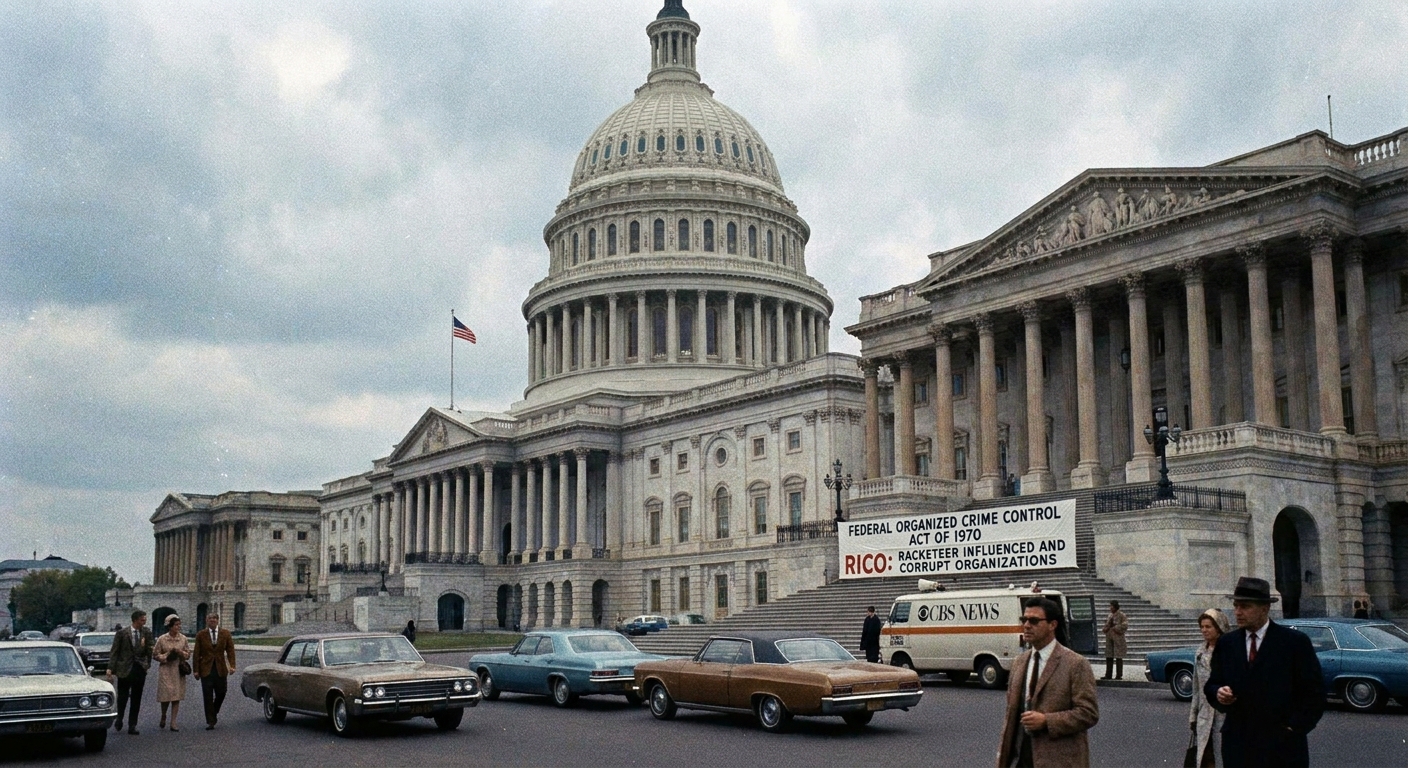
RICO is a federal law passed in 1970 as part of the Organized Crime Control Act. Its original political purpose was straightforward: traditional criminal charges were not reaching the people who ran criminal organizations while keeping their hands clean.
RICO tries to solve that by allowing prosecutors to prove that:
- an enterprise exists,
- the defendant was connected to it, and
- the defendant engaged in a pattern of racketeering activity tied to the enterprise.
If that sounds broad, it is. And it is why RICO shows up in cases that look nothing like classic mob prosecutions.
The two key ideas: enterprise and pattern
1) What counts as an “enterprise”?
Under RICO, an enterprise can be a formal entity like a corporation, partnership, or union. It can also be an “association-in-fact,” meaning a group of people who function together for a common purpose even if they have no official paperwork.
The Supreme Court has said an association-in-fact enterprise must have three basic features:
- Purpose (the group is working toward something),
- Relationships among those involved (not random, not accidental),
- Longevity (long enough to pursue the purpose).
2) What counts as a “pattern” of racketeering activity?
Federal RICO requires at least two predicate acts. As a minimum timing rule, the last predicate act must occur within 10 years of an earlier predicate act (excluding any time the defendant spent in prison). But “two acts” is not the whole story. The Supreme Court has emphasized that a pattern also involves relationship and continuity. In plain terms: prosecutors must show the crimes are connected and reflect ongoing criminal conduct, not a one-time episode.
That is why RICO cases tend to be document-heavy. Prosecutors are not only proving crimes. They are proving the connections between crimes.

What are predicate acts?
RICO does not invent new underlying crimes. Instead, it incorporates a list of qualifying offenses called predicate acts. If prosecutors can prove a pattern of those acts tied to an enterprise, RICO becomes available.
Two important details help make the list make sense:
- Some predicates are state-law crimes (like murder, kidnapping, robbery, bribery, extortion) that qualify if they are chargeable under state law and punishable by more than one year in prison.
- Others are specifically listed federal offenses (like mail fraud and wire fraud) that qualify because Congress named them.
Common predicate acts include (not an exhaustive list):
- Bribery
- Extortion
- Money laundering
- Mail fraud and wire fraud
- Drug trafficking
- Gambling offenses
- Witness tampering and obstruction-related offenses
- Violent crimes like murder, kidnapping, or robbery when they fit RICO’s predicate definitions (often through the state-law predicate category)
This is where the public often gets confused. A RICO case might look like a fraud case or a gang case on the surface, but RICO is the theory that ties the series together.
The main federal RICO charges
When people say “charged under RICO,” they are usually talking about one of these provisions:
- 18 U.S.C. § 1962(c): conducting (or participating in) an enterprise’s affairs through a pattern of racketeering activity.
- 18 U.S.C. § 1962(d): RICO conspiracy, meaning an agreement to pursue a RICO pattern connected to an enterprise. Many headline cases are charged this way.
- 18 U.S.C. § 1962(a) and § 1962(b): less common in everyday coverage, and generally focused on using racketeering income or acquiring control through racketeering.
What prosecutors must prove in a federal RICO case
The core criminal provision most readers mean is 18 U.S.C. § 1962(c), which generally prohibits conducting or participating in an enterprise’s affairs through a pattern of racketeering activity.
While the exact elements vary by jurisdiction and specific charge, prosecutors typically must prove:
- An enterprise existed.
- The enterprise affected interstate or foreign commerce (a common federal hook).
- The defendant was associated with the enterprise.
- The defendant participated in the conduct of the enterprise’s affairs, not merely knew about it.
- The participation was through a pattern of racketeering activity (predicate acts, related and continuous).
One practical takeaway: a defendant does not have to be “the boss” to face RICO. But in federal court, participation usually means something closer to an “operation or management” role, not passive membership or mere proximity.
Why RICO charges are powerful
RICO is powerful because it changes the shape of a case.
It turns many acts into one narrative
Instead of presenting separate charges as isolated events, the prosecution presents them as chapters in a single narrative: the enterprise’s operation.
It can widen exposure without becoming guilt by association
RICO is not supposed to be strict vicarious liability. But in practice, it can expand a defendant’s exposure through tools like RICO conspiracy under § 1962(d), aiding and abetting, and in some cases conspiracy doctrines that attribute foreseeable acts to co-conspirators. The key is that prosecutors still have to prove knowing agreement or knowing participation tied to the enterprise, not just friendship, ideology, or association.
Penalties can be severe
Federal RICO carries major leverage: a typical maximum of 20 years per RICO count (and potentially life if the predicate conduct allows), plus significant fines and forfeiture. Forfeiture is a pressure point because it targets money, property, and assets alleged to be tied to the racketeering activity.
There is also such a thing as civil RICO, which allows private plaintiffs in some cases to seek treble damages (triple damages) plus attorneys’ fees.

RICO and constitutional issues
RICO is statutory law, not a constitutional provision. But RICO cases stress-test constitutional protections because they are sprawling, evidence-intensive, and often built on communications, associations, and financial trails.
First Amendment: association and speech
RICO prosecutions sometimes involve groups that also engage in protected speech or political activity. The Constitution protects speech and association, but it does not immunize criminal conduct. The recurring legal fight is about where advocacy ends and coordination of criminal acts begins.
Courts generally require proof of predicate crimes and participation in the enterprise’s affairs, not mere beliefs, affiliations, or rhetoric.
Fourth Amendment: searches and digital evidence
RICO cases often rely on:
- cell phone extractions,
- email and cloud warrants,
- location data,
- wiretaps in some investigations (including disputes about minimization),
- searches of homes, offices, and vehicles.
That puts the Fourth Amendment at center stage. The legality and scope of a warrant can determine whether a key piece of the pattern comes into evidence, like a chain of messages that the government argues shows coordination.
Fifth Amendment: due process and self-incrimination
Because RICO cases can be complex, defendants often challenge whether the government’s theory is too vague, or whether the evidence creates unfair prejudice. And as in any criminal case, the right to remain silent and the right to counsel shape what can be used at trial.
Sixth Amendment: confrontation and speedy trial
Large enterprise cases can involve many witnesses, co-defendants, informants, and recorded statements. That raises confrontation issues and practical speedy-trial tensions when cases take months or years to assemble.
Federal RICO vs state RICO
When headlines say “RICO,” they might mean the federal statute, but many states have their own RICO-style laws. Those statutes often:
- use different lists of predicate offenses,
- have different penalty structures,
- do not require the same interstate commerce showing,
- are tailored to local crime patterns.
The result is that “RICO” can describe a family of laws, not one uniform process.
Common myths about RICO
Myth: RICO is only for the mafia
It started there. It did not stay there. RICO has been used in cases involving gangs, public corruption, corporate fraud, and coordinated theft operations.
Myth: If you did one thing, you can get RICO
RICO requires a pattern. A single act, even a serious one, is typically not enough to make RICO fit. Prosecutors may still charge the underlying crime, just not RICO.
Myth: Being friends with someone in the group is enough
Association is not the legal standard. The government generally must prove participation in the enterprise’s affairs through racketeering activity, or an agreement to further that racketeering through a conspiracy theory.
Myth: RICO is a shortcut around the Bill of Rights
RICO can feel like a legal sledgehammer, but it still has to move through constitutional gates: warrants, admissibility rules, confrontation rights, and due process constraints. It is also, at its best, a legitimate tool for charging coordinated wrongdoing that would otherwise be artificially chopped into disconnected cases.
How RICO cases are built
RICO investigations tend to look like mosaics made of ordinary pieces. Not because prosecutors want to overwhelm a jury, but because proving a pattern requires showing repeat behavior and coordination.
Common categories of evidence include:
- Financial records (bank transfers, shell companies, ledgers)
- Communications (texts, encrypted apps, emails, calls, social media DMs)
- Cooperating witnesses (insiders who flip)
- Surveillance and controlled buys in some cases
- Business records and government filings
- Forensic evidence tied to specific predicate acts
That breadth is exactly why RICO has leverage. A case can survive even if one piece falls away, as long as the enterprise and pattern remain provable.
What a RICO charge can mean for a defendant
If you are a reader trying to understand the stakes, the most important thing to know is that RICO changes the negotiation landscape.
- More counts and more exposure can increase pressure to plead.
- Co-defendants can create cascading incentives to cooperate.
- Forfeiture can put homes, vehicles, cash, and business assets at risk depending on the allegations.
- Pretrial detention arguments may be more aggressive in cases involving violence, obstruction allegations, or high flight risk.
None of this means conviction is inevitable. It means the government is attempting to frame the case as organized, ongoing, and structurally coordinated. That framing can be contested.
The civic takeaway
RICO sits at a crossroads of two American instincts that often clash.
One is the belief that organized wrongdoing requires an organized legal response. The other is the constitutional suspicion of laws broad enough to be bent toward politics, publicity, or overreach.
The tension is not accidental. It is structural. RICO is a tool designed to connect dots. Our constitutional system is designed to make sure the government proves those connections in open court, under rules that protect the accused, even when the accusations are unpopular.
If you hear “RICO” in a headline, the real question is rarely “What did one person do?” The better question is: Can the government actually prove an enterprise, a pattern, and a defendant’s role in conducting the enterprise’s affairs, beyond a reasonable doubt?