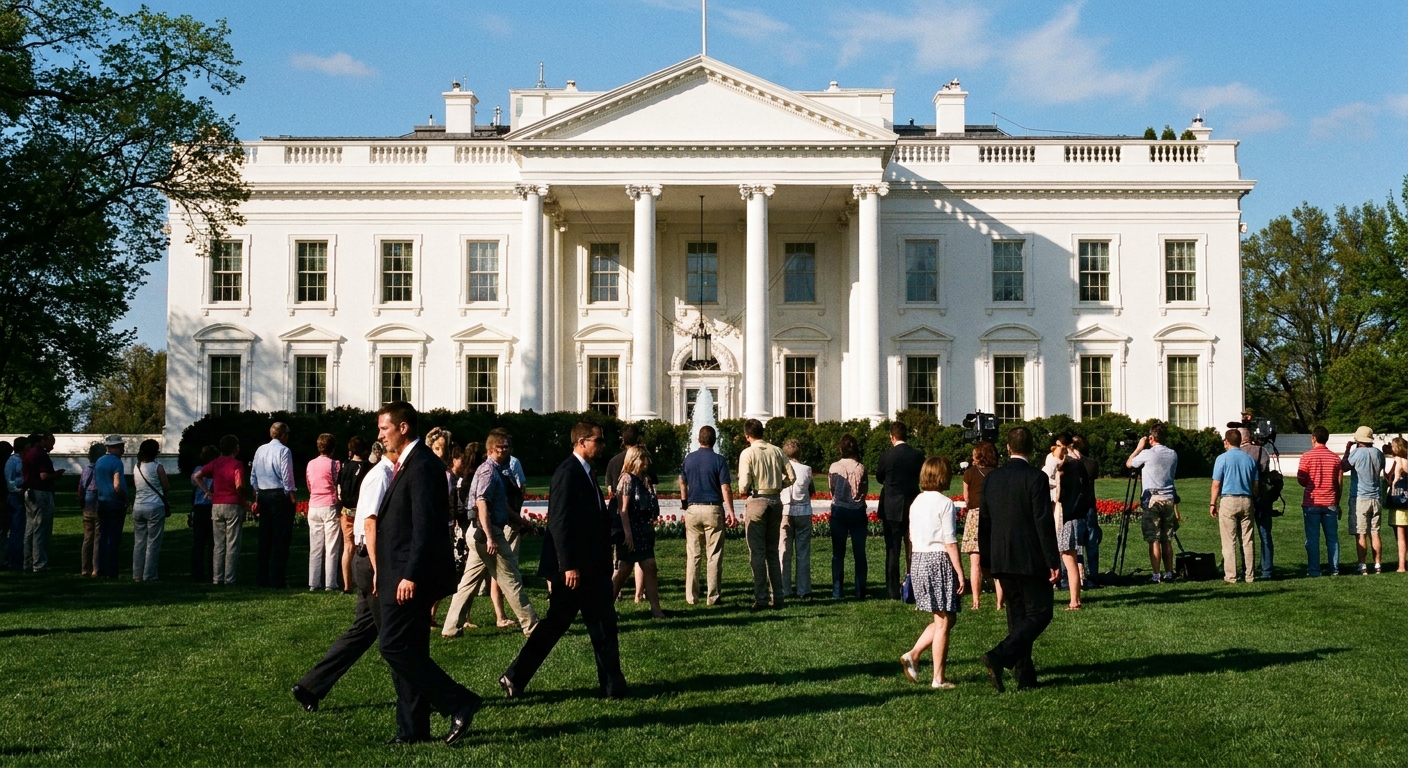
You will sometimes hear the presidency described as a job with two contradictory settings: “commander” and “caretaker.” The commander pushes policy. The caretaker runs the machinery of government. The Constitution captures part of that caretaker role in text.
Article II requires that the president “shall take Care that the Laws be faithfully executed.” That one sentence is doing a lot of work. It is a duty. It is also a limitation. It tells us the president is not a second legislature, free to choose which statutes “count” and which ones can be ignored as inconvenient.
But it also does not turn the president into a robot. In real life, laws are broad, resources are finite, and enforcement involves judgment. The Take Care Clause lives in that tension between obligation and discretion.
Join the Discussion
The clause in plain English
The Take Care Clause appears in Article II, Section 3. The relevant language is short and famously direct: the president “shall take Care that the Laws be faithfully executed.”
There are two key words that shape how lawyers, presidents, and courts think about it:
- “Laws” means enacted statutes (and, in practice, other binding federal law such as self-executing treaties and final court judgments that bind the government in a particular case). Some treaties require implementing legislation before they can be enforced domestically, so “treaties” is not always a shortcut for immediately enforceable rules.
- “Faithfully” signals more than bare compliance. It suggests honest, good-faith administration rather than pretextual enforcement designed to nullify a law in practice.
This is why the clause is often described as both a source of executive responsibility and a check against executive suspension of law.
Where it came from
The Constitution was drafted in a world where “executive power” carried a historical warning label. English kings had claimed a power to suspend laws (pause them) or dispense with them (grant exceptions), even when Parliament had spoken. That idea helped trigger constitutional conflicts that culminated in the English Bill of Rights of 1689, which rejected a royal power to set statutes aside.
American framers were building a republic in which Congress makes the laws, and the executive executes them. The Take Care Clause expresses that division in a single line: the president’s legitimacy is tied to carrying out the law, not replacing it.
Early practice reinforced the point. Presidents from Washington onward understood the office as responsible for administration, but not as possessing an open-ended authority to ignore statutes they disliked. When the executive branch thought a statute raised constitutional problems, a common move was to seek a narrow, law-grounded interpretation, or to press the disagreement through politics and the courts rather than claiming a general power to switch a statute off. For example, Jefferson’s administration ultimately pursued repeal of the Judiciary Act’s “midnight judges” provisions, and the broader dispute over judicial authority reached the Supreme Court in Marbury v. Madison (1803).
Not a blank check
A common misunderstanding is that the clause gives the president a sweeping power: because the president must execute the laws, the president can decide what the laws mean and how to treat them. The first half is true. The second half is where the trouble starts. Execution requires interpretation, but not unconstrained interpretation.
Execution is not legislation
The president can recommend legislation, veto bills, and use political pressure. But once a law is enacted, the Take Care Clause points the president toward implementation, not rewriting.
That matters most when presidents try to create policy outcomes that Congress has not authorized. A familiar separation-of-powers theme shows up here: enforcing a statute is different from inventing a new one through executive action. Many of the legal fights over executive orders and agency rules boil down to that distinction. (A classic reference point for this basic separation-of-powers framework is Youngstown, 1952.)
Faithful execution is not nullification
Presidents have always had enforcement discretion. But there is a difference between prioritizing cases and effectively announcing, “This law will not operate.” The Take Care Clause is often invoked when critics argue the executive has crossed that line.
One way to frame it is this: discretion is inevitable, but bad-faith under-enforcement can look like a modern version of the old suspending power the framers wanted to avoid.
How it fits enforcement priorities
Real enforcement is triage. No administration can investigate every violation, prosecute every case, or audit every regulated entity. So presidents and executive agencies set priorities.
That reality is not a loophole. It is baked into modern governance. Courts have long recognized broad executive discretion in areas like charging decisions and resource allocation, especially in criminal law and immigration enforcement. But that discretion has limits, and recent controversies often turn on when a “priority” becomes something closer to a categorical exemption that conflicts with the statute’s design. One landmark case often cited for the general presumption that nonenforcement decisions are usually not reviewable is Heckler v. Chaney (1985), though later disputes show the boundaries can be contested.
What discretion looks like
- Prosecutorial discretion: deciding whether to bring a case, what charges to file, and what penalties to seek.
- Regulatory prioritization: focusing inspections and enforcement on the most serious violations or highest-risk actors.
- Guidance and internal policy: setting factors that frontline officials should weigh, so enforcement is more consistent.
These choices can be controversial, but they are not automatically unconstitutional. The hard question is when prioritization becomes something else: a practical announcement that a statute will not be enforced across an entire category, not because of limits, but because the executive branch disagrees with the law’s policy.
Case-by-case vs. categorical
Courts and scholars often find it easier to justify case-by-case discretion than categorical nonenforcement. The first is inherent in execution. The second can begin to resemble suspension.
Even then, the line is not mechanical. Categorical policies can sometimes be justified by statute, by Congress’s delegation of authority, or by genuine resource constraints. The Take Care Clause does not answer every dispute, but it shapes how we argue about them.
A low-drama way to see the difference: a prosecutor declining charges in a weak case is ordinary discretion. An agency announcing that a whole class of regulated entities will not be subject to a statutory requirement for the indefinite future, despite having the resources and legal tools to apply it, is where Take Care arguments get louder.
When courts step in
The Take Care Clause conversation changes when a court issues a binding order. At that point, “faithful execution” is not just about how an agency chooses to allocate staff time. It becomes about compliance with the judiciary’s authority to decide cases.
If a federal court issues an injunction telling an agency to stop enforcing a rule, or telling the government to do something required by law, the executive branch generally must comply as to the parties (including the government) unless the order is stayed, narrowed on appeal, modified, clarified, or overturned.
Two points matter for civic literacy:
- Disagreeing is allowed. The executive can argue the court is wrong and pursue appeals, or seek clarification if an order is unclear.
- Defying is different. Open defiance raises constitutional alarms because it undermines the judiciary’s role and turns “faithful execution” into optional compliance.
Questions about the scope of injunctions, including nationwide relief, are themselves contested. But as a practical matter, once an order applies to you, ignoring it is not a “policy choice.”

Does it mean strictest enforcement
No. Faithful execution does not mean maximal enforcement, and it does not mean the president must pursue the harshest possible outcome in every case.
Execution involves interpretation, and interpretation involves judgment. Statutes are often broad, sometimes ambiguous, and frequently leave gaps for executive agencies to fill through regulations. When Congress delegates authority, it is expecting executive branch expertise and policy choices within legal bounds.
The key is that discretion must be tethered to law. The executive can choose among lawful options. It cannot manufacture options that the statute does not permit, then call the result “execution.”
Three misunderstandings
1) “The president can ignore unconstitutional laws.”
Presidents do sometimes take the view that a statute is unconstitutional and should not be enforced in a particular way. But the Take Care Clause does not clearly grant a free-standing power to disregard statutes whenever the president believes they are invalid.
In practice, the system relies on interbranch conflict resolution: vetoes, legislation, litigation, and judicial review. A president’s constitutional objections can shape enforcement positions, but they do not automatically erase Congress’s work.
2) “The president controls the whole branch like a remote control.”
The president sits atop the executive branch, but Congress can structure agencies, create procedural requirements, and impose statutory duties that limit pure presidential preference. The Take Care Clause makes the president responsible for execution, but it does not delete the legal constraints Congress writes into the programs it creates.
3) “If an agency is slow, it is a Take Care violation.”
Not every failure, delay, or bureaucratic mess is a constitutional crisis. The clause is a broad duty statement, not a stopwatch. Many disputes that are framed as Take Care violations are really fights about statutory interpretation, administrative law, or funding choices made by Congress.
How it shows up today
The Take Care Clause rarely decides cases by itself. It is more often a supporting argument in bigger separation-of-powers fights: who has authority to set policy, and where does executive flexibility end.
In real-world terms, these conflicts often arise through familiar mechanisms: agency rulemaking, enforcement guidance, case-processing memos, and budgeting tools like administrative holds on spending. You will see the clause invoked in debates over:
- Nonenforcement policies that appear to exempt large groups from statutory requirements.
- Administrative rulemaking when agencies claim authority to reshape major policy areas without clear congressional authorization.
- Compliance with court orders, including disputes about the reach and remedy of injunctions.
- Spending and program administration when statutes require distribution of funds or operation of benefits programs and the executive resists or delays.
In each setting, the same core question returns: is the executive branch executing the law as written, or substituting its own preferences for Congress’s choices?
What it asks of a president
If you strip away the litigation jargon, the Take Care Clause is a civic promise. It tells the public that the president is not elected to be above the law, but to run the government under it.
At minimum, “faithful execution” requires:
- Good-faith administration of statutes Congress has enacted.
- Respect for legal constraints, including procedural requirements that make enforcement fair and consistent.
- Compliance with binding court judgments while pursuing lawful appeals when necessary.
- Transparency about limits, acknowledging when priorities are driven by resources and when they are driven by policy.
The clause will never remove politics from execution. But it does something more subtle and more important: it makes execution a constitutional duty, not a personal choice.