
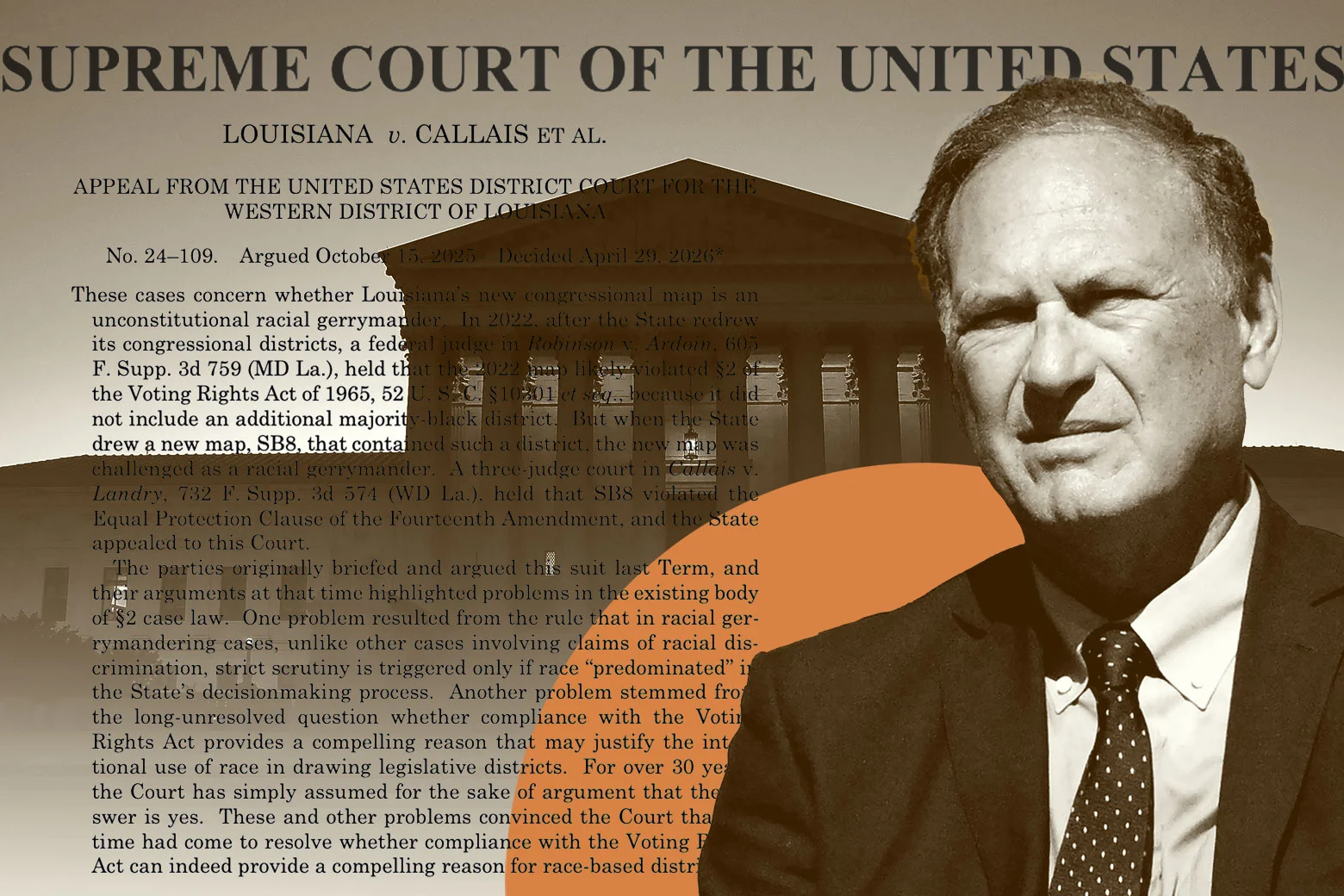
The Supreme Court handed down a major redistricting decision on April 29, 2026, striking down Louisiana’s 2024 congressional map and sending a clear message to states nationwide: using race as the leading factor in drawing district lines triggers the Constitution’s toughest test, and states cannot rely on a broad reading of the Voting Rights Act to justify it.
In a 6-3 ruling written by Justice Samuel Alito, the Court held that Louisiana’s plan violated the Equal Protection Clause of the Fourteenth Amendment because it amounted to an unconstitutional racial gerrymander.
Join the Discussion
What Louisiana’s 2024 map did
The map at the center of the case divided Louisiana into six congressional districts. Under the 2024 plan, two districts were majority-Black and four were majority-White.
That arrangement was not just political. The Court concluded that race was the predominant consideration when the state drew at least one of those districts, specifically when it created a second majority-Black seat. When race drives the line-drawing process like that, the Court treats it as a constitutional problem unless the state can satisfy strict scrutiny.
The constitutional rule the Court applied
Here is the key civics point, and it comes up often in redistricting cases.
- Partisan gerrymandering is controversial, but the Supreme Court has generally treated it as a political question that federal courts are not well-positioned to police.
- Racial gerrymandering is different. When race becomes the main driver of district lines, the Equal Protection Clause is in play, and the Court applies strict scrutiny, meaning the state must show a truly compelling reason and use a narrowly tailored approach.
In this case, Louisiana argued that it was attempting to comply with Section 2 of the Voting Rights Act, which can require states to avoid voting maps that unlawfully dilute minority voting strength. But the Court said that justification did not work here, because Section 2 did not actually require Louisiana to create the additional majority-minority district.
Why Section 2 did not save the map
The majority’s reasoning was straightforward: compliance with federal voting rights law can sometimes be a compelling interest, but only when the law truly demands the remedy the state chose.
Justice Alito wrote: “Because the Voting Rights Act did not require Louisiana to create an additional majority-minority district, no compelling interest justified the state’s use of race in creating SB8. That map is an unconstitutional gerrymander, and its use would violate the plaintiffs’ constitutional rights.”
In other words, a state cannot treat Section 2 as a general permission slip to make race the centerpiece of redistricting. If Section 2 does not require a race-conscious fix, then using race as the predominant tool becomes constitutionally suspect.
What happens to Louisiana’s districts now
The contested map stayed in place for the 2024 elections because the Supreme Court had previously issued an emergency stay. But the Court’s final judgment now means the plan is off the table going forward.
Louisiana will need to draw a new congressional map for future elections. That is not a minor administrative task. Redistricting involves public hearings, legislative bargaining, and often litigation. The calendar also matters: Louisiana’s congressional primary is scheduled for May 16, and election deadlines across the country do not pause just because maps are in flux.

The dissent: concern about making Section 2 harder to use
Justice Elena Kagan, joined by Justices Sonia Sotomayor and Ketanji Brown Jackson, dissented. The core concern from the dissent is that the majority’s approach leaves Section 2 with less practical power in redistricting disputes, particularly when minority voters argue that map lines dilute their ability to elect candidates of choice.
For readers trying to understand the clash, it is this: the majority places heavy weight on Equal Protection limits when race dominates mapmaking; the dissent sees the decision as weakening a major enforcement tool designed to protect minority voters from dilution.
Political reactions highlight the stakes
The ruling prompted immediate, sharply different reactions.
California Governor Gavin Newsom criticized the decision on X, writing: “The Supreme Court majority continues to gut the Voting Rights Act and vital protections for our democracy and fair representation.”
In Louisiana, Attorney General Liz Murrill welcomed the decision as “seismic,” saying: “It is gratifying that the Supreme Court has finally vindicated our original position and, in doing so, clarified that only under very narrow circumstances, where there is proof of intentional discrimination, may race be used as a remedy under Section 2.”
The White House also applauded the ruling. Spokeswoman Abigail Jackson said: “The color of one’s skin should not dictate which congressional district you belong in.”
Why this matters beyond Louisiana
This decision does not just reshape one state’s map. It also provides guidance, and a warning, for every state that tries to balance two powerful forces:
- The Constitution’s Equal Protection Clause, which is deeply skeptical of government decision-making that sorts people by race.
- The Voting Rights Act, which can require attention to racial voting patterns in order to prevent minority vote dilution.
The practical takeaway is that states face a narrower path when race is the main factor in building a district. If lawmakers believe Section 2 requires a race-conscious remedy, they may need to show that more clearly, and design districts that rely on race no more than necessary.
And for minority voters and voting-rights organizations, the ruling signals a steeper hill in Section 2 litigation when the remedy sought involves drawing new majority-minority districts.
At a glance
- Vote: 6-3
- Opinion author: Justice Samuel Alito
- Constitutional basis: Equal Protection Clause of the Fourteenth Amendment
- Map struck down: Louisiana’s 2024 congressional map
- Core holding: Race predominated in drawing a district, and Section 2 of the Voting Rights Act did not require the additional majority-Black district
- Result: Louisiana must redraw its map for future elections