
Rudy Giuliani, the former New York City mayor and onetime adviser to President Donald Trump, has been hospitalized and is in “critical but stable condition,” according to his spokesman.
The statement came Sunday from spokesman Ted Goodman, who did not disclose what led to Giuliani’s hospitalization or how long he has been receiving care. “Mayor Giuliani is a fighter who has faced every challenge in his life with unwavering strength, and he’s fighting with that same level of strength as we speak,” Goodman said. He added that Giuliani “remains in critical but stable condition.”
Trump also weighed in with a lengthy post on his social media platform. “Our fabulous Rudy Giuliani, a True Warrior, and the Best Mayor in the History of New York City, BY FAR, has been hospitalized, and is in critical condition,” Trump wrote. “What a tragedy that he was treated so badly by the Radical Left Lunatics, Democrats ALL — AND HE WAS RIGHT ABOUT EVERYTHING! They cheated on the Elections, fabricated hundreds of stories, did anything possible to destroy our Nation, and now, look at Rudy. So sad!”
Join the Discussion
What we know
Giuliani is 81. Beyond the “critical but stable” description, few details have been made public. The absence of specifics is not unusual in a medical emergency, but it leaves a vacuum that politics loves to fill.
One clear data point is timing. Giuliani hosted his online program, America’s Mayor Live, on Friday night from Palm Beach, Florida. At the start of the broadcast, he coughed and sounded hoarse, telling viewers: “My voice is a little under the weather, so I won’t be able to speak as loudly as I usually do, but I’ll get closer to the microphone.”
Legacy is not a plan
In American civic life, we like our public figures neatly sorted into moral filing cabinets: hero, villain, cautionary tale. Giuliani has never stayed in one drawer.
For many Americans, the phrase “America’s mayor” still lands with the weight of September 2001, when Giuliani’s leadership after the attacks made him a symbol of resolve. For others, his later role as Trump’s personal attorney and a leading promoter of claims of fraud in the 2020 election defines him far more than any earlier chapter.
This is the uncomfortable civic truth: a legacy is not a verdict delivered once, then sealed. It is an argument a country keeps having, sometimes for decades. A health crisis does not end that argument. It just changes the tone.
Accountability does not pause
Giuliani’s recent years have been shaped not only by politics, but by courtrooms and consequences.
Two former Georgia election workers won a $148 million defamation judgment against him. As collection efforts moved forward, Giuliani was found in contempt of court and faced a winter trial over the ownership of certain assets. He later reached a deal that allowed him to keep homes and personal property, including World Series rings, in exchange for unspecified compensation and a promise to stop speaking ill of the election workers.
That arc matters for constitutional reasons, not gossip reasons. In a nation built on the rule of law, the test is whether institutions can impose consequences even when the defendant is famous, politically connected, or once celebrated.
A career in power
Giuliani did not become a national figure by accident. Before City Hall, he built a reputation as a hard-charging federal prosecutor, known for pursuing organized crime and financial wrongdoing.
He was elected mayor in 1993. In 2000, he began a campaign for the U.S. Senate but dropped out after a prostate cancer diagnosis, abandoning his race against Hillary Rodham Clinton.
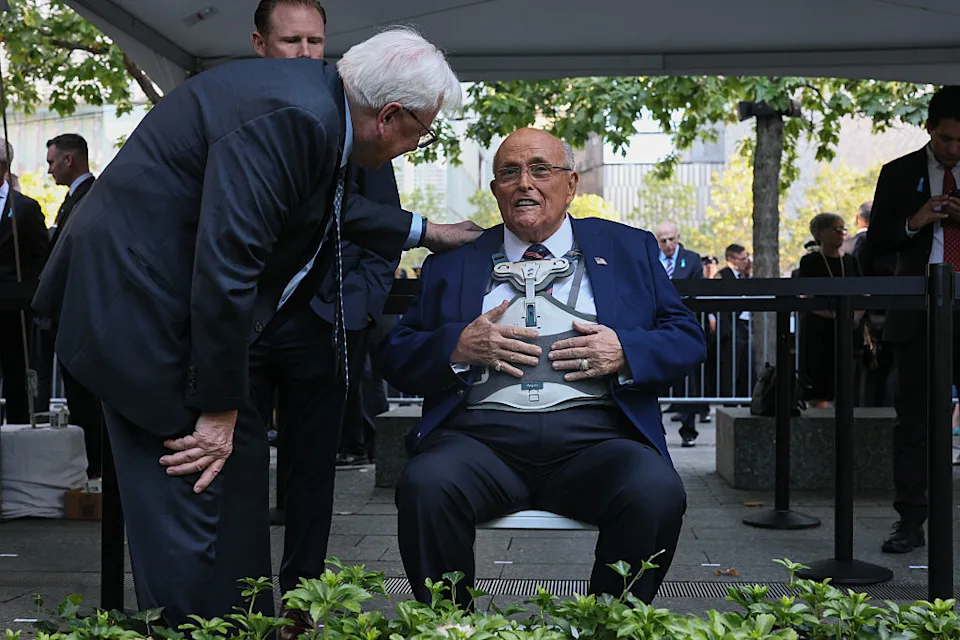
More recently, he was hospitalized in September after a car crash in New Hampshire left him with a fractured vertebra and other injuries.
The harder question
When a prominent figure becomes gravely ill, Americans often reach for one of two scripts. One script demands silence, as if criticism becomes immoral the moment a hospital is involved. The other script treats illness as a final talking point, a reason to intensify the political fight.
Both scripts dodge the real civic work, which is steadier and less satisfying: hold two ideas at once. A person can be praised for real public service and also judged for real damage. Sympathy for suffering and accountability for choices are not constitutional enemies. In a mature democracy, they coexist.
Giuliani’s condition is a human story first. But it is also a mirror, reflecting what our politics has become: a country that struggles to separate loyalty from truth, celebrity from responsibility, and personal narrative from public consequence.