
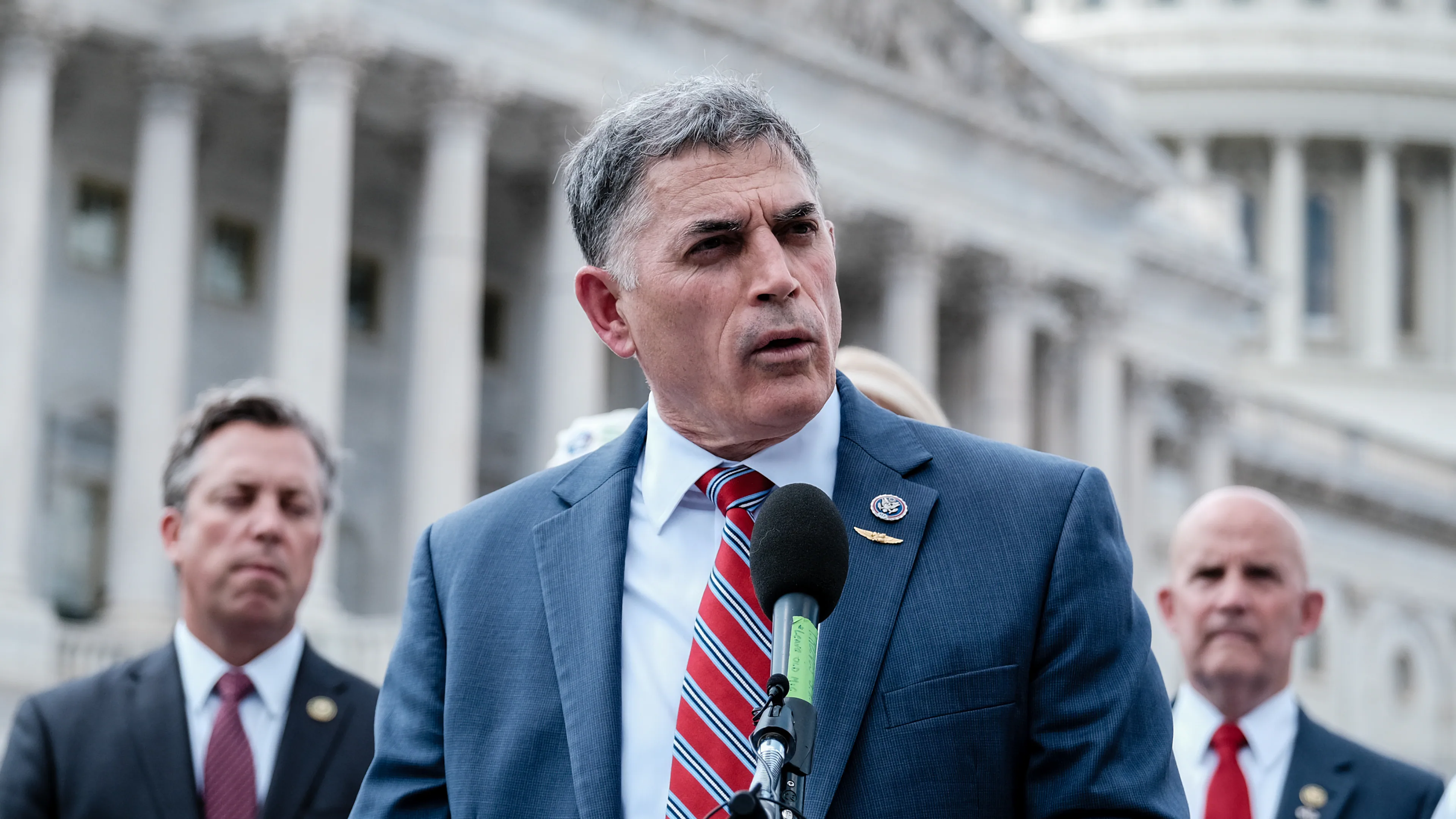
When Americans talk about “gun policy,” they often picture Congress passing a law. But a large share of day-to-day Second Amendment enforcement flows through the Department of Justice and its sub-agency, the Bureau of Alcohol, Tobacco, Firearms and Explosives (ATF). That reality is at the center of a new request from Rep. Andrew Clyde of Georgia and other House Republicans: they want President Donald Trump to choose an attorney general who will quickly unwind Biden-era gun rules and redirect how the DOJ handles firearms cases.
The constitutional question underneath the politics is worth slowing down for: how far should an attorney general go in using executive power to reshape Second Amendment enforcement? There is real authority here. There are also hard boundaries set by statutes, courts, and basic separation-of-powers principles.
Join the Discussion
What Clyde is asking for
On April 21, 2026, Clyde and 32 other House members sent a letter urging Trump to select an attorney general who will “immediately cease enforcement of Biden-era gun rules and secure permanent–not temporary–relief.”
The letter points to three Biden-era regulatory efforts the signers want targeted right away:
- The pistol stabilizing brace rule, which they say DOJ continues to enforce against certain firearms despite pro-Second Amendment injunctions.
- The “ghost gun” regulation, which they say survived U.S. Supreme Court review only because DOJ failed to render the case moot.
- The “engaged in the business” rule (often discussed as a universal background check rule), which they argue DOJ has maneuvered to keep in place rather than pursue full repeal.
They also ask for internal DOJ guidance that would change litigation posture after New York State Rifle & Pistol Ass’n v. Bruen, writing: “The DOJ should not be in the business of defending plainly unconstitutional firearms restrictions,” and urging DOJ lawyers to evaluate cases under Bruen’s text-and-history approach and decline to defend laws that cannot meet it.
What an AG can do fast
People sometimes talk as if an attorney general can erase rules by willpower. In reality, DOJ power comes in a few concrete tools, each with different limits.
1) Enforcement priorities
DOJ leadership can direct how aggressively certain cases are pursued. That can include shifting investigative focus, narrowing categories for prosecution, or deprioritizing cases that rely on legally contested interpretations. This is often the fastest lever because it does not require new legislation.
But prioritizing is not the same as nullifying. If a statute requires enforcement in specific circumstances, DOJ cannot simply announce that the law no longer applies. Prosecutorial discretion is real, but it is not a blanket veto over Congress.
2) Litigation posture and settlement choices
DOJ can change its strategy in court. It can decide whether to appeal a loss, whether to seek stays, whether to narrow arguments, and when to settle. Over time, those choices can reshape the legal landscape by allowing certain lower-court rulings to stand.
Clyde’s letter explicitly asks DOJ to stop defending restrictions that cannot survive Bruen scrutiny. That is a significant request because it moves beyond enforcement and into the executive branch’s role as defender of existing law. Administrations sometimes decline to defend a law they view as unconstitutional, but it is controversial for a reason. It can look like the executive branch is trying to achieve through non-defense what it cannot win through Congress.
3) Rulemaking and repeal
If DOJ and ATF want to repeal or replace a regulation, they generally must use the same administrative process used to create it. That means notice, an opportunity for public comment, and a final rule that can survive judicial review. A demand for immediate action may run into those procedural realities, especially if the goal is durable, court-tested change.
Where the limits are
One phrase in Clyde’s request is especially telling: they want “permanent, not temporary, relief.” Even if an attorney general moves quickly, long-lasting outcomes usually depend on how courts rule, how rules are written, and whether Congress changes underlying statutes.
Congress writes criminal law
ATF administers and DOJ enforces federal statutes like the Gun Control Act and the National Firearms Act. Those statutes do not disappear when administrations change. If a regulation is tightly tied to the text of a statute, a new attorney general may have limited room to maneuver without Congress amending the law.
Courts decide constitutionality
After Bruen, Second Amendment cases often turn on whether a modern restriction is consistent with the nation’s historical tradition of firearm regulation. DOJ can choose how to argue these cases, but courts decide what the Constitution requires. If the executive branch tries to accomplish constitutional wins through aggressive non-enforcement or procedural tactics, it risks being checked by judges who view the move as evasion rather than faithful execution.
Permanent relief usually means one of two things
- A final court judgment that invalidates a rule or its application.
- Legislation that changes the underlying statute, leaving less room for future administrations to reverse course.
Without one of those, a future attorney general can often reverse guidance, restart enforcement, or reissue a similar rule with a new legal rationale.
ATF reforms in the letter
Clyde’s coalition also calls for reform and cleaning house at ATF. They describe this task as including purging the ATF of “gun-grabbing bureaucrats,” opposing any effort to create, operate, or maintain a federal firearms registry in any form, stopping the release of sensitive trace data they say violates the Tiahrt amendment, shutting down and deleting the Out-of-Business Records Imaging System (OBRIS), and reducing National Firearms Act processing times.
Some of these goals are managerial and could move quickly, especially improvements to processing backlogs. Others, especially anything touching data retention or records systems, can be constrained by recordkeeping laws, court orders, inspector general oversight, and ongoing litigation. Calls to delete systems also raise basic governance questions. Even if a system is criticized as illegal, the remedy is often a court ruling or a formal administrative decision supported by legal analysis, not simply an order to hit delete.

How far should an AG go
Even for readers who strongly favor rolling back gun restrictions, it is worth asking what kind of executive power you would be comfortable with if the next administration held the opposite view. That is a useful stress test in a system built to outlast any single election cycle.
Healthy uses of AG power
- Clarifying guidance so ordinary people are not trapped by vague definitions.
- Focusing enforcement on conduct that is clearly unlawful and clearly dangerous, rather than novel test cases.
- Improving due process inside agencies, including transparent standards and predictable timelines.
- Respecting judicial decisions by aligning policy with controlling precedent, including Bruen.
Risky uses of AG power
- Attempting policy repeal by non-enforcement when the underlying rule remains on the books, creating uncertainty for the public and whiplash for regulated communities.
- Using selective defense as a substitute for democratic lawmaking, especially when the goal is political speed rather than constitutional clarity.
- Politicizing personnel decisions in ways that undermine professional norms and consistent application of law.
The Constitution’s design is slow on purpose. That can frustrate people who want quick change. But it also protects everyone from the government lurching wildly every four years.
What to watch next
If Trump chooses an attorney general aligned with Clyde’s roadmap, the early signs will likely show up in three places:
- New DOJ guidance memos describing how prosecutors and civil litigators will apply Bruen.
- Changes in active litigation, especially whether DOJ seeks stays, appeals losses, or agrees to settlements that narrow enforcement.
- Administrative moves at ATF, including timetables for revising or repealing contested rules and measurable changes in NFA processing times.
Clyde’s letter closes with a pointed political reminder that “American gun owners have been some of your most loyal and enthusiastic voters,” and argues the plan “requires no new legislation.” In a constitutional system, though, the most lasting changes almost always involve either Congress or the courts. An attorney general can move fast. The question is whether moving fast produces lawful stability or simply the next round of conflict.