
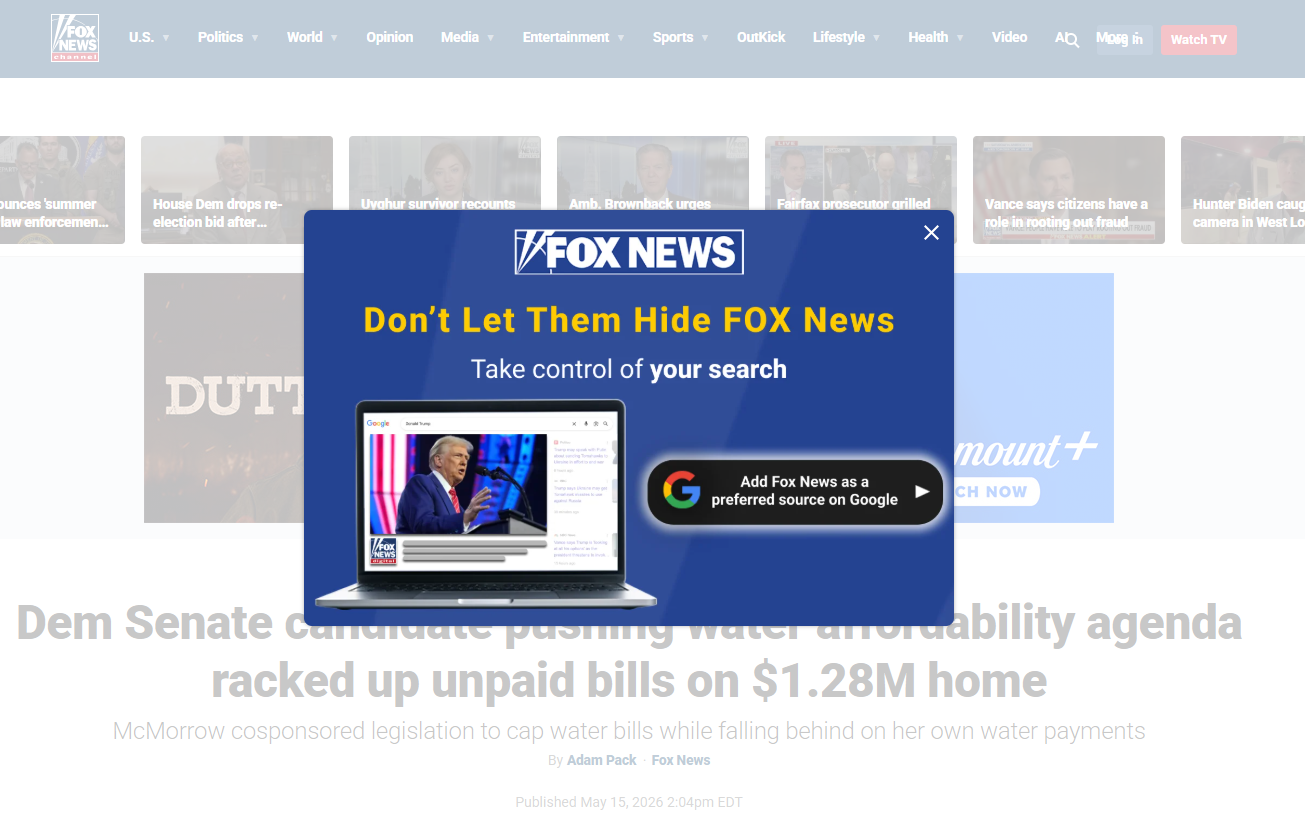
You are on Fox News. The page dims. A centered popup takes over the screen in dark blue with Fox branding and a warning that sounds less like marketing and more like mobilization: “Don’t Let Them Hide FOX News.” Under it: “Take control of your search.”
The call to action is specific. A graphic shows a Google search page on a laptop, and a big button-like prompt urges readers to “Add Fox News as a preferred source on Google.” There is an “X” to close it, but the rhetorical point has already landed: if you do nothing, Fox implies, someone else gets to decide what you see.
Note: I am describing a promotional overlay that has been reported and circulated via screenshots, but the exact wording, design, and timing can vary by user, device, A/B test, or region. If you are publishing this as reported analysis, consider adding a dated screenshot or link to a web archive capture for the specific version you saw.
Join the Discussion
What Fox is claiming
The popup does not accuse the federal government of censoring Fox News. It does not cite a court order, a new statute, or a regulatory threat. Instead, it suggests something more contemporary and harder to pin to a single villain: that Google’s search ecosystem can make a major media outlet effectively disappear, at least for the average user who treats the top results as reality.
That is the heart of the message:
- Search ranking is power. If discovery is controlled, speech can be functionally muted without being banned.
- The gatekeeper is private. Fox is framing the problem as Big Tech influence, not formal state censorship.
- The solution is individual action. “Take control of your search” is an instruction to route around the algorithm.
It reads like a warning about information control because, in the internet era, distribution is often the difference between being heard and being ignored. Small changes in ranking can translate into large changes in traffic, attention, and downstream influence, even if nothing is “banned” in the classic sense.
What “preferred sources” means
Even if the popup’s prompt is taken at face value, it is worth being precise about the mechanics. Google has offered features that let users prioritize or follow selected publishers in certain contexts, but the name, availability, and impact of those features are not universal and can change over time.
- In some versions of Google’s news and discovery surfaces, a preference may influence what appears in modules like Top Stories or a news feed style experience.
- It is not necessarily the same thing as “pinning” a source to the top of general web search results, and it may not override other signals like location, freshness, or spam and quality protections.
- In short, it can be meaningful, but it is not full control. The popup sells agency; the product, as with most personalization, is narrower.
The First Amendment limit
Here is the constitutional friction Fox’s popup brushes up against without naming it: the First Amendment is a restraint on government, not a general guarantee that your speech will be amplified by private intermediaries.
In traditional doctrine, the baseline looks like this:
- Google can rank, demote, or exclude content under its own policies because it is a private company.
- Fox News can criticize Google, pressure it publicly, and campaign against its practices.
- Users can choose alternatives, change preferences, or rely on different sources.
None of that automatically triggers a First Amendment violation because the constitutional question usually starts with: where is the state? As a rule, no state actor means no First Amendment claim, though there are edge-case theories like joint action, entanglement, or public function that sometimes complicate the analysis.
Also, “not a First Amendment violation” does not mean “no constraints at all.” Private companies still operate under other bodies of law and pressure, including contracts, consumer protection, antitrust, and in some jurisdictions platform regulation. Those are different frameworks, but they can matter in the real world even when the Constitution does not.
Hidden vs banned
Fox’s popup is effective because it targets a modern reality: for many Americans, search often functions like the front door to public life. If an outlet is downranked, fewer people encounter it, fewer people share it, and the outlet’s influence shrinks. That can look and feel like censorship even when no law is involved.
There is a term often used in these debates that captures the emotional experience if not the legal doctrine: de facto censorship. The claim is not that speech is illegal. The claim is that speech is made harder to find inside systems that, in practice, act like essential infrastructure for discovery.
Search is not the only pathway, of course. People find news through apps, newsletters, cable, podcasts, social feeds, and aggregators like Apple News. But the popup is betting on a simple truth: the first page of results still carries an aura of neutral authority for a lot of users.
When private acts become state action
Most serious First Amendment litigation in this space does not argue that Google, by itself, is constitutionally forbidden from ranking content. The sharper constitutional-style critique usually shifts the focus to government pressure.
The theory goes like this:
- If the government coerces a platform to suppress lawful speech, the platform’s action can start to look like state action.
- If the government and platforms coordinate in a way that effectively turns private policy into an arm of public censorship, First Amendment scrutiny may attach.
This is the legal frame that animates post-2020 controversies about platform moderation, official requests, and behind-the-scenes nudging. It is also why debates over coordination claims and cases like Murthy v. Missouri became a constitutional flashpoint.
For precision: in Murthy, the Supreme Court did not announce a broad rule that platforms are the government. It focused on threshold issues including whether the plaintiffs had standing to seek sweeping injunctive relief, which narrowed what the courts could do with the case. That procedural posture matters because the public conversation often treats the dispute as if it settled the entire censorship question on the merits.
Fox’s popup does not allege that kind of coercion. But it lives in the same neighborhood: a world where information is filtered by a small number of distribution hubs, and where the public is primed to suspect those hubs are not merely technical.
Why this framing works
The popup is not just a constitutional provocation. It is also smart media strategy.
1) Audience identity
“Don’t let them hide FOX News” presumes an out-group with control and an in-group being targeted. The reader is invited to see themselves as someone who must actively defend access to “the truth,” which increases loyalty and attention.
2) Distribution as bias
Search ranking decisions can be about relevance, spam prevention, quality signals, or a thousand other factors. The popup compresses that complexity into a simpler story: they are burying us. It does not need proof inside the popup. The point is to seed doubt about neutrality.
3) Less platform risk
There is also an unromantic business reason. Referral traffic can evaporate when algorithms change. Encouraging users to manually preference Fox is a way to reclaim some control over discovery in a world where platforms decide what surfaces.
The counterargument
A centrist, liberal, or tech-policy response would likely start with a definitional pushback: ranking is not censorship. Search engines must filter low-quality pages, spam, and manipulation. They are not obligated to present results in a way that treats every publisher as equal.
That camp would also point out that Fox News is not a fragile speaker. It is one of the largest media organizations in the country with enormous reach. The word “hidden” can be read as rhetorical exaggeration, useful for mobilizing an audience but not necessarily descriptive of Fox’s actual visibility.
And there is a genuine civil-liberties concern on the other side: if the government forces platforms to be “neutral,” that can collide with platforms’ own expressive and editorial rights. Compelling a private entity to carry speech it does not want to carry can also raise First Amendment problems, a point the Supreme Court has emphasized in the NetChoice cases involving state laws that attempted to restrict platform content moderation and ranking discretion.
The real tension
The popup’s power is that it highlights a gap most Americans feel but struggle to articulate: the Constitution draws a line around government, while modern public discourse runs through private distribution hubs.
So we end up with two truths that sit uncomfortably together:
- First Amendment law: Google is generally free to design and rank search results, because the First Amendment does not require private platforms to act as neutral conduits.
- First Amendment culture: if a few companies control discovery at scale, their policies can shape what society can realistically hear, even without a single law being passed.
This is why the debate keeps drifting toward concepts like common carriers, public utilities, monopoly power, and the “digital public square.” Those terms are attempts to solve a mismatch: our constitutional speech rules were built for a world where the main threat was the state. Our information world is one where the main leverage point is often private, centralized, and easy to miss unless you go looking for it.

The question
Fox’s popup asks readers to change a setting. The deeper question it raises is harder: What should “free speech” mean in a world where speech is not just spoken, but ranked?
The First Amendment, as written and as usually applied, will not rescue every speaker from every algorithm. It was not designed to. But when the pathways to knowledge are privately owned, the public will keep reaching for constitutional language to describe what feels like a constitutional injury.
That is the modern paradox in one dark-blue popup: the Constitution limits government power over speech, but it does not limit the quiet power of the systems that decide what you see first.