
DACA is one of those policies that feels like it should be either firmly legal or clearly illegal. Instead, it has lived for more than a decade in America’s most contested constitutional space: the gap between what Congress has written into law and what presidents do when Congress does not.
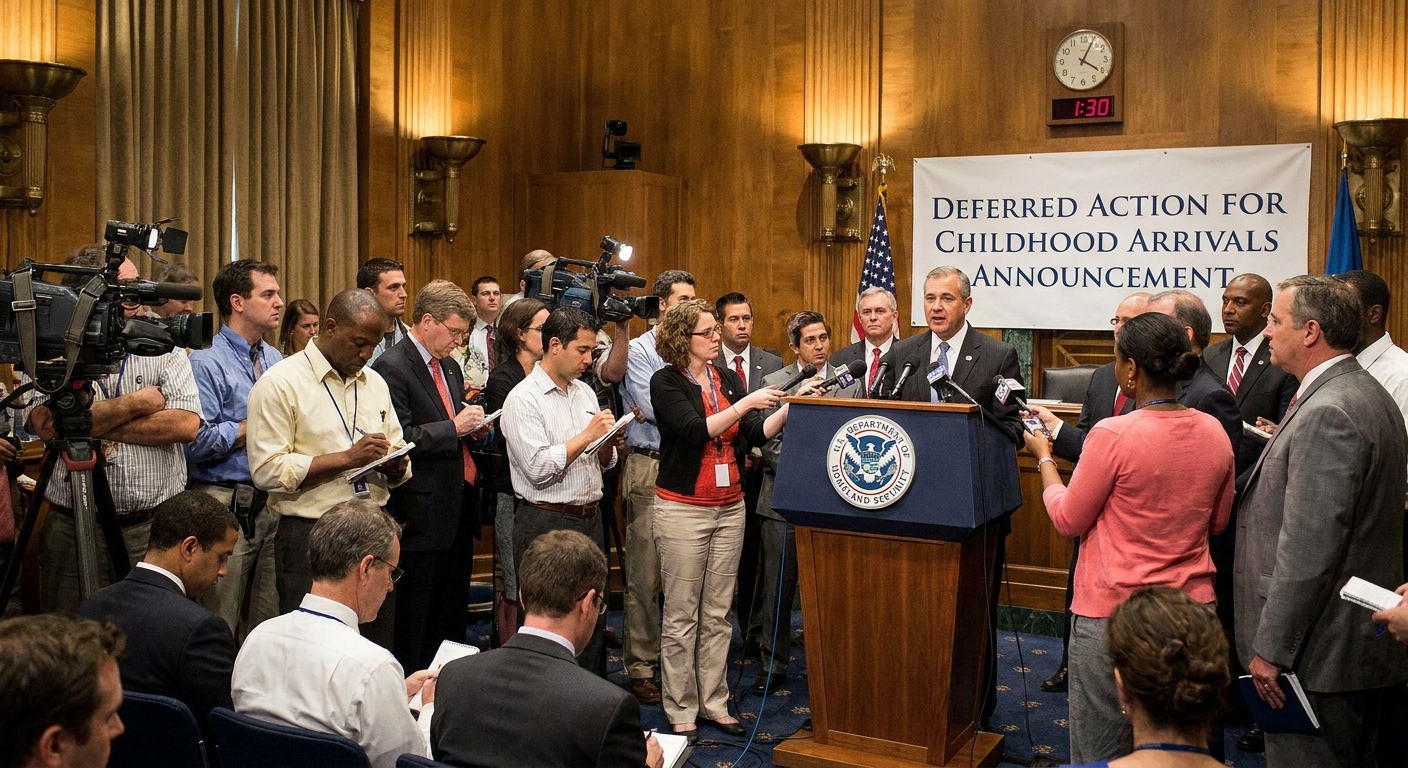
Deferred Action for Childhood Arrivals, announced in 2012, does not grant citizenship. It does not create a visa category. It does not rewrite the immigration statutes. What it does is narrower and, constitutionally, more contested: it tells immigration officials to deprioritize deporting a defined group of people and to recognize them as having a period of authorized stay for limited purposes, including the ability to apply for work authorization.
One clarification matters up front because it drives much of the litigation: DACA can be described as “lawful presence” or “authorized stay” in certain agency and INA contexts, but it does not confer lawful status. DACA recipients remain removable under federal law unless they later obtain an independent status through some other legal pathway.
That is why DACA keeps coming back to the same constitutional question: when does executive enforcement discretion become executive lawmaking?
Join the Discussion
What DACA does
DACA offers two primary benefits to certain undocumented immigrants who came to the United States as children:
- Deferred action, meaning DHS adopts a temporary, revocable decision not to pursue removal for a set period (historically two years, renewable). This is an enforcement posture, not a legal status.
- Work authorization, because recipients may apply for an Employment Authorization Document (EAD) under longstanding DHS regulations that treat deferred action recipients as eligible in the (c)(14) category (see 8 C.F.R. 274a.12(c)(14) and related provisions). In practice, that enables lawful employment verification (Form I-9) and, typically, access to a Social Security number.
Eligibility in the original 2012 policy has been relatively stable, tied to factors like age at arrival, continuous residence, education or military service, and lack of serious criminal history. What has shifted most over time is not the basic checklist, but the program’s availability and legal footing: attempted expansions, rescission efforts, and court orders that have affected whether first-time applications can be approved.
This is where the constitutional friction begins. Prosecutorial discretion is normal. A structured, renewable, large-scale program with an application system starts to look less like case-by-case discretion and more like policy that belongs in Congress.
Quick timeline
- 2012: DHS announces DACA by policy memorandum.
- 2014: DHS attempts to expand DACA and create DAPA (Deferred Action for Parents of Americans). Those initiatives are blocked in court and never take effect.
- 2017: DHS moves to rescind DACA.
- 2020: The Supreme Court in DHS v. Regents blocks the rescission on APA grounds (procedure and reasoning), without deciding DACA’s underlying legality.
- 2021: A federal district court in Texas rules the 2012 DACA policy unlawful and restricts new approvals, while allowing many existing recipients to continue renewing during litigation.
- 2022: The Biden administration issues a Final Rule through notice-and-comment to formalize DACA, aiming to address procedural APA objections.
- 2023: A federal judge again rules DACA unlawful on the merits (substantive authority under the INA), while preserving renewals under existing terms pending appeals.
Current status note (as of May 2026): DACA’s operational rules for renewals and the treatment of first-time applications have continued to depend on the latest court orders and agency guidance. Before publication, verify the most current posture in the Texas-led litigation and DHS processing practices.
Congress’s role
The Constitution never uses the word “immigration,” but the federal government’s authority over it is deeply rooted in the structure of the document and two key sources of power:
- Article I gives Congress power to “establish an uniform Rule of Naturalization.” Naturalization is not the whole of immigration law, but it is part of the same subject area: who may join the political community.
- The federal government’s sovereignty over foreign affairs, recognized in Supreme Court precedent, has long supported broad federal power over admission and removal of noncitizens.
Modern immigration law is mostly statutory. Congress has built a vast scheme in the Immigration and Nationality Act (INA), setting categories for lawful admission, grounds of removability, and procedures for enforcement.
DACA exists inside that statutory world without being enacted by Congress. That does not automatically make it unconstitutional. But it means the program will always be judged against the separation of powers: Congress legislates, the President executes.
The executive argument
The executive branch has limited resources and broad responsibilities. Even in the most aggressive enforcement eras, immigration agencies cannot deport every removable person. So priorities are inevitable.
That practical reality has a legal label: prosecutorial discretion. In immigration, discretion can include decisions about:
- Whom to place in removal proceedings
- Whom to detain
- Whom to remove first
- Whether to grant forms of temporary relief recognized in practice, such as deferred action
The constitutional idea here is not that the President can ignore laws. It is that the Take Care duty includes setting enforcement priorities when full enforcement is impossible and when Congress itself has left room in the statutory scheme.
DACA’s defenders often frame the policy as a priority decision plus paperwork: if the government is choosing not to remove someone, it can also formalize that choice so employers, states, and agencies know how to treat the person in the meantime.
Where the fight is
Many Americans look for DACA’s constitutional status in individual rights language, like due process or equal protection. Those ideas appear in DACA-related litigation, but the central constitutional clash has been structural:
- Did the executive branch create a program that effectively changes the legal consequences Congress set?
- Or did it remain within the executive’s traditional discretion over enforcement?
This matters because structural constitutional disputes can be decisive even when the human equities are obvious. A court can sympathize with DACA recipients and still hold that the policy exceeded executive authority. Likewise, a court can disapprove of the policy and still hold that discretion is discretion.
Regents (2020)
In 2017, the Trump administration attempted to end DACA. The effort led to a Supreme Court decision that is frequently misunderstood.
In DHS v. Regents of the University of California (2020), the Court did not hold that DACA was constitutionally required. It did not declare DACA lawful on the merits. Instead, the Court focused on administrative law, specifically the Administrative Procedure Act (APA): the government must provide a reasoned explanation when it rescinds a major policy and must consider important reliance interests.
The Court held the rescission was arbitrary and capricious because the agency’s reasoning was insufficient. More specifically, DHS failed to adequately consider obvious alternatives, including the possibility of retaining deferred action while eliminating or changing related benefits. The Court also emphasized the disruption to people and institutions that had relied on DACA.
That ruling kept DACA alive temporarily, but it also made one fact unavoidable: DACA’s survival was being decided largely through the mechanics of agency procedure, not through a clear constitutional endorsement.
Lower-court battles
After Regents, the legal focus shifted back to DACA’s underlying legality. A major challenge came from a coalition of states, led by Texas, arguing that DACA exceeded DHS’s authority and violated the APA (procedurally and substantively).
Courts in that litigation have, at various points, ruled against DACA and limited new approvals while allowing many existing recipients to continue renewing. The practical result has been a program that functions for some, but with a door that has repeatedly narrowed for first-time applicants depending on the operative court order.
Two legal theories drive these challenges:
- Substantive authority: the claim that the INA does not authorize an initiative this large and structured without Congress, particularly when it creates a durable, categorical system that carries significant downstream effects.
- Procedural requirements: the claim that DACA could not be created (or sustained) as a major policy via memorandum alone and should have gone through notice-and-comment rulemaking under the APA.
This is where the 2022 Biden administration rulemaking matters. DHS issued a DACA Final Rule through notice-and-comment to address the procedural objection. But the program still faced an additional hurdle: courts have continued to scrutinize whether DHS has substantive statutory authority under the INA to operate DACA at this scale. In key rulings after the Final Rule, judges have concluded the procedural fix did not cure the asserted merits problem.
This is an important civic education point: a policy can be popular, humane, and long-running, and still be struck down if the government did not use the correct legal vehicle to create it, or if the agency lacked power to create it in the first place.
Why work permits matter
If DACA were only an internal priority list, it would look more like classic enforcement discretion. The government decides whom to pursue first. That is a familiar executive function.
The constitutional and statutory tension increases when deferred action is paired with affirmative benefits that ripple outward, especially work authorization. Work permits are not just a promise to refrain from deportation. They are a permission mechanism that affects employment eligibility verification, access to Social Security numbers, and in many states the practical ability to obtain a driver’s license.
Supporters argue that work authorization has long been attached to deferred action by regulation and practice, and that it helps stabilize families and communities. Opponents argue that treating hundreds of thousands of people as eligible to work, renewably, looks like Congress-level policymaking.
In constitutional terms, the work-permit piece is often where critics say the executive crosses from “how to enforce” into “what the law is.”
Dreamers’ rights
There is no explicit constitutional right for a noncitizen to remain in the United States without lawful status. Immigration law is shaped heavily by Congress, and courts have historically given the political branches wide latitude in admission and removal decisions.
That said, constitutional protections are not absent. Noncitizens in the United States generally have due process rights in removal proceedings, and government decision-making can implicate equal protection principles through the Fifth Amendment’s Due Process Clause.
But those protections do not automatically translate into a durable, affirmative right to DACA itself. DACA is best understood as a policy choice made within, and contested under, the federal government’s statutory and constitutional structure.
If DACA ends
If DACA were terminated without a replacement, the immediate legal effect would not be mass deportation by constitutional command. It would be a return to a world where DACA recipients are removable under existing statutes and must rely on whatever enforcement priorities exist at the time.
Some would pursue other forms of relief if eligible, such as:
- Family-based immigration pathways
- Asylum or other humanitarian protections
- Temporary Protected Status (TPS), for those who qualify, if their country is designated
- Cancellation of removal in very limited circumstances
Many would have no clear alternative. That reality is exactly why DACA became so politically and morally significant: it stabilized lives in a system that had no statutory category designed for them.
It is also worth stating plainly what DACA does not do. DACA by itself does not provide a direct path to a green card or citizenship. Any path to permanent status depends on separate legal authorities and individual eligibility.

Congress is the durable fix
The most stable answer to DACA is also the most constitutionally straightforward: Congress passes a law creating a lawful status, or a path to it, for people who meet defined criteria.
That could take many forms, from a tailored Dream Act approach to broader immigration reform. The specifics are political. The constitutional point is structural: when Congress speaks clearly, the executive branch is no longer forced to govern by workaround.
Until Congress acts, DACA remains what it has always been: an executive-built bridge over a legislative gap, sturdy enough for millions of ordinary days, and fragile enough to sway when courts or administrations change.
Questions to ask
DACA is often discussed as if it is only about immigration. It is also about constitutional design. If you want to understand why this debate will not go away, these are the questions that keep resurfacing:
- How much discretion should a president have when Congress refuses to update laws that no longer match reality?
- When does a priority policy become a shadow statute?
- Should rights and security for long-resident communities depend on executive action that can be reversed?
- What do we lose when major social questions are settled by agency memos instead of legislation?
The Constitution does not answer those questions with a single clause. It answers them with a system. DACA is one of the clearest stress tests we have of whether that system can still handle modern problems without sliding into government by temporary measures.