
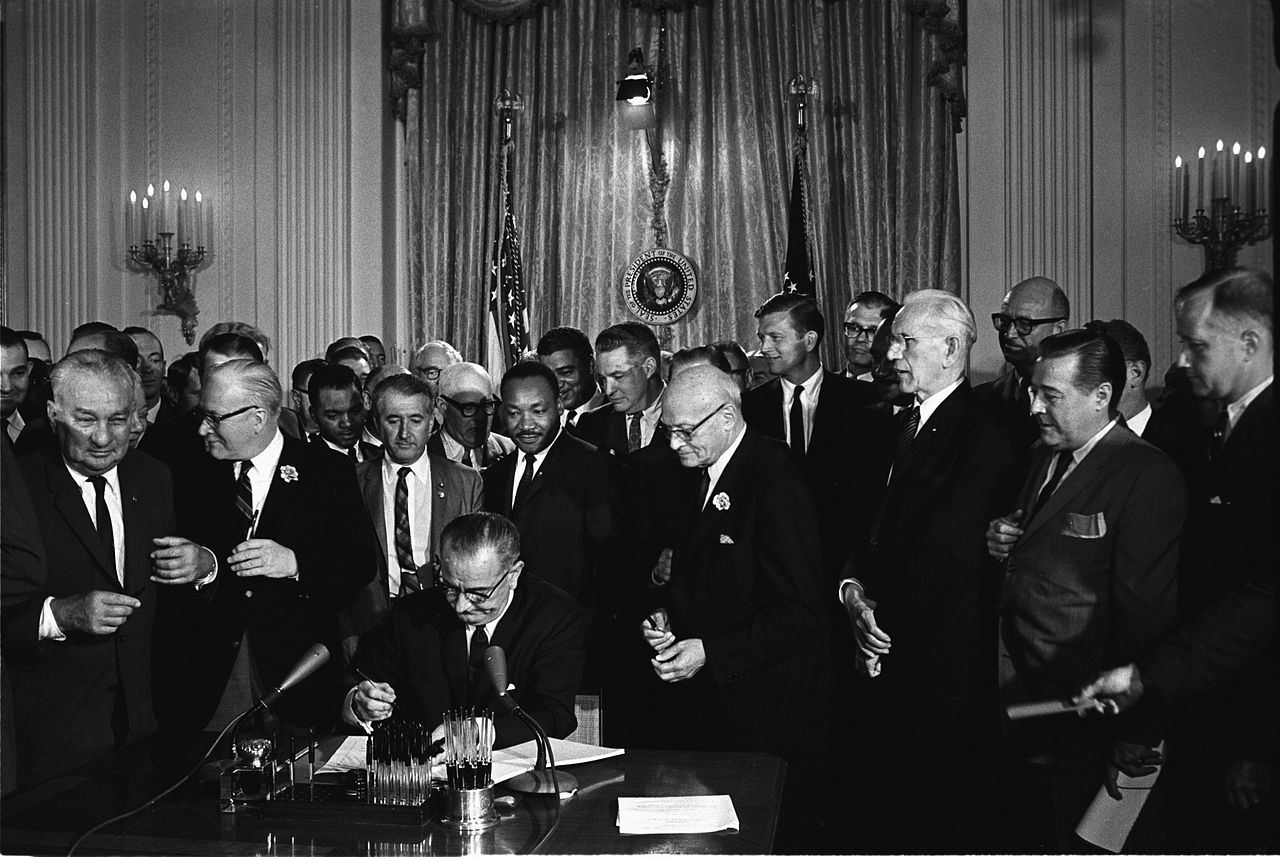
The Civil Rights Act of 1964 is often remembered as a moral turning point, and it was. But it is also a piece of legal engineering: a statute built to do something the Constitution, standing alone, did not clearly require private businesses to do in 1964.
The Fourteenth Amendment limits what states may do. It does not, on its face, regulate a hotel owner who refuses to rent a room or a restaurant that turns customers away. (Other constitutional theories existed in the background, including enforcement powers and the Thirteenth Amendment’s reach, but the Act’s central design for private businesses did not depend on them.) So Congress wrote a law that could reach private actors, then anchored it to constitutional powers the Court had already treated as broad enough to carry the weight.
If you have ever wondered why the Act talks so much about interstate commerce, this is why. Civil rights ideals supplied the purpose. Constitutional structure supplied the scaffolding.
Join the Discussion
What it does in one sentence
The Civil Rights Act of 1964 is a federal law that prohibits discrimination in key parts of public life, including public accommodations, employment, and programs receiving federal funds. It also strengthens federal enforcement in education and includes limited voting-related provisions that foreshadowed the stronger Voting Rights Act of 1965.
It is not one rule. It is a set of titles, each aimed at a specific problem, using a specific enforcement tool.
The structure
The Act is organized into “titles.” Think of each title as its own mini law, with its own scope, definitions, and enforcement mechanism.
- Title I: Voting registration (limits unequal application of voter registration requirements)
- Title II: Public accommodations (hotels, restaurants, entertainment venues, and more)
- Title III: Public facilities (state and local government owned or operated facilities)
- Title IV: Public education (desegregation and enforcement)
- Title VI: Federal funds (no discrimination by recipients of federal financial assistance)
- Title VII: Employment discrimination (creates the modern federal workplace framework)
Other titles matter too, including provisions that strengthen the Civil Rights Commission and collect voting-related data. But the titles above are the pillars most Americans still encounter, even if they never read the statute.
Title I
Voting registration
Title I targets discrimination at the front door of democracy: voter registration. In plain terms, it limits the unequal application of registration requirements, a practice that let officials use “standards” as instruments of exclusion.
It mattered, but it did not solve the problem. The Voting Rights Act of 1965 would bring the more muscular tools, including federal oversight mechanisms that directly confronted systematic suppression.
Title II
Public accommodations
Title II prohibits discrimination or segregation in certain “places of public accommodation” (businesses open to the public) on the basis of race, color, religion, or national origin.
Notice what is not on that list. Title II does not cover sex discrimination, and it does not cover disability, which would be addressed by later statutes such as the ADA.
Its target was not subtle: businesses open to the public that used “private choice” as cover for systemic exclusion.
What counts
Title II names categories rather than trying to list every possible business. Core examples include:
- Lodging: hotels, motels, and similar establishments
- Food service: restaurants, cafeterias, lunch counters
- Entertainment: movie theaters, concert halls, sports arenas
- Connected facilities: places located within covered establishments, or that serve patrons of covered establishments
The backbone
Title II is where the constitutional strategy becomes easiest to see. Congress did not primarily rely on the Fourteenth Amendment to regulate private restaurants and hotels. It relied on Article I, Section 8, the power to regulate interstate commerce.
The Supreme Court upheld this approach in two landmark cases decided the same day:
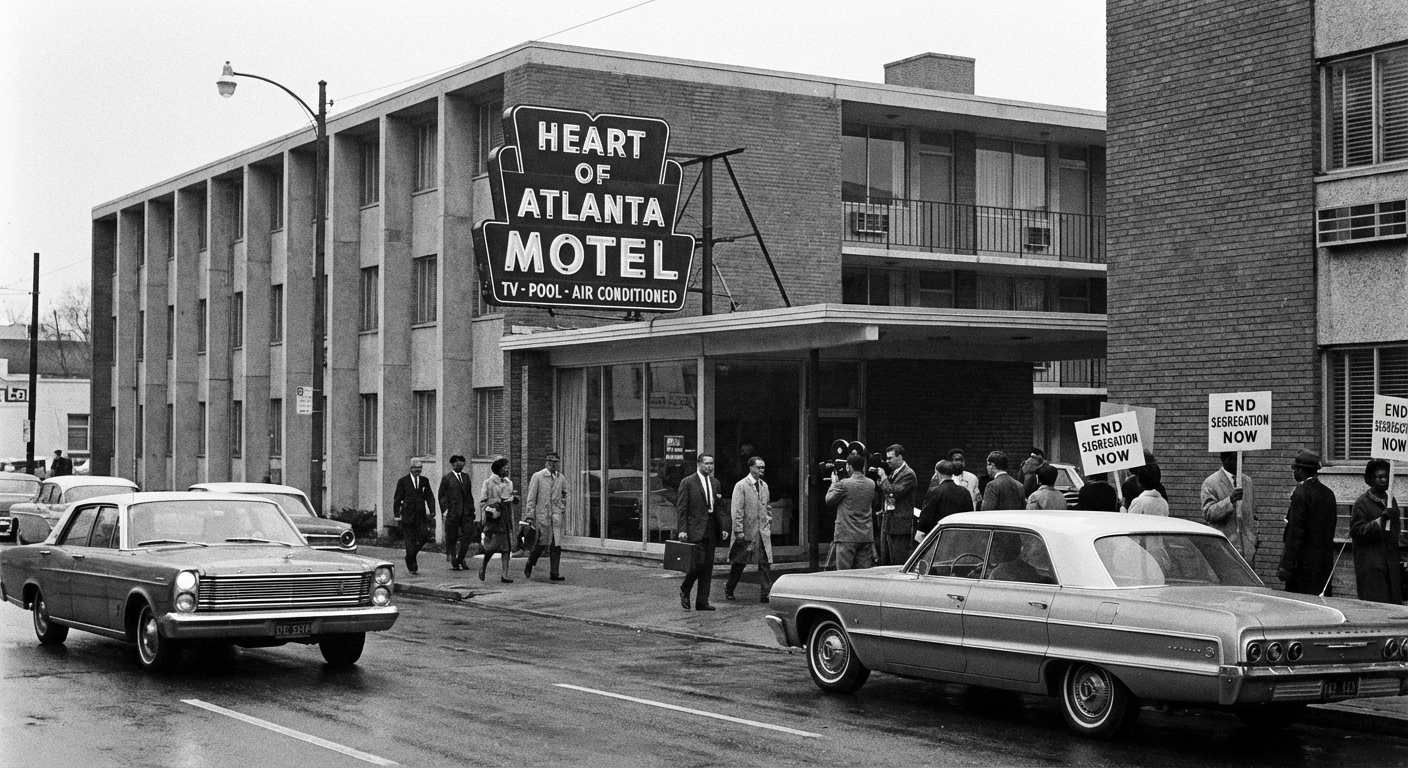
- Heart of Atlanta Motel v. United States (1964): A motel that served interstate travelers could be regulated because racial exclusion burdened interstate commerce.
- Katzenbach v. McClung (1964): Even a local restaurant could be covered if its food moved through interstate commerce and discrimination, in the aggregate, affected interstate commerce.
Those cases are a constitutional lesson disguised as civil rights history: the Court accepted that discrimination was not only a moral harm but also an economic barrier that Congress could address through commerce power.
How it is enforced
Title II’s remedies are narrower than many people assume. It is primarily enforced through court orders requiring equal service (injunctive relief), rather than money damages.
Title VII
Employment discrimination
Title VII prohibits employers from discriminating in hiring, firing, compensation, or “terms, conditions, or privileges of employment” because of race, color, religion, sex, or national origin.
It also prohibits retaliation against employees who assert their rights under the statute.
Who it applies to
Title VII applies to many private employers, plus employment agencies and labor organizations. Today the familiar threshold is generally 15 or more employees, though the original 1964 coverage was narrower and later amendments expanded it.
Why it changed everything
Title VII did not just declare discrimination wrong. It created a federal enforcement framework that still shapes workplace life today:
- It established the Equal Employment Opportunity Commission (EEOC).
- It built a system for administrative charges, investigation, conciliation, and then litigation.
- It made discrimination a federal legal claim, not just a local grievance.
Key concepts
- Disparate treatment: intentional discrimination because of a protected trait.
- Disparate impact: neutral policies that disproportionately harm protected groups and are not justified by business necessity, a framework recognized by the Court in Griggs v. Duke Power Co. (1971).
- Hostile work environment harassment: severe or pervasive harassment that changes the conditions of employment, developed through later doctrine.
Constitutional grounding
For private employers, Title VII is typically defended as an exercise of Congress’s power to regulate interstate commerce and the national economy. Employment is economic activity, and discrimination in labor markets can be framed as a burden on commerce and productivity.
When the defendant is a state or local government employer, additional constitutional authority can come into view, including Congress’s enforcement power under the Fourteenth Amendment. The hook can vary with the target, even when the statutory rule is the same.
Title VI
Federal funds
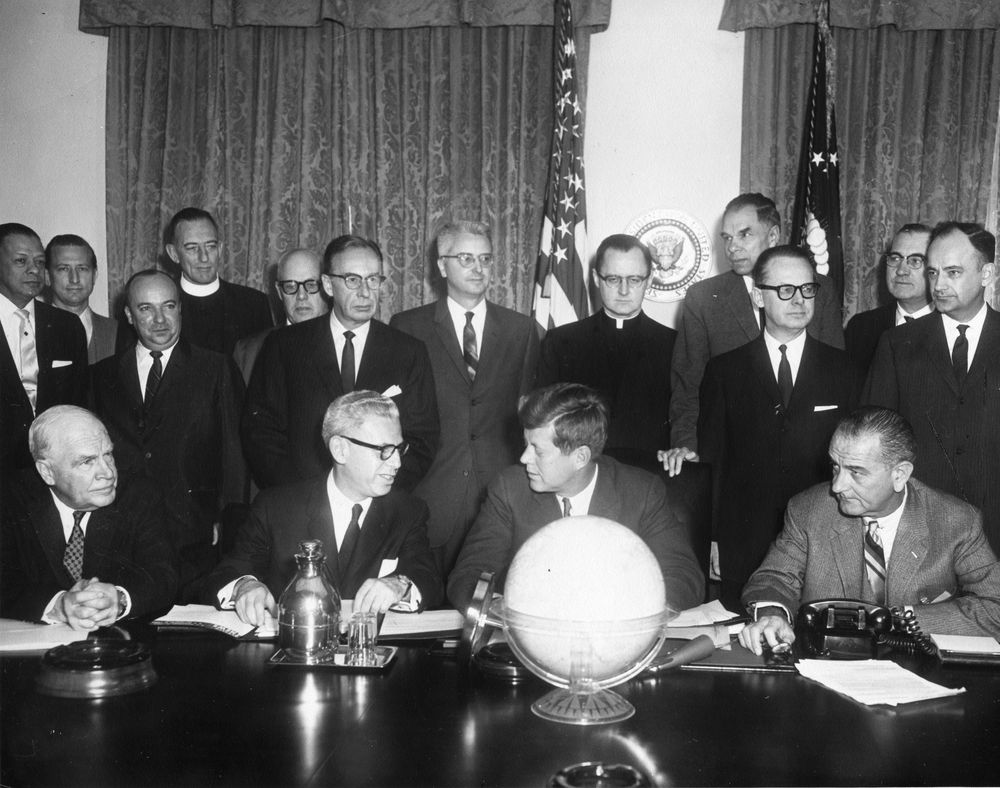
Title VI says that entities receiving federal financial assistance cannot discriminate on the basis of race, color, or national origin in the funded program or activity.
Why it is powerful
Title VI works like a constitutional pressure point. It does not need to regulate every private decision directly. It conditions the receipt of federal money on compliance with nondiscrimination requirements.
That matters because schools, hospitals, transit systems, and state agencies often rely on federal dollars. Title VI turned civil rights compliance into a practical prerequisite for participating in federally supported programs.
The backing
Title VI is typically linked to Congress’s spending power, and it also sits comfortably alongside Congress’s broader authority to enforce equal protection norms in federally supported programs. The idea is straightforward: Congress may spend for the general welfare and attach conditions to funds, so long as the conditions are clear and related to the federal interest in the program.
One precision point matters historically: the phrase “program or activity” has been fought over. Congress later broadened how that concept operates in practice through the Civil Rights Restoration Act of 1987, expanding when nondiscrimination obligations can apply across an institution.
How it is enforced
Enforcement often runs through federal agencies that can investigate and, in serious cases, move to terminate or withhold funds. Courts have also recognized private enforcement in important contexts, which is part of why Title VI remains a live tool rather than a symbolic condition.
Title IV
Education
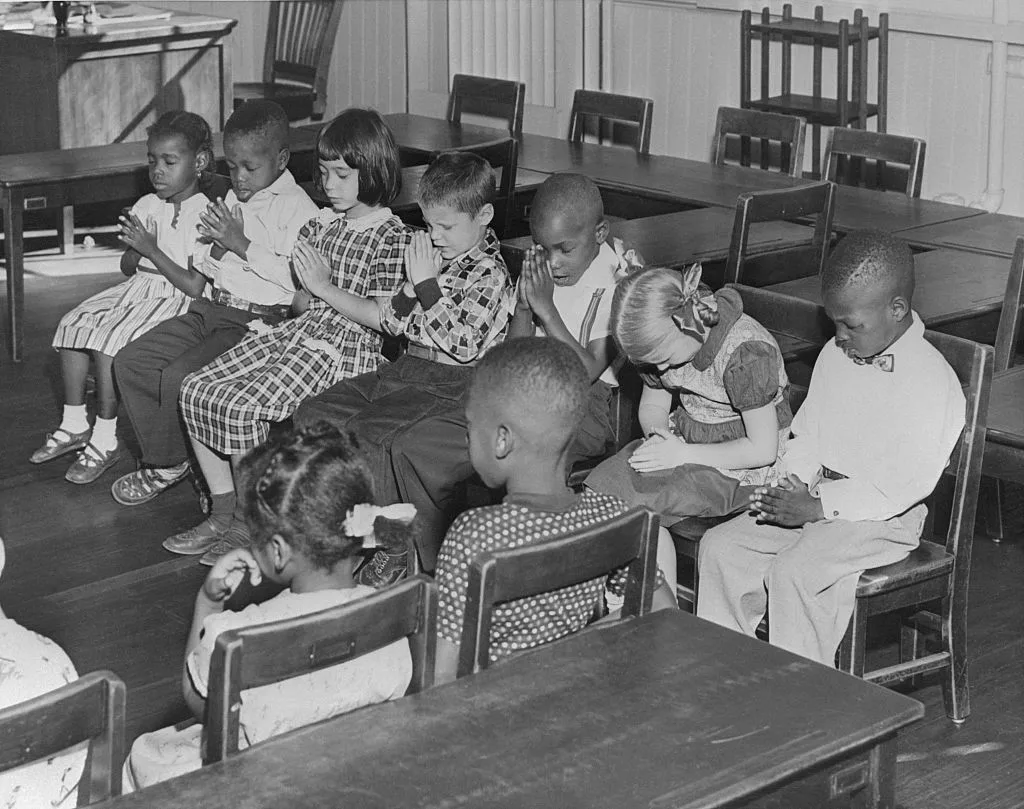
Title IV strengthened the federal government’s ability to enforce school desegregation by authorizing the Department of Justice to bring suits regarding public school desegregation and by providing technical assistance related to compliance.
How it relates to the Constitution
School segregation is where the Fourteenth Amendment sits closest to the surface. Brown v. Board of Education (1954) held that state-sponsored school segregation violates the Equal Protection Clause.
Title IV does not replace Brown. It helps implement it, moving desegregation from a principle announced by the Court to a reality enforced through federal capacity.
This is a recurring constitutional theme: the Court articulates a constitutional rule, then Congress builds statutory machinery to enforce it.
Title III
Public facilities
Title III addresses discrimination and segregation in certain public facilities owned or operated by state or local governments. It authorized the Attorney General to seek relief when people were denied equal use of public facilities.
This title is closer to traditional Fourteenth Amendment territory because it involves government action. When the state denies equal access, equal protection is directly implicated.
Key definitions
Even when a title sounds simple, the real fights often turn on defined terms. A few definitions and concepts appear again and again in civil rights enforcement:
- Discrimination: not just overt exclusion, but often unequal treatment in service, access, or conditions.
- Public accommodation: a category tied to commerce, travel, and service to the public, not a synonym for “any business.”
- Federal financial assistance: grants, loans, and other funding streams that bring Title VI obligations with them.
- State action: the constitutional line between what the Fourteenth Amendment reaches directly (government conduct) and what Congress must reach indirectly through its Article I powers (private conduct).
That last term is the quiet hinge. The Civil Rights Act is, in part, a response to the state action doctrine: it finds constitutional ways to regulate discrimination that is not officially “the state” but still structures public life.
Why commerce shows up
To modern ears, it can sound strange to justify equal access by talking about interstate commerce. But the framing was strategic and, in 1964, necessary.
Congress knew the Court had once struck down earlier civil rights efforts and had narrowly interpreted federal power in other eras. So it built an evidentiary record that showed how segregation and discrimination:
- restricted travel for Black Americans and other minorities
- shifted where people could safely eat, sleep, and shop
- altered labor markets and the flow of goods
- created measurable burdens on interstate commerce
Heart of Atlanta and Katzenbach validated the approach. They also helped define the modern understanding that Congress can regulate local activity when its aggregate effects substantially affect interstate commerce.
Equal protection and statutes
The Civil Rights Act of 1964 is not the same thing as the Fourteenth Amendment. But in practice, they developed in tandem.
Here is the relationship in plain terms:
- The Fourteenth Amendment set constitutional limits on state discrimination through the Equal Protection Clause.
- Brown and subsequent cases made those limits concrete in education.
- The Civil Rights Act extended the project into places the Fourteenth Amendment does not cleanly reach, especially private commerce and employment.
- Later doctrine shaped how courts evaluate government classification and intent, while civil rights statutes supplied parallel tools for private settings.
This is why civil rights debates often sound like they are happening in two languages at once: constitutional law (equal protection, state action, levels of scrutiny) and statutory law (titles, agencies, burdens of proof, remedies). In practice, American civil rights enforcement is bilingual.
What it does not do
The Civil Rights Act of 1964 is sweeping, but it is not unlimited. A few common misconceptions are worth clearing away:
- It did not end all discrimination: it created enforceable rules, but enforcement requires complaints, litigation, administrative capacity, and political will.
- It is not a single universal ban: different titles protect different traits and apply in different contexts.
- It does not cover every category people now expect: age and disability protections largely come from later statutes, including the ADEA and the ADA.
- It does not erase the Constitution’s lines: the state action doctrine still matters, which is why Congress often relies on commerce and spending powers to reach private conduct.
Why it is still a constitutional story
We tend to treat the Civil Rights Act as settled history. But its real lesson is structural: rights are not only declared, they are built.
Congress took a constitutional system that limits federal power and still found lawful ways to confront a national injustice. It did that by choosing tools the Constitution clearly provides, especially the Commerce Clause and the spending power, and by pairing them with the moral force of equal citizenship.
That is the enduring question the Act leaves us with: when the Constitution sets boundaries, what does democratic government do inside those boundaries to make liberty real?
Quick reference
- Title I: limits unequal voter registration requirements; a bridge to the Voting Rights Act of 1965.
- Title II: bans discrimination in covered public accommodations; upheld under the Commerce Clause; primarily injunctive remedies.
- Title III: addresses discrimination in certain public facilities; closely tied to Fourteenth Amendment constraints on government.
- Title IV: strengthens enforcement of public school desegregation and provides technical assistance; implements equal protection developments after Brown.
- Title VI: bans discrimination by recipients of federal funds; tied to Congress’s spending power; later broadened in application by the Civil Rights Restoration Act of 1987.
- Title VII: bans employment discrimination; enforced through the EEOC and courts; generally grounded in commerce power, with additional constitutional considerations for government employers.