
When a president announces that a national monument will be cut down to size, the fight is not just about acres. It is about which branch of government controls federal land, and whether a statute written in 1906 gives the president a one-way power or a two-way power.
Today’s news cycle is reviving a familiar question: the Antiquities Act clearly authorizes presidents to create national monuments, but does it also authorize them to shrink those monuments later? A related question is whether a president can revoke a monument entirely. (For clarity: a reduction changes boundaries; a revocation eliminates the designation.) The answers are less settled than most people expect.
Join the Discussion
What the Antiquities Act says
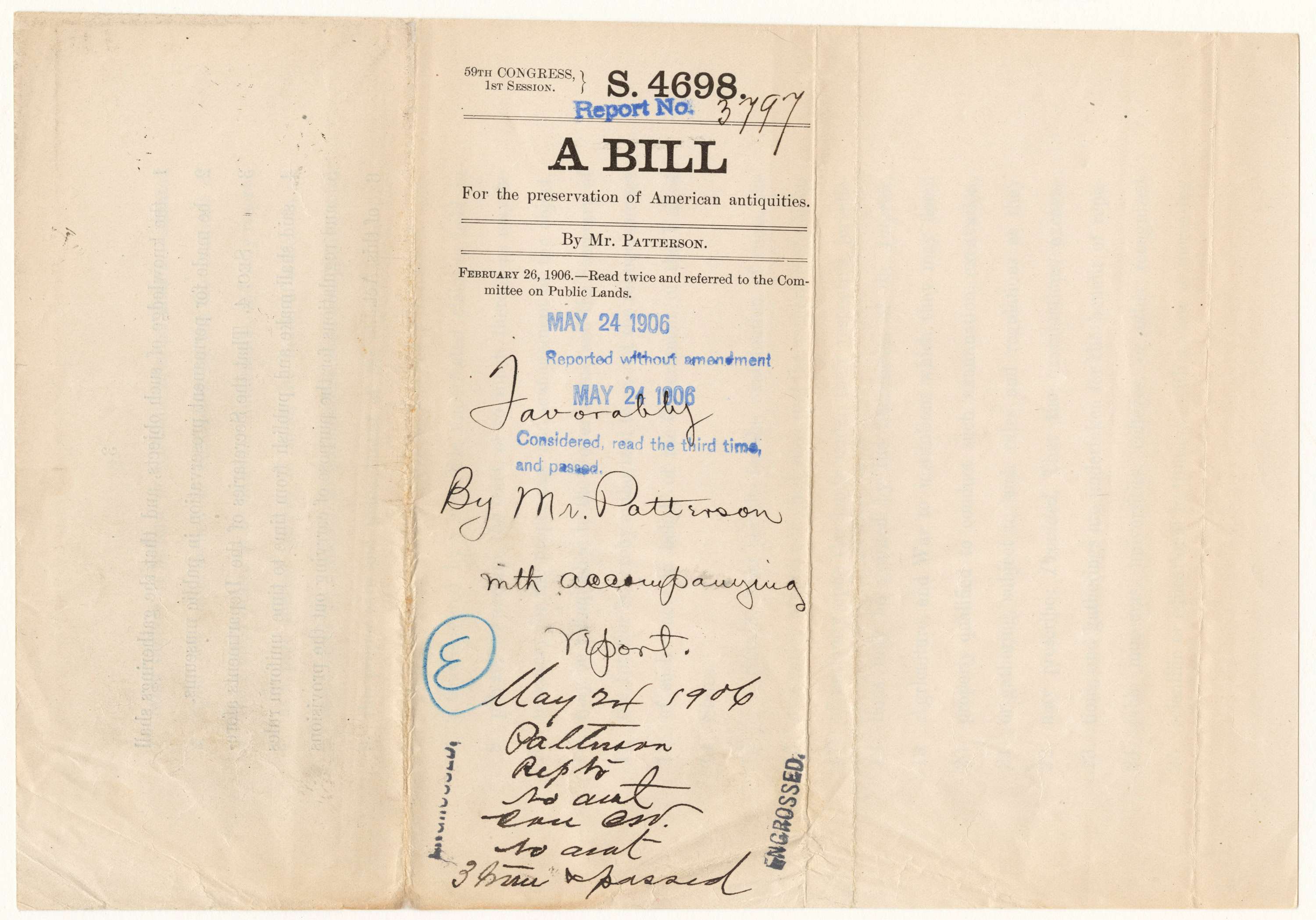
The Antiquities Act of 1906 empowers the president to proclaim national monuments on federal land to protect “historic landmarks, historic and prehistoric structures, and other objects of historic or scientific interest.” It also instructs that the monument’s boundaries must be limited to “the smallest area compatible with the proper care and management of the objects to be protected.”
That second phrase is doing a lot of work. Supporters of broad presidential monument power read it as a management constraint that courts can enforce only rarely. Critics read it as a meaningful limit that a later president may “correct” if a prior designation was, in their view, too large.
Creation power is clear
On the creation side, presidents have used the Antiquities Act for more than a century. The Supreme Court has repeatedly upheld monument designations against challenges that argued the statute was being used too broadly, including in Cameron v. United States (1920) and Cappaert v. United States (1976). In other words, the basic authority to proclaim a monument is well established.
Reduction power is the gap
What is missing from the statute is just as important as what is present. The Antiquities Act does not expressly say a president may revoke a monument or reduce its boundaries. That silence is the opening for both sides.
Who controls federal land?
The Constitution’s center of gravity here is the Property Clause, which gives Congress the power to “dispose of and make all needful Rules and Regulations respecting the Territory or other Property belonging to the United States.” In plain terms: Congress has the primary authority to decide what happens on federal lands.
So how does the president get involved at all? Through delegation. Congress can pass a law that authorizes the executive branch to act within defined limits. The Antiquities Act is one of those delegations: it is Congress telling the president, “you may reserve land as a monument to protect certain objects.”
That sets up the separation of powers question that dominates monument reduction disputes:
- One-way view: Congress delegated the power to create monuments, but did not delegate the power to undo or shrink them. Under this view, only Congress can substantially reduce or revoke a monument.
- Two-way view: The power to reserve land includes an implied power to revise reservations, at least to ensure the monument is no larger than necessary.
Both arguments claim to be “textual.” The difference is whether statutory silence is treated as a prohibition or as room for implied executive authority.
Can a president shrink a monument?
Argument for presidential power
Presidents who reduce monuments typically argue that the Antiquities Act’s “smallest area compatible” language allows later presidents to reassess whether the reserved acreage is truly necessary to protect the relevant objects. On that theory, a reduction is framed not as an “undoing,” but as an adjustment to comply with the statute’s limit.
They also point to historical practice. Multiple presidents in the 1900s issued proclamations that reduced prior monument boundaries, including reductions by Presidents Taft and Wilson, and later adjustments by Presidents Truman and Eisenhower. Defenders of reduction authority also frequently cite a 1938 Attorney General opinion that concluded presidents may reduce monument boundaries (while arguing they may not abolish a monument outright). That opinion is influential, but it is not a Supreme Court decision and does not bind courts the way a judicial ruling would.
Argument against presidential power
Opponents respond with a basic separation of powers premise: the president only has the authority Congress granted. Since Congress explicitly granted the power to declare monuments, but did not include a power to revoke or reduce them, there is no legal basis for a later president to cut them down.
They often analogize to other federal land withdrawal frameworks where Congress granted authority to withdraw lands but reserved revocation, or major changes, to Congress, particularly when the practical effect is to reopen land to mining, drilling, or other development.
What courts have said
Here is the key point for readers looking for a simple “Supreme Court said yes” or “Supreme Court said no”: there is not a clean, definitive Supreme Court ruling squarely resolving the president’s power to significantly shrink a national monument under the Antiquities Act.
Courts have upheld many monument designations when challenged, including the Supreme Court decisions noted above. But reduction cases often get diverted by timing and posture, and they sometimes become moot when a later administration changes course. For example, litigation over the Bears Ears and Grand Staircase-Escalante boundary changes became moot after later proclamations restored larger boundaries, leaving less for courts to decide on the merits.
That means the legal landscape is shaped by three recurring factors:
- Statutory interpretation: what the Antiquities Act’s text most naturally authorizes.
- Administrative law: standing, ripeness, and what agency actions (like land use plans or leases) make a dispute concrete enough for review.
- Institutional reality: changing presidents can change the government’s position before appellate courts reach the core question.

How boundaries change in practice
A national monument begins with a presidential proclamation. That proclamation describes the protected objects and defines boundaries, often with maps and legal land descriptions. Once set, the monument is managed by a federal agency, commonly the National Park Service, Bureau of Land Management, or Forest Service.
When a president attempts to shrink a monument, the change also comes through a proclamation or executive action that revises the prior boundaries. The immediate practical effects can include:
- Shifting which federal land management plan applies to the removed acreage
- Changing what development is permitted, including leasing decisions and environmental review pathways
- Creating uncertainty for tribes, local governments, conservation groups, ranchers, and industry that have planned around one set of boundaries
But one thing does not change: the land usually remains federal land. A reduction does not automatically transfer property to a state or private owner. Instead, removed acreage generally returns to its underlying federal land status and management regime (for example, Bureau of Land Management multiple-use rules or National Forest management), rather than monument-specific protections.
What has happened recently
Recent Utah disputes are often summarized in a simple cycle: a president proclaims a monument, a later president reduces it, and a later president restores some or all of the prior boundaries. That back-and-forth is one reason courts do not always reach a final merits ruling. By the time appeals mature, the map may have changed again, and plaintiffs and the government may be litigating a landscape that no longer exists.
Who can sue?
Not everyone who dislikes a proclamation can walk into federal court. A challenger must establish standing, meaning a concrete injury that is fairly traceable to the action and likely to be redressed by a court order.
In monument reduction litigation, plaintiffs often include:
- Tribal governments and tribal members asserting harms to cultural sites and treaty or statutory interests
- Environmental and conservation organizations asserting harms to members’ recreational, aesthetic, and scientific interests
- Local governments or businesses asserting economic or administrative harms tied to land management changes
The defendant is typically the federal government and the relevant land management agencies. In some cases, states or industry groups intervene to defend the reduction.
What happens if a court rules no?
If a court concluded a reduction exceeded presidential authority, the most direct remedy would be to set aside the reduction proclamation or declare it unlawful, which would typically mean the prior boundaries are treated as reinstated. Downstream effects could include agency plans needing revision and, depending on the timing and facts, new questions about leases, permits, or approvals issued for lands that were treated as removed from the monument.
Why Congress has not settled it
Congress can settle it. Under the Property Clause, Congress could amend the Antiquities Act to do any of the following:
- Explicitly authorize presidents to reduce monuments, with standards and procedures
- Explicitly forbid reductions without congressional approval
- Require environmental review and public process for major boundary changes
- Convert certain monuments into national parks or other designations through legislation
Congress has also sometimes stepped in after the fact by ratifying, modifying, or redesignating particular monuments by statute. That history cuts in two directions. It shows Congress knows how to speak clearly when it wants to. It also gives both sides material to argue over what congressional silence means in any specific dispute.
The reason Congress often does not resolve the general question is political and institutional. Monument fights cut across region, party, industry, and identity. Leaving ambiguity can be a way to avoid taking a recorded vote on a controversial land management outcome.
Why Utah monuments are flashpoints
Disputes over Bears Ears and Grand Staircase-Escalante tend to bundle multiple constitutional and governance tensions into one map:
- Federalism: Utah officials often argue federal control over vast in-state acreage distorts local governance and economic planning, while the federal government points to constitutional ownership and national interests.
- Separation of powers: presidents act quickly through proclamations; Congress moves slowly; courts are asked to decide what the statute allows.
- Competing public land values: cultural protection, recreation, conservation, grazing, and resource development all seek priority in the same terrain.
When a proclamation removes protections connected to drilling or mining, the legal stakes rise because the change is not merely symbolic. It becomes a question of whether a president can unilaterally reopen land that a prior president withdrew from development under delegated congressional authority.
Bottom line
Presidents clearly can create national monuments under the Antiquities Act. That has been the consistent practice for over a century and is strongly supported by Supreme Court precedent upholding designations such as Cameron and Cappaert.
Whether presidents can significantly shrink existing monuments is legally contested. The Antiquities Act does not explicitly grant reduction authority, and the Constitution places primary control of federal lands with Congress through the Property Clause. Reduction proclamations therefore tend to trigger litigation that turns on statutory interpretation, historical practice, and separation of powers.
If you are watching a headline about dramatic acreage cuts, the civics lesson is this: the fight is not only about what a president wants to protect or develop. It is about how much law Congress wrote into the delegation, and whether courts will treat silence as a limit or as permission.
Common questions
Does shrinking a monument give the land to the state?
Usually no. It typically remains federal land. The change is the designation and management rules, not ownership.
Can a president abolish a national monument?
That is even more legally disputed than a reduction. Because the Antiquities Act does not expressly authorize revocation, many scholars argue abolition would require Congress.
Could Congress override a president’s reduction?
Yes. Congress can pass a law restoring boundaries or creating a different land designation. The practical hurdle is political agreement and overcoming a potential veto.