
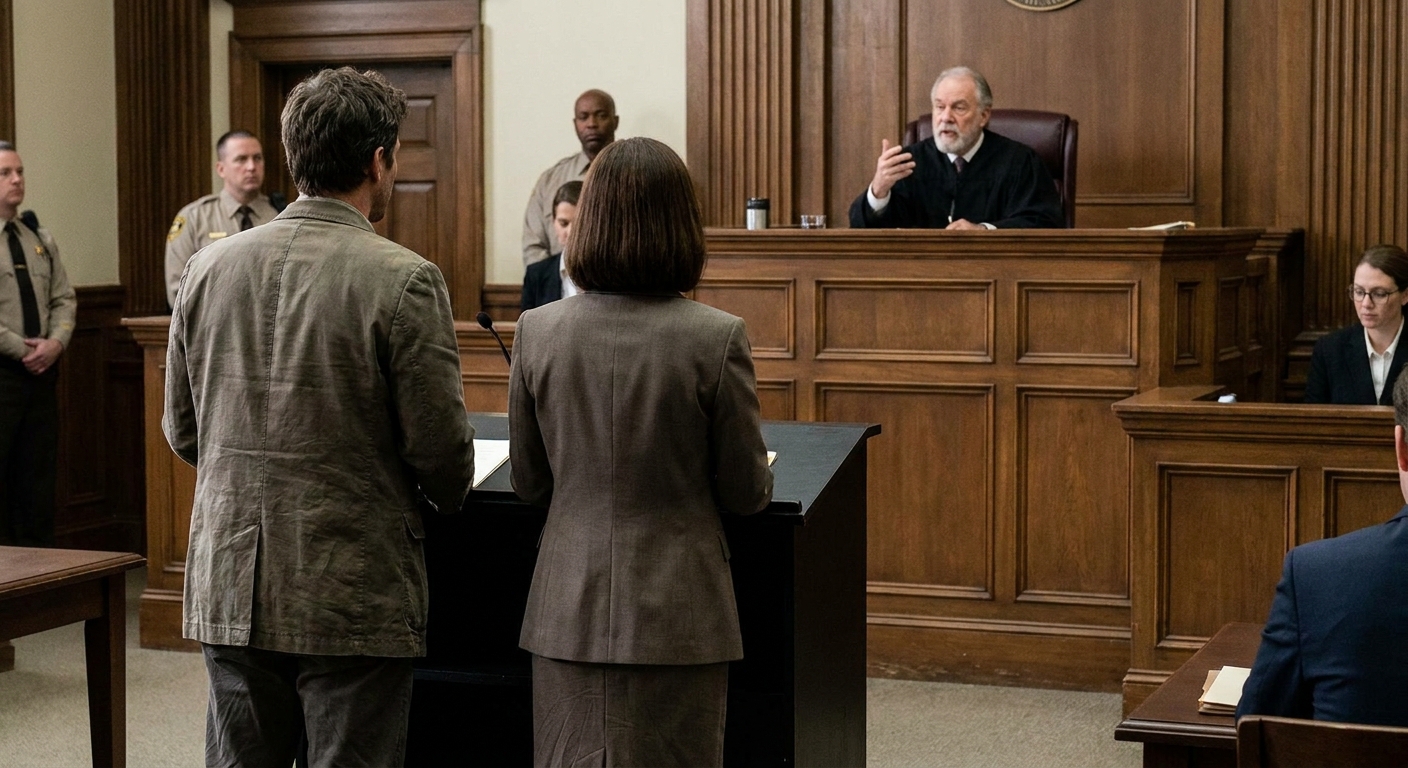
Arraignment sounds like a procedural speed bump. In reality, it is one of the first moments a criminal case becomes real in open court, on the record, with a judge looking directly at the person the state is accusing.
It is also where a quiet constitutional shift happens. Before court, you might mostly be dealing with police or paperwork. At arraignment, the prosecution formally shows up as the government’s representative in court, and the charges now have names, statutes, and consequences. That is why this short hearing is built around a few questions the Constitution and criminal procedure rules force the system to answer early: Do you know what you are accused of? Do you have a lawyer? Will you be held or released while the case proceeds?
Join the Discussion
What an arraignment is
An arraignment is a formal court appearance, often early in a case, where a judge:
- Confirms the defendant’s identity
- States or summarizes the criminal charges
- Ensures the defendant understands key rights, including the right to counsel
- Takes a plea (many defendants plead not guilty at this stage)
- Addresses release conditions, including bail, if it has not already been handled
- Sets next court dates
Some states run arraignment as a quick, high-volume docket. Others treat it as a more detailed hearing. Federal court has its own rhythm, and some of these steps may be split across an initial appearance, a detention hearing, and an arraignment. But the core purpose is consistent: to formally bring the accused into the court process and lock in the next steps.
Where arraignment fits
The sequence varies by jurisdiction, but a typical path looks like this:
- Arrest or citation
- Charging decision (complaint, information, or indictment)
- Initial appearance or first appearance (often the first formal court appearance after arrest, especially if the person is jailed)
- Arraignment (sometimes combined with the initial appearance in state court, sometimes later)
- Pretrial hearings (motions, discovery disputes, suppression issues)
- Plea negotiations or trial
- Sentencing if convicted
Many people use “initial appearance” and “arraignment” interchangeably because the hearings can be combined in practice. The important point is what the law requires early: a prompt judicial check on detention, notice of charges, and counsel protections.
What happens at arraignment
1) The court states the charges
The judge ensures the defendant is informed of the charges filed. This is not the prosecutor telling a story. It is the legal definition of what the state claims happened, tied to specific statutes.
In many courtrooms, the “reading” is brief and the written charging document does most of the work. Either way, the purpose is the same: clear notice of what is being alleged.
This step connects to basic due process: you cannot defend yourself against an accusation you have not been clearly told.
2) The judge advises rights
Courts usually advise defendants of rights such as:
- The right to counsel and, if eligible, appointed counsel
- The right to remain silent
- The right to a trial
- The right to confront witnesses at trial
Some advisements are required by rule or state law, and some are done as a best practice to prevent later challenges. In some jurisdictions, courts also give additional warnings, such as potential immigration consequences of a plea, especially for non-citizens.
3) The defendant enters a plea
The plea entered at arraignment is commonly:
- Not guilty, to preserve all defenses and force the government to prove its case
- Guilty, sometimes with a negotiated agreement, though many courts discourage unrepresented guilty pleas
- No contest (nolo contendere), where permitted, which generally avoids an explicit admission in open court while accepting conviction
A not guilty plea is not a claim of innocence in a moral sense. It is a procedural posture that says: prove it.
Many jurisdictions also allow a defendant to “stand mute” (or the functional equivalent). In those systems, the court typically enters a not guilty plea on the defendant’s behalf.
If a guilty plea is entered at arraignment, the judge typically must ensure it is knowing and voluntary, and in many courts, especially in federal court, the judge will also confirm there is a factual basis for the plea. Requirements vary by jurisdiction and charge level.
4) Release and bail may be addressed
If the defendant is in custody, or if bail has not been set, the court may decide:
- Release on personal recognizance
- Release with conditions (check-ins, travel limits, no-contact orders)
- Monetary bail
- Preventive detention (in limited circumstances, where authorized)
This can be the most consequential part of arraignment. Being held pretrial can change everything: employment, housing, family stability, and the practical ability to help build a defense.

Constitutional rights early
Notice of the accusation
In federal criminal prosecutions, the Sixth Amendment guarantees that the accused shall “be informed of the nature and cause of the accusation.” State systems provide notice through their own constitutions and criminal procedure rules, and due process principles reinforce the same idea: the government has to tell you what it is accusing you of, with enough clarity to allow a defense.
Right to counsel
The Sixth Amendment right to counsel becomes especially important once formal proceedings begin. In modern practice, arraignment is a point where courts often:
- Confirm whether the defendant has retained counsel
- Determine eligibility for appointed counsel
- Appoint a public defender
This matters because early decisions can have long tails. A no-contact order, a bail condition, or a rushed plea can shape the entire case.
Bail and the Eighth Amendment
The Eighth Amendment prohibits “excessive bail.” That does not mean there is always a right to affordable bail or any bail in every case. It means bail cannot be set higher than necessary in light of the government’s permitted goals, such as ensuring court appearance and, where the law authorizes it, addressing public safety.
Bail law is heavily shaped by state constitutions, statutes, and local practice. Still, the constitutional principle is a warning label: pretrial detention is intended to be regulatory, not punishment before conviction.
Due process and a fair proceeding
The Fifth and Fourteenth Amendments are not a checklist the judge recites. They are the background rules that require the process to be fundamentally fair. At arraignment, that includes meaningful notice, an opportunity to be heard on release, and procedures that do not coerce a plea.
Federal vs state arraignment
People often assume there is one arraignment process. In reality, there are at least two broad ecosystems.
Federal court (general pattern)
- Many defendants first appear at an initial appearance before a magistrate judge
- Detention and release may be litigated under the Bail Reform Act, sometimes at a separate hearing
- The arraignment may occur after indictment, with a formal statement of charges and a plea
State court (wide variation)
- Some states combine initial appearance, arraignment, and bail decisions
- Some run “first appearance” for custody review and then schedule arraignment later
- Misdemeanor arraignments are often faster and may occur soon after citation or arrest
The takeaway is practical: the name of the hearing matters less than what is happening at it. If charges are being addressed, counsel is being handled, and plea and release conditions are on the table, you are in the constitutional neighborhood of arraignment.
Do you have to plead?
Courts usually require some plea at arraignment, but “not guilty” is the default when a case is just beginning. It preserves rights and buys time for:
- Reviewing evidence (discovery)
- Investigating witnesses
- Challenging searches, seizures, or statements
- Negotiating with the prosecutor
In many jurisdictions, if a defendant does not enter a plea, the court will enter a not guilty plea for them.
How judges set release
Courts vary, but judges commonly consider:
- Risk of nonappearance (history of missed court dates, community ties)
- Public safety (alleged violence, threats, weapons, prior convictions), where authorized
- Severity of charges and potential sentence exposure
- Criminal history
- Ability to comply with conditions (work schedule, housing stability)
- Victim safety and no-contact provisions where relevant
Even when the law allows monetary bail, reform debates focus on a hard truth: cash bail can function as a two-track system, where freedom depends less on risk and more on resources. Constitutional doctrine does not eliminate that tension by itself, but it frames the question courts cannot avoid: is this restriction necessary for its stated purpose, or is it functioning like punishment?

Common questions
How long does an arraignment take?
Often just a few minutes, especially in crowded dockets. If release is contested, an interpreter is needed, or counsel status is complicated, it can take longer.
Is arraignment the same as trial?
No. No witnesses testify to prove guilt at arraignment, and victims or complaining witnesses typically do not testify. The case is not decided there unless a plea resolves it.
Can charges be dismissed at arraignment?
Sometimes, but it is not typical. Dismissals usually happen later, after motions practice or prosecutor review. Arraignment is usually about posture: charges, plea, counsel, release, and scheduling.
What should a defendant say?
In most cases: as little as necessary. Identity confirmation and the plea are handled through counsel when possible. Substantive explanations about the incident can create problems later, especially if the defendant speaks on the record without legal advice.
What if the defendant does not have a lawyer yet?
The court may appoint counsel if the defendant qualifies, continue the hearing, or enter a not guilty plea and set a follow-up date. Procedures vary, but the system is supposed to address counsel early because the adversarial process has already begun.
What should someone expect logistically?
Many arraignments are fast and crowded. Some are done by video, especially for people in custody. If you need an interpreter or have accessibility needs, it is usually something to flag as early as possible through the clerk or your attorney. If you have paperwork related to the case, bring it, but do not expect the hearing to be a full discussion of evidence.
Why arraignment matters
Arraignment is easy to dismiss because it can feel like paperwork performed out loud. But it is one of the few early moments when the judge, not the police and not the prosecutor, is required to engage the person being accused.
It is where the state has to put its accusation into a formal shape. It is where liberty is often decided for the weeks or months that follow. And it is where the Constitution begins to operate less like a civic ideal and more like a set of guardrails: notice, counsel, due process, and limits on pretrial restraint.
If you remember only one thing, make it this: arraignment is not the end of anything. It is the beginning of the government proving its case under rules that exist precisely because power, once aimed at a person, tends to keep moving unless something stops it.