
If you are eligible, you can pursue a green card from inside the United States without traveling abroad for a visa interview. That process is called Adjustment of Status, or AOS. It sounds simple in a sentence, but in practice it is a choreography of forms, deadlines, and eligibility rules that turn on details that feel small until they are not.
This page is the procedural companion to our “What Is a Green Card?” explainer. That page answers what permanent residence is. This one answers how people already in the U.S. sometimes get there without leaving.
Join the Discussion
AOS vs. consular processing
There are two primary procedural routes to a green card:
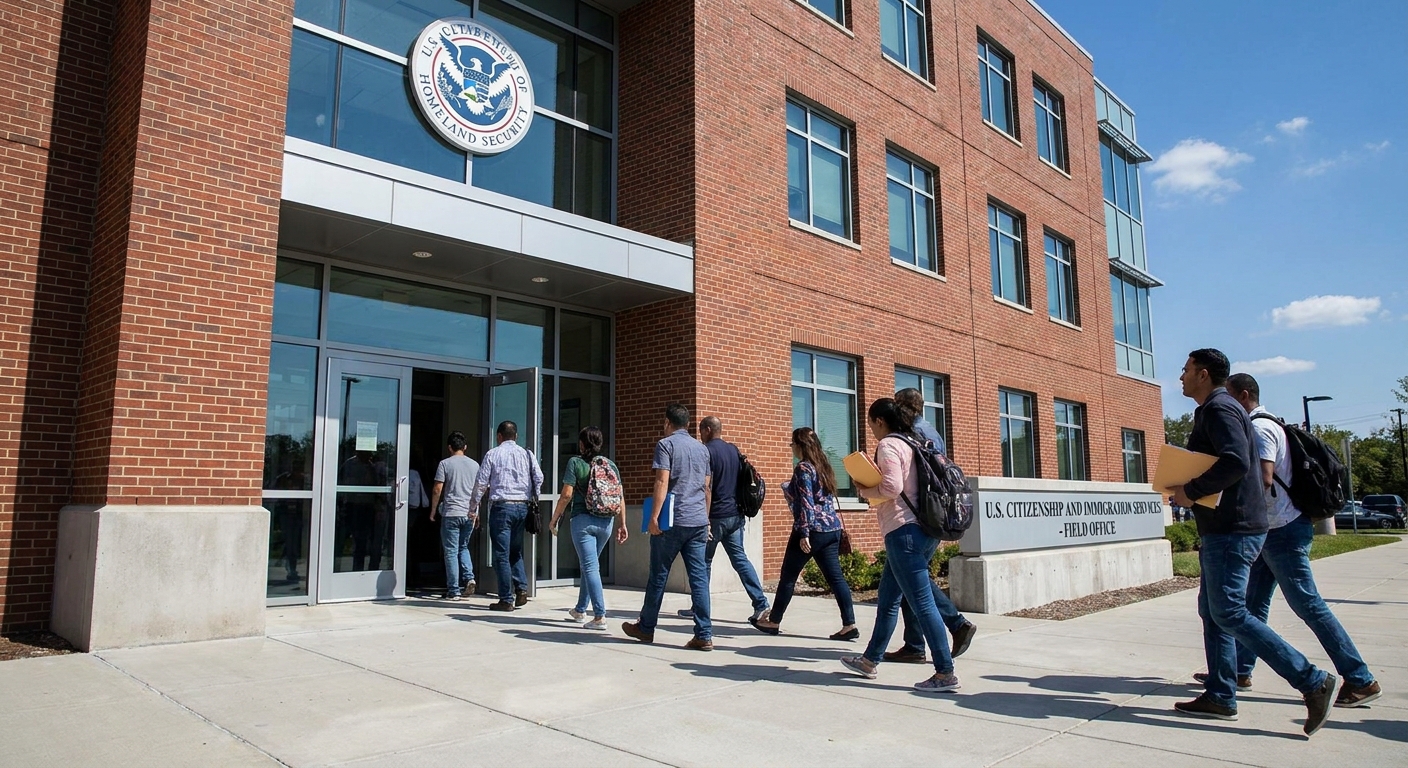
- Adjustment of Status (AOS): You apply to “adjust” from a temporary or other eligible status to lawful permanent resident while physically present in the United States, typically by filing Form I-485. Most of the process is paperwork-based, and many applicants later attend an interview at a USCIS field office.
- Consular processing: You pursue an immigrant visa through a U.S. embassy or consulate abroad, then become a permanent resident when you enter the U.S. using that immigrant visa.
The right route is not just preference. It is often dictated by your current location, how you entered the country, whether you are eligible to adjust, and whether leaving the U.S. would trigger bars to reentry.
Why people prefer AOS
- No international departure required. For some people, leaving is risky because it can trigger reentry bars or derail a pending case.
- Possible work and travel permission while you wait. Many AOS applicants can request interim authorization to work and travel, but eligibility and strategy vary by category and history, and processing times can be unpredictable.
- One pipeline, one agency. USCIS handles most of the process. Consular processing splits tasks across USCIS, the National Visa Center, and a consulate.
Why consular processing is sometimes the only option
- You are not eligible to adjust status in the U.S. under the rules that apply to your situation.
- You are outside the U.S. and cannot, or should not, enter just to file AOS.
- Your category or facts make consular processing strategically cleaner, even if AOS is theoretically possible.
The big eligibility question: can you adjust?
In broad terms, AOS is for people who are physically present in the U.S. and eligible under the Immigration and Nationality Act to become permanent residents. The precise rules differ by category, but most AOS cases revolve around a few recurring “gates.”
Gate 1: a qualifying basis for a green card
AOS is not a standalone benefit. It is the final step in a larger immigration category, commonly:
- Family-based: Immediate relatives of U.S. citizens and other family preference categories, often starting with Form I-130.
- Employment-based: Employer sponsorship, extraordinary ability categories, and related classifications, often starting with Form I-140 (and sometimes a labor certification first).
- Humanitarian or special categories: Asylum-based adjustment, certain victims, special immigrant classifications, and other statutory paths.
Gate 2: inspection and admission or parole
Many AOS applicants must have been inspected and admitted or paroled into the U.S. In everyday terms, this usually means you entered through a port of entry with permission, or you were paroled in under a lawful process.
There are exceptions and special provisions for certain groups. But if your entry history is complicated, it is one of the first facts that determines whether AOS is even on the table.
Gate 3: status issues and 245(c) bars
Some AOS categories are more forgiving of overstays, unauthorized work, and other status violations than others. Many employment-based and preference-category cases run into the INA 245(c) “bars,” while many immediate relatives of U.S. citizens have special forgiveness for certain overstays and unauthorized work. The category you are using matters as much as the fact you are in the U.S.
One practical implication: even if you can file AOS, maintaining lawful nonimmigrant status can still matter as a backup plan. If AOS fails and you later need consular processing, unlawful presence and status history can suddenly become the center of the case.
Gate 4: admissibility and “bars”
Even with an approved petition, USCIS can deny AOS if you are inadmissible under the immigration laws. Inadmissibility grounds can involve health-related issues, certain criminal history, fraud or misrepresentation, prior immigration violations, or public charge related concerns. Some grounds can be waived in some categories. Some cannot. Public charge standards, in particular, can be policy-sensitive and may change over time.
The key procedural takeaway is this: AOS is not just about proving you qualify. It is also about proving there is no legal reason you must be refused.
Petitions: the filing that starts the clock
Most green card paths begin with a petition, filed by someone other than the green card applicant, or by the applicant in a limited set of self-petition categories.
- Family cases: Often begin with a U.S. citizen or lawful permanent resident filing Form I-130.
- Employment cases: Often begin with an employer filing Form I-140, sometimes after labor certification, depending on the category.
Think of the petition as the government recognizing the category you claim. Adjustment of Status is the second half: proving you personally are eligible to be granted permanent residence in that category.
Concurrent filing in plain English
In some situations, you can file the immigrant petition and the AOS application at the same time (for example, some immediate relative and employment cases where visa numbers are available). In other situations, you must wait for visa availability and, depending on the category and rules for concurrent filing, you may also need to wait for petition approval. The operative rule is not a single sentence. It is “what does my category allow, and is a visa number available under the chart USCIS is using this month?”
Priority dates and visa availability
If you are in a category with annual numerical limits, you may have to wait in line. That line is tracked with a priority date, which is usually the date the petition (or labor certification, in some employment cases) was received by the government.
When a visa number becomes available for your category and country of chargeability, your priority date is considered current. Only then can many applicants file AOS, or have AOS approved, depending on the filing chart USCIS is using for that month.
Visa Bulletin mechanics, one sentence
The Visa Bulletin has multiple charts, and USCIS announces whether AOS applicants may use Dates for Filing or must use Final Action Dates in a given month.
Why this matters for timing
- Some categories are “always current.” Immediate relatives of U.S. citizens, for example, generally are not subject to the same waiting lines.
- Other categories have backlogs. In those, the wait can be months or years.
- Being in the U.S. does not erase the line. AOS changes location and procedure, not the underlying visa availability limits.
If you have ever wondered why someone with an approved petition still cannot file AOS yet, priority dates are usually the answer.
What you actually file in an AOS case
USCIS forms change over time, but a typical AOS packet includes:
- Form I-485: the adjustment application itself, where you request permanent residence.
- Identity and entry documentation such as passport pages, visa pages, and proof of lawful entry or parole when required.
- Form I-864 (often): Affidavit of Support in many family-based cases, showing the sponsor meets financial requirements.
- Form I-693: medical examination by an authorized civil surgeon, submitted in the required format.
- Supporting evidence tailored to the category, such as proof of a bona fide marriage, employment documentation, or other eligibility materials.
After filing, most applicants should expect some combination of:
- Receipt notices confirming USCIS accepted the filing.
- Biometrics (fingerprints and photo) at a USCIS appointment.
- Requests for Evidence (RFEs) if something is missing or unclear.
- An interview in many, but not all, categories. USCIS can waive some interviews, but marriage-based cases are commonly interviewed.
- A decision granting or denying adjustment.
Work and travel permission while AOS is pending
AOS can take time. Congress has built a practical pressure valve into the system: many applicants can request interim authorization to work and, separately, permission to travel. These benefits are not automatic, and strategy matters.
Work authorization
Many AOS applicants request an Employment Authorization Document (EAD) using Form I-765. This can allow lawful employment while the green card application is pending, even if your prior nonimmigrant status does not allow work or has restrictions. Processing times vary, and maintaining an underlying nonimmigrant status can still be important in some cases.
Advance parole for travel
Many applicants also request advance parole using Form I-131, which is a form of permission to return to the U.S. after temporary travel abroad while AOS is pending.
One of the most common misconceptions is that advance parole is a casual travel perk. It is not. It is a legal mechanism that can carry risk depending on your history and circumstances. Leaving the U.S. without the correct travel authorization can also lead USCIS to treat an AOS application as abandoned in many situations.
One important caveat: some people in certain dual-intent or quasi dual-intent statuses, commonly H-1B/H-4 and L-1/L-2, may be able to travel and re-enter without advance parole while an I-485 is pending if they remain eligible for that status. Many others generally should not depart without advance parole.

Common pitfalls that derail AOS
AOS is not just paperwork. It is paperwork with tripwires. Here are the issues that most often create serious problems.
1) Filing when you are not eligible
People sometimes assume that being physically in the U.S. and having a pending or approved petition automatically means AOS is allowed. It does not. Eligibility depends on category rules, your manner of entry, the INA 245(c) bars that apply to you, and whether a visa is available.
2) Overstays and status violations
Some categories are more forgiving of overstays and certain status violations than others. Others are not. The consequences of an overstay can also look different inside the U.S. than at a consulate abroad. This is one reason AOS versus consular processing is not just a logistical choice.
3) Travel at the wrong time
Travel while an AOS case is pending can be one of the most consequential decisions you make. Leaving without appropriate permission can cause abandonment in many cases. Leaving with permission can still present complications at reentry in some cases. Treat travel planning as part of your legal strategy, not an afterthought.
4) Weak evidence in family cases
In marriage-based cases especially, USCIS is evaluating whether the relationship is bona fide. Thin documentation, inconsistent answers, or missing joint evidence can lead to RFEs, interviews that go poorly, or denial.
5) Missing deadlines or sending incomplete responses
An RFE is not an accusation, but it is a timer. Partial responses and late submissions are common reasons cases get denied even when the underlying facts are strong.
6) Misrepresentation and “small” inaccuracies
AOS forms ask about past names, addresses, immigration history, arrests, and prior applications. People are sometimes tempted to simplify. That is the wrong instinct. Errors can be treated as credibility problems, and in some situations, as misrepresentation.
Special situations worth flagging
Some fact patterns are common enough that they deserve a quick mention. These are not one-size-fits-all rules, but they are frequent sources of confusion.
- K-1 fiancé(e) entrants: Often adjust through the U.S. citizen petitioner after marriage, with category-specific rules.
- Visa Waiver Program (ESTA): Some immediate relatives of U.S. citizens adjust from ESTA, but it can be high-risk and time-sensitive. Many other categories cannot treat VWP entry as a flexible AOS platform.
- TPS and DACA: These programs can intersect with AOS in category-specific ways, especially around admission or parole and travel history.
- Asylees and refugees: Adjustment is often available under separate statutory rules with distinct timing and evidence requirements.
- 245(i): A narrow but powerful provision for certain people with older filings, sometimes allowing AOS despite issues that would otherwise block it.
Process rights and delays
Immigration is governed mostly by federal statutes, regulations, and agency procedures. But constitutional and administrative-law principles show up in practical places that matter to applicants.
- Due process shows up in the paperwork. RFEs, Notices of Intent to Deny, and many denial frameworks exist because procedure requires notice and a meaningful chance to respond.
- Courts can matter in extreme situations. Most AOS cases never see a courtroom. But in rare cases of extraordinary delay, some applicants consider federal court tools like a writ of mandamus or claims under the Administrative Procedure Act to push an agency to act. These are fact-intensive decisions and should be discussed with counsel.
- Immigration authority is shared across branches. Congress writes the statutes, agencies administer them, and courts review certain actions and limits. When AOS rules shift, it is often because one branch changed policy, another changed the statute, or courts clarified what the law permits.
Understanding AOS as a procedure, not a promise, helps explain why it can feel both rule-bound and politically sensitive at the same time.
Where AOS fits on the timeline
If you are trying to map the process in your head, here is a simplified sequence:
Find the basis: Family, employment, or another category.
Petition is filed: The category is recognized and a priority date may be set.
Wait for visa availability: If your category is numerically capped, the priority date may need to become current under the chart USCIS is using.
File AOS (Form I-485): Submit the application and supporting evidence to USCIS (sometimes at the same time as the petition).
Biometrics, RFEs, interview: USCIS verifies identity, reviews evidence, and may interview you.
Decision: If approved, you become a lawful permanent resident without leaving the U.S.
This is the procedural map. The real journey depends on category-specific rules and individual facts.
After approval: your first green card
Approval is not always the end of the compliance story. For example, some marriage-based applicants receive conditional permanent residence (a 2-year card) if the marriage was recent at the time residence was granted. Those residents typically must later file to remove conditions, commonly using Form I-751, within the required window.
Practical next steps
If you think AOS might be your route, start with three questions:
- What is my green card basis? Family, employment, humanitarian, or special category.
- Is a visa available for my category right now? If not, what is my priority date and how does the line move under the Visa Bulletin charts?
- Does my entry and status history support AOS? This is where many cases rise or fall.
From there, treat evidence gathering as a project, not a weekend task. Keep clean copies of every filing, every notice, and every receipt. And if your case involves prior violations, criminal history, or complicated travel and entry facts, speak with a qualified immigration attorney before you file. In AOS, the safest time to fix a problem is before USCIS is the one discovering it.