
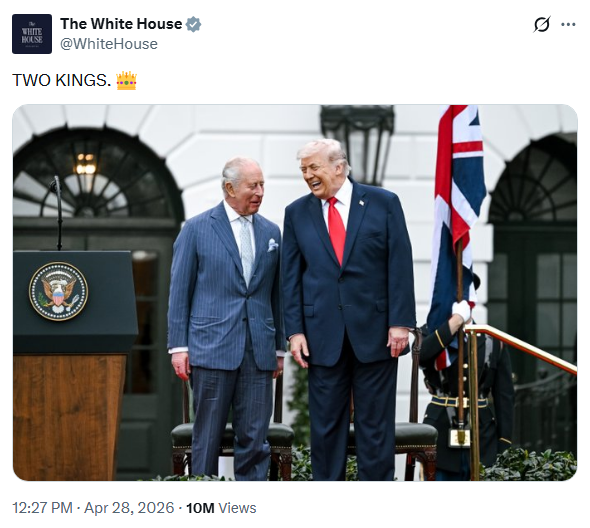
A royal visit is always a little surreal in Washington. It invites a republic to admire the optics it claims to reject.
That tension shows up whenever American politics brushes against crowns, carriage-processions, and the theater of inherited authority. The question is not whether the United States should be courteous to allies. The question is what happens when a republic starts treating its anti-monarchical instincts as corny, outdated, or merely performative.
The underlying tension transcends any single diplomatic visit, photo, or viral post. It reveals a recurring reflex in American public life: to scoff at the phrase “no kings” while leaning harder into king-like aesthetics for the presidency.
Join the Discussion
Why “No Kings” Matters
“No kings” is not a slogan America borrowed. It is one of the country’s founding arguments compressed into two words: legitimate power is temporary, accountable, and never owned by a family line. The Constitution was drafted in the shadow of a war fought against monarchy, and it was written by people who feared executive power when it becomes personal, ceremonial, and insulated from ordinary voters.
The hard part is that the Constitution does not merely criticize monarchy. It tries to engineer against monarchy by structure.
- Article I puts lawmaking in a legislature with many members, competing interests, and built-in friction.
- Article II creates a single president, but limits that president through elections, impeachment, and separation of powers. Presidential term limits arrive later as a constitutional amendment, the 22nd Amendment (ratified in 1951), after the country learned what long tenure can do to the office.
- Article III insulates federal judges through life tenure and salary protection, helping ensure disputes over power can be adjudicated outside immediate electoral pressure. It is not a perfect firewall, and Congress shapes the judiciary in meaningful ways, but it does make it harder for any president to be the final judge of the scope of presidential authority.
So when “no kings” gets treated as a joke, it is not irrational for people to hear an echo of an older American fear: that symbolism eventually becomes self-justification.
Mockery as a Signal
In politics, public mockery is rarely neutral. It is boundary testing. When public officials, campaign surrogates, or political influencers dismiss “no kings” language, they frame republican anxiety as childish. That framing does two things at once.
1) It recasts limits as insecurity
In a healthy republic, worrying about executive overreach is not paranoia. It is maintenance. But when leaders and their megaphones treat restraint talk as laughable, they nudge the public toward a dangerous assumption: that demanding limits is weakness rather than civic competence.
2) It normalizes court-like style
By “monarchy-coded,” I mean politics that borrows the emotional grammar of a court: reverence, spectacle, personal loyalty, the suggestion of destiny, the idea that the leader is not merely a temporary officeholder but the country’s central character.
The American presidency already carries heavy symbolic freight: motorcades, military ceremony, grand backdrops, sweeping claims of mandate, and a culture that treats the president as the nation’s single protagonist. Any one gesture can seem trivial. The problem is accumulation. The drift is subtle: a little more reverence, a little more stagecraft, a little more impatience with friction.
Plain on Purpose
Regal symbolism tempts republics because it offers emotional clarity. One figure. One household. One story drenched in ceremony. That is easy to understand and easy to rally around.
But republican government is intentionally less satisfying in that way. It is supposed to feel procedural, slow, and sometimes frustrating because those inefficiencies are how liberty is protected. The boring parts are not bugs. They are the guardrails.
In a monarchy, the head of state is designed to represent permanence. In a republic, leaders are designed to represent replaceability. The office matters more than the person, and the person is supposed to be temporary.
That is why dismissing “no kings” as a punchline lands so strangely. It treats the anti-monarchical instinct as quaint, even though that instinct is the moral logic behind checks and balances.
Text and Performance
The Constitution does not spend its time naming the thing it rejects. It does something more practical: it splits power and makes it contestable.
And yet the modern presidency is a constant tug-of-war between two versions of American leadership:
- The constitutional version: the president is one branch among three, limited by law, subject to oversight, and dependent on Congress for the architecture of governance.
- The symbolic version: the president is the national solver-in-chief, the face of the country, the single voice that answers for America.
This tension is intensified by a structural fact Americans often forget: the United States merges head of state and head of government into one person. In constitutional monarchies, those roles are split. In the U.S., ceremony and administration share the same body, the same voice, the same spotlight. That makes the office unusually vulnerable to court-like performance, because there is no separate figure to absorb the pageantry.
Royal pageantry, whenever it appears near Washington, heightens that contrast. It puts our own executive symbolism under bright lights. The risk is not that we will literally install a monarch. The risk is that we will keep rewarding a style of power that feels quasi-royal even while we insist we hate the idea.

The Real Question
The issue is not whether Americans must behave rudely toward an allied monarch. Diplomatic courtesy is not the problem. Some ceremony is not the same thing as unchecked power, and a pluralistic country will always reach for shared ritual when it wants unity.
Still, the question is whether Americans should tolerate anti-republican mockery from their own political class at a moment when the presidency already feels larger than the constitutional design many of us were taught.
Here are the questions that matter more than any one fleeting controversy:
- When “no kings” is mocked, is the target merely unserious activists, or is it the principle that leaders are not entitled to reverence?
- Does executive symbolism strengthen accountability, or does it numb the public to the idea that the president is simply an employee with a job description?
- If we keep rewarding court-like performance, why would we be surprised when presidents start acting as if constraints are optional?
The Constitution is a mirror. In it, you can usually see what a country expects from power. The uncomfortable possibility is that the joke lands because some Americans have started wanting a presidency that looks a little more like a crown, as long as it is worn by their side.