
DACA is one of those government programs that millions of people can describe from lived experience. The Constitution, meanwhile, does not lay out a detailed immigration code. Instead, immigration rules largely come from federal statutes, executive enforcement choices, and court decisions about where each branch’s authority begins and ends.
“DACA” stands for Deferred Action for Childhood Arrivals. It is a federal policy that allows certain undocumented immigrants who came to the United States as children to request a temporary assurance from the federal government: DHS will defer (pause) removal for a period of time, and it may grant permission to work legally.
From the start, DACA has been legally contested. Not because Dreamers are obscure, but because DACA was created through executive branch action rather than a statute passed by Congress. That choice helps explain why the program has been repeatedly challenged in court.
Join the Discussion
What DACA does and does not do
What DACA provides
- Deferred action, meaning DHS agrees to pause removal (deportation) for a set period.
- Work authorization through an Employment Authorization Document (EAD), allowing recipients to work lawfully in the U.S.
- Access to a Social Security number and, in many states, eligibility for a driver’s license or state ID.
- “Lawful presence” for certain purposes while DACA is in effect (a limited legal concept that does not equal lawful status), such as eligibility to receive an EAD and a Social Security number.
What DACA does not provide
- Not citizenship.
- Not a green card.
- Not a guaranteed path to permanent legal status. DACA can be narrowed, redesigned, or ended by later administrations and is heavily shaped by court rulings.
- Not an automatic benefit for family members. DACA is individual. It does not automatically legalize parents, siblings, or spouses.
- Not guaranteed forever, even for individuals. Deferred action can be terminated on a case-by-case basis, including for certain criminal issues or other disqualifying conduct.
- Not a uniform benefits package. DACA does not itself make someone eligible for federal financial aid, and access to state benefits varies by state law.
The simplest way to think about it is this: DACA is a temporary shield and a work permit, not membership.
Who created DACA and why
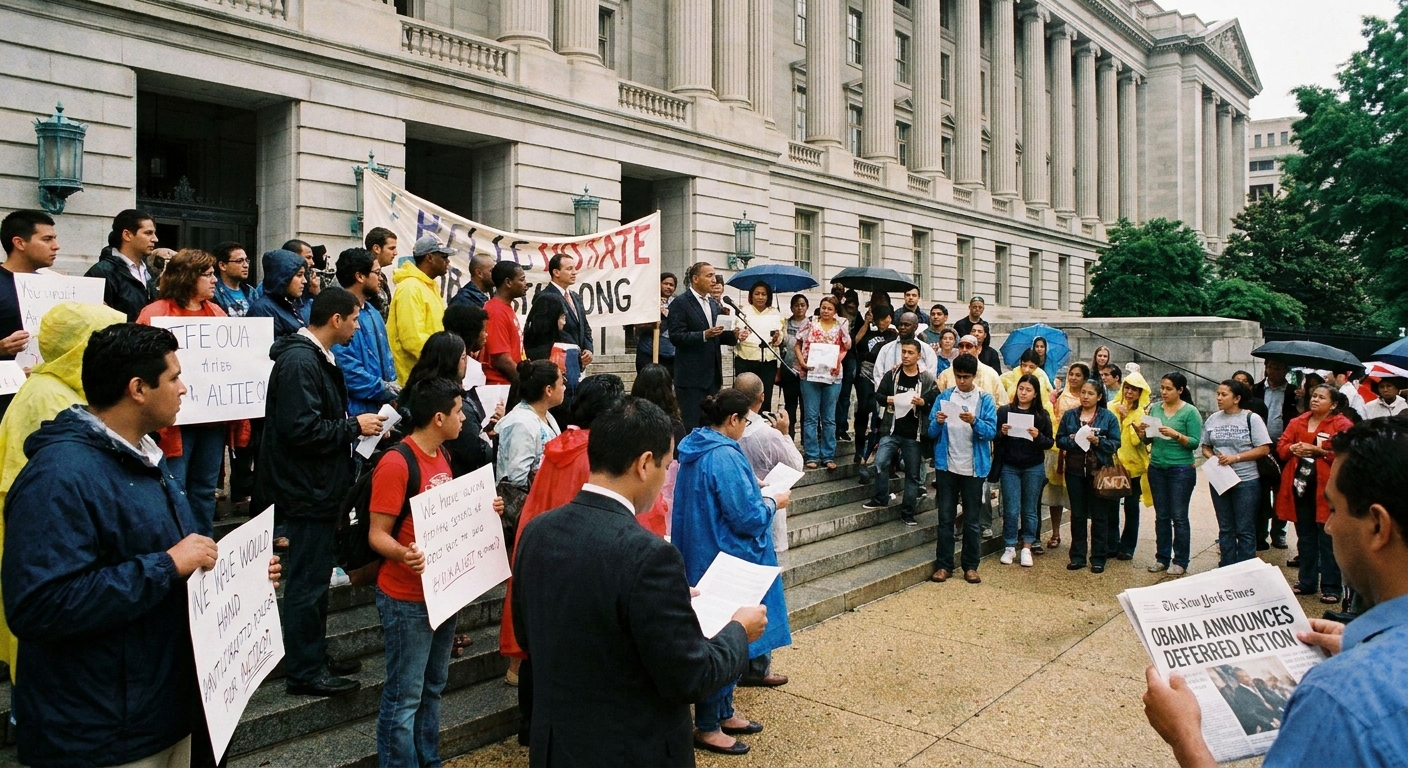
DACA was announced in June 2012 by the Obama administration through the Department of Homeland Security (DHS). The legal tool it relied on is often described as prosecutorial discretion, the executive branch’s longstanding practice of deciding how to prioritize enforcement when resources are limited.
Immigration law is full of “must” language on paper, but enforcement in the real world always involves choices. DACA formalized one of those choices for a specific group: people who were brought to the U.S. as children and who met certain education, background, and residency criteria.
In 2022, DHS also issued a final rule after notice-and-comment rulemaking to codify DACA in regulations. That step was meant to make the policy more durable under administrative law, but it did not end the core legal fight over whether DHS has the power to run a program like DACA without congressional authorization.
Who qualifies for DACA
Eligibility is defined by DHS rules and guidance. While details can shift through policy and litigation, the core idea has been consistent: DACA is aimed at undocumented immigrants who arrived as minors, lived here for years, and meet education and background requirements.
Historically, the core requirements have included:
- Arrival in the United States before turning 16.
- Continuous residence in the U.S. since June 15, 2007.
- Being physically present in the U.S. on June 15, 2012 and at the time of requesting DACA.
- Being under age 31 as of June 15, 2012.
- Education or service criteria, such as currently being in school, having graduated, having a GED, or having served in the U.S. military.
- Passing background checks and not having certain criminal convictions.
One practical note that is easy to overlook: DACA is not automatic. It requires an application, documentation, fees, biometrics, and renewals. DACA approvals are typically issued for two years at a time, so most recipients renew on a two-year cycle and must continue to meet the program’s requirements. In practice, that usually means refiling forms, paying the filing costs, completing biometrics if required, and clearing background checks again. (Because fees and procedures can change, applicants should confirm the current requirements directly on the USCIS DACA page.)

What deferred action means
Deferred action is not a new invention. It is an enforcement posture. In constitutional terms, it sits inside the executive branch’s duty to “take Care that the Laws be faithfully executed.” That duty does not mean every law is enforced against every person in identical ways at identical times. It means the executive enforces the law through priorities, guidance, and resource allocation.
But deferred action still has a hard limit. It does not rewrite the immigration statutes Congress enacted. It does not grant lawful immigration status in the way a visa or green card does.
This is where the vocabulary can get confusing. DACA can mean someone is treated as lawfully present for certain purposes while their grant is in effect, and it can affect how unlawful presence is counted in some contexts. But it still does not convert a person into a lawful permanent resident or create a new statutory immigration category.
Can DACA recipients travel
Sometimes, but only under strict rules and only when DHS and USCIS policy allows it. DACA recipients have historically been able to request advance parole, permission to travel for specific reasons such as education, work, or certain humanitarian purposes.
USCIS policy on DACA advance parole has changed over time, including through shifting guidance and litigation. Because this is one of the fastest-changing areas, it is smart to check current USCIS instructions before filing or making travel plans.
Advance parole is not a free pass. It requires approval in advance, and traveling without proper authorization can create severe immigration consequences. Applicants should verify current requirements and availability directly with USCIS or a reputable legal aid organization.
Why DACA keeps going to court
DACA’s legal fight is fundamentally about separation of powers and administrative law, not about whether Dreamers are sympathetic. Courts have been asked to answer questions like:
- Did DHS have the authority to create a program of this scale without Congress?
- Did the government follow the required rulemaking process under the Administrative Procedure Act (APA)?
- If DACA is unlawful, what happens to people already relying on it?
The Supreme Court’s most famous DACA decision is Department of Homeland Security v. Regents of the University of California (2020). The Court did not declare DACA itself constitutional or permanently valid. Instead, it held that the Trump administration’s attempt to end DACA was arbitrary and capricious under the APA because the administration did not adequately explain its reasoning or consider reliance interests.
That distinction is crucial. Regents said, in effect: you can try to end it, but you have to do it properly.
Since then, major litigation in lower courts has continued to question whether DACA can exist at all without congressional authorization and whether DHS’s later efforts to preserve DACA through formal rulemaking are enough.
Are new DACA applications accepted
As of [Publication Month/Year], readers need a cautious answer: DACA has been subject to shifting court orders that affect whether first-time requests are processed, whether renewals continue, and what DHS can do administratively. This section is time-sensitive by design, so it is worth checking the USCIS DACA page for the latest operational status before filing.
One key distinction: USCIS can sometimes be required to accept initial filings but be barred from approving them. In recent years, initial requests have at times been accepted and queued while approvals were blocked by court order, even as renewals continued.
Because litigation and injunctions can change the program’s operating rules quickly, the best practice is to verify the current status directly through USCIS and reputable legal aid organizations.
For constitutional context, the core point remains stable even when the details shift: DACA exists in a legal limbo because it is policy built on executive discretion, repeatedly tested in the courts, and not anchored in a statute enacted by Congress.
How DACA fits the Constitution
The Constitution does not mention “DACA,” and it does not map out immigration policy in modern detail. Instead, DACA sits at the intersection of three constitutional realities:
1) Congress writes immigration law
Congress has broad authority over immigration through its legislative powers, including naturalization and its role in federal lawmaking, along with doctrines tied to national sovereignty and foreign affairs. That authority is not spelled out in one single “immigration clause.” It is inferred from multiple constitutional sources and longstanding Supreme Court doctrine. When Congress creates or changes immigration status categories, those are durable because they are statutes.
2) The executive enforces immigration law
Presidents and agencies decide how to enforce federal law day to day. That discretion is real, and it is necessary. DACA is a formalized use of that discretion, which is why supporters see it as pragmatic and opponents see it as executive overreach.
In practice, DACA is administered by DHS, with USCIS processing requests, while immigration enforcement and removal decisions can also involve other DHS components like ICE and, when cases are filed, the immigration court system within the Department of Justice.
3) Courts police the boundary
Federal courts review whether agencies followed required procedures and stayed within statutory authority. Many DACA rulings turn on administrative law and process, not purely on constitutional text.
Why this is bigger than paperwork
DACA is about young adults with jobs, families, degrees, and mortgages. It is also about how government works when Congress cannot or will not legislate.
If Congress passes a statute creating permanent legal status for Dreamers, the uncertainty largely ends. If Congress does not, then DACA remains a temporary structure built from executive discretion and defended, limited, or dismantled through litigation.
In other words, DACA is not only a policy. It is a live demonstration of separation of powers under pressure.
Key terms
- DHS: Department of Homeland Security, the cabinet agency that administers DACA.
- USCIS: U.S. Citizenship and Immigration Services, the agency that processes DACA requests.
- ICE: U.S. Immigration and Customs Enforcement, a DHS agency involved in immigration enforcement and removals.
- Deferred action: A discretionary decision to pause removal for a period of time.
- EAD: Employment Authorization Document, the work permit DACA recipients receive if approved.
- APA: Administrative Procedure Act, the law governing how federal agencies make and change rules.
- Reliance interests: The idea that people build lives around existing government policies, which agencies and courts may need to consider when changing course.

One question to leave you with
When Congress stays silent, should presidents be able to create large-scale protections like DACA through enforcement discretion? Or does that quietly transfer lawmaking power from the legislative branch to the executive branch?
That argument is the engine behind almost every DACA lawsuit. And it is why DACA, even after more than a decade, still feels temporary.