
The Constitution gives Congress the power to declare war. The Constitution makes the president the Commander in Chief. Those two sentences look clean on parchment and collide messily in real life.
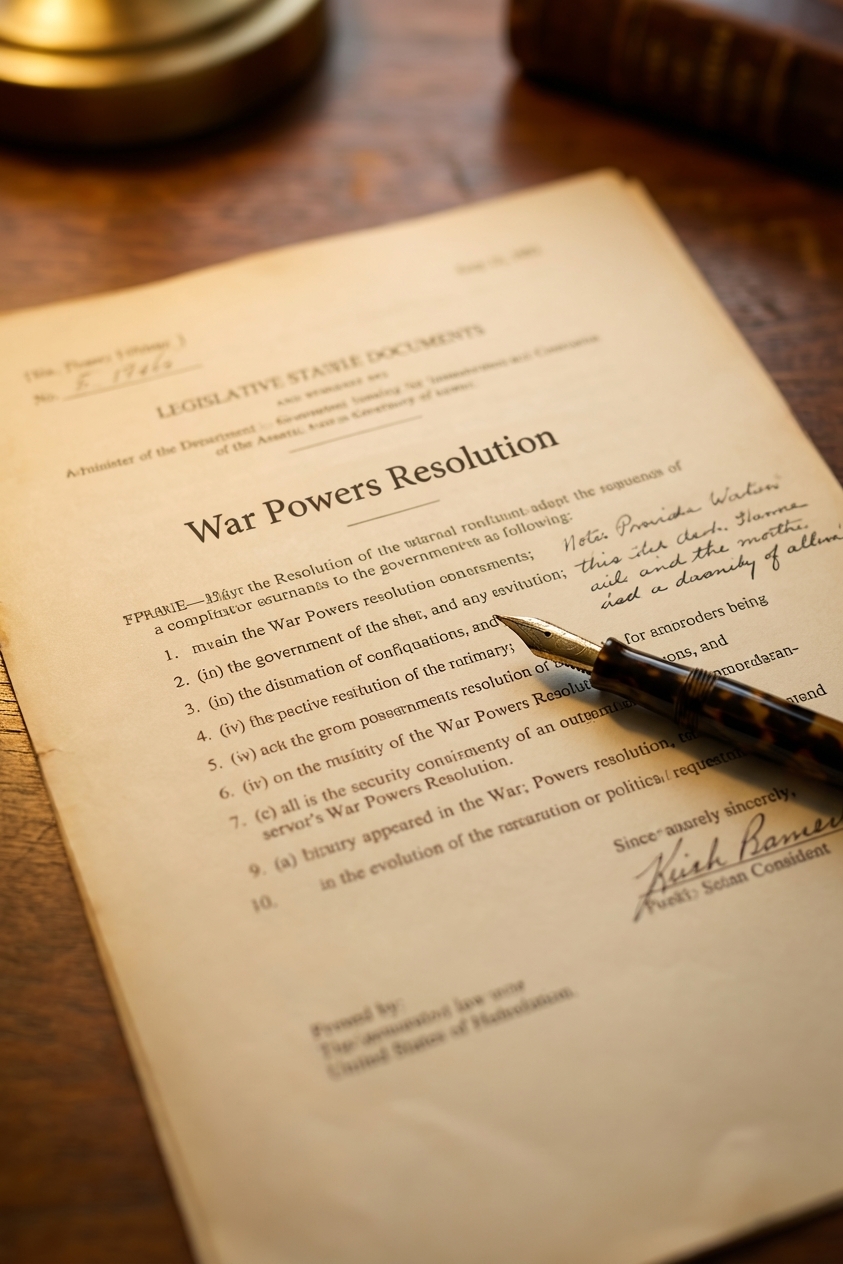
The War Powers Resolution of 1973 is Congress’s attempt to manage that collision. It does not eliminate presidential flexibility, and it does not guarantee congressional control. Instead, it creates deadlines, reporting requirements, and a framework that forces the political branches to argue on the record when American forces are introduced into situations that could become war.
Why Congress Passed It in 1973
The War Powers Resolution was born from a specific kind of constitutional frustration: presidents had been waging major conflicts without a formal declaration of war, while Congress funded the wars and then argued about whether it had truly consented.
By the early 1970s, Vietnam had become the cautionary tale. The United States fought a long, escalating war without a declaration of war, relying instead on measures like the Gulf of Tonkin Resolution and broad claims of Commander in Chief authority. Many members of Congress concluded that once troops and momentum were committed, Congress’s practical ability to say no was largely theoretical.
So Congress tried to write a rulebook for the moment between “the president can act quickly” and “Congress must decide whether we are actually at war.” President Richard Nixon vetoed the bill, arguing it unconstitutionally restricted the presidency. Congress overrode the veto, and the War Powers Resolution became law on November 7, 1973.
What the Law Requires
The War Powers Resolution is often summarized as “48 hours to notify, 60 days to get out.” That is the headline version, but the actual framework matters because presidents have spent decades working in the seams.
1) Consultation comes first
The statute begins with an idea that sounds simple and is, in practice, hard to enforce: the president should consult with Congress “in every possible instance” before introducing U.S. Armed Forces into hostilities or situations where hostilities are imminent, and should continue consulting while forces remain engaged.
Consultation is not precisely defined. Is it a phone call to leadership? A classified briefing? A vote? The law does not say, which makes this requirement politically powerful but legally slippery.
2) The 48-hour report
When U.S. forces are introduced into certain situations, the president must submit a report to Congress within 48 hours. The core triggers include:
Introducing U.S. forces into hostilities or into situations where imminent involvement in hostilities is clearly indicated by the circumstances.
Introducing forces into the territory, airspace, or waters of a foreign nation while equipped for combat, with limited exceptions.
Substantially enlarging U.S. forces already stationed in a foreign nation.
The report is supposed to explain the circumstances, the constitutional and legislative authority invoked, and the estimated scope and duration of the involvement.
In theory, this forces clarity. In practice, the phrasing of these reports has become a long-running constitutional chess match, with some administrations avoiding the word “hostilities” to avoid conceding that the strictest clock has started.
3) When the clock starts
A key precision point in the statute is that not every 48-hour report necessarily triggers the same withdrawal deadline. The 60-day withdrawal requirement in Section 5 is tied to the hostilities category, meaning situations reported under Section 4(a)(1), or situations where such a report is required because forces are in hostilities or imminent hostilities.
By contrast, the other reporting categories, like moving combat-equipped forces into a country or substantially enlarging a deployment, can require notice even when the United States is not yet in “hostilities” as administrations interpret that term. Those reports can matter politically, but they do not automatically equal the 60-day countdown as the statute is structured.
4) The 60-day rule and the 30-day withdrawal period
If the hostilities category applies and Congress has not provided authorization, U.S. forces are to be withdrawn within 60 days. The president can extend that deadline by an additional 30 days if unavoidable military necessity requires more time for safe withdrawal.
That creates a rough maximum of 90 days under the law’s framework, absent congressional authorization, assuming the clock is deemed to have started.
5) How Congress can authorize or end an action
The statute contemplates that Congress can authorize the operation through:
A declaration of war.
A specific statutory authorization.
It also tries to shut down a common escape hatch. The law states that authority to introduce forces into hostilities should not be inferred from any statute, including appropriations, unless the statute specifically authorizes that introduction.
Congress can also try to end an operation by passing legislation. Earlier versions of the War Powers framework included a “legislative veto” concept, but after the Supreme Court’s decision in INS v. Chadha (1983), Congress cannot use a one-house legislative veto to force withdrawal. In modern practice, ending a deployment generally requires a law passed by both houses and either signed by the president or enacted over a veto. A funding cutoff can also do it, but that is its own political cliff.

The Constitutional Tension
The War Powers Resolution sits on the fault line between Article I and Article II, and it exists because the Constitution does not draw the line for us.
Article I: Congress’s war powers
Article I, Section 8 gives Congress powers that look designed to prevent unilateral war making. Congress may declare war, raise and support armies, provide and maintain a navy, make rules for the armed forces, and control funding for the military.
That toolkit suggests Congress is supposed to decide when the nation moves from peace into war, and to maintain ongoing leverage through appropriations and regulation.
Article II: The president as Commander in Chief
Article II, Section 2 makes the president the Commander in Chief of the armed forces. Presidents have long argued that this role includes the power to respond quickly to attacks, protect U.S. persons and interests, and conduct limited military operations without waiting for Congress.
But the Constitution does not define “Commander in Chief” as a blank check, either. It describes a command role, not an explicit power to initiate war.
The unresolved question
So who is right? The honest answer is that the system was built to force negotiation and friction, not to supply a single clean rule. The War Powers Resolution is Congress attempting to harden its side of that friction into deadlines and procedures.
Presidents often respond with a different constitutional theory: that the statute cannot restrict the president’s Article II authority, or that the particular operation does not trigger the hostilities category because it does not amount to “hostilities.”
Presidents and Pushback
If you are looking for a single moment when the War Powers Resolution “worked” and everyone agreed, you will not find it. Most modern administrations have questioned it in some form, either explicitly or through careful compliance that avoids conceding its constitutionality.
Richard Nixon
Nixon vetoed the Resolution, calling it an unconstitutional intrusion on the Commander in Chief. Congress overrode him, and his veto message became the first major presidential statement of opposition.
Ronald Reagan
Reagan’s administration often treated the statute as a reporting framework while disputing that it could bind the president. Debates during the 1980s over deployments and engagements reinforced a pattern that still holds: presidents may file reports “consistent with” the Resolution without admitting that the Resolution compels them.
George H. W. Bush
The 1991 Gulf War highlighted a different dynamic. President Bush sought and received congressional authorization for the use of force against Iraq, which reduced the War Powers conflict. But the episode also underscored the political reality behind the law: when presidents want broad legitimacy, they often ask for Congress, even if they claim they do not legally need it.
Bill Clinton
Kosovo (1999) became one of the most cited War Powers controversies. The U.S. participated in NATO air operations, and Congress did not pass a clear authorization for the campaign. Litigation followed. In Campbell v. Clinton, for example, courts avoided reaching the core merits, leaning on doctrines like standing and justiciability. The result was familiar: lots of constitutional argument, little judicial resolution.
Barack Obama
Libya (2011) revived the hostilities debate in plain English. The administration argued that U.S. involvement, though militarily significant, did not rise to the level of “hostilities” under the Resolution because of the nature and risk profile of the operation, and therefore the 60-day clock did not apply. Critics argued this interpretation made the law optional whenever a president could describe a campaign as limited.
Donald Trump
Trump-era disputes included U.S. support for the Saudi-led war in Yemen and the 2020 strike that killed Iranian General Qasem Soleimani. Congress passed War Powers-related measures aimed at limiting involvement or requiring withdrawal, and presidential vetoes and political pushback again illustrated the core problem: the statute is easiest to enforce when Congress can assemble veto-proof majorities or control funding.
Joe Biden
Biden’s presidency has seen ongoing War Powers debates tied to U.S. strikes and deployments in the Middle East and the continued reliance on older Authorizations for Use of Military Force (AUMFs), especially the 2001 and 2002 AUMFs. Even when a president reports actions to Congress, the deeper question persists: is the legal basis truly Article II, an AUMF, or both, and how long can that basis stretch before Congress must reauthorize in plain words?
Does It Limit the President?
The War Powers Resolution has real effects, but not always the ones its authors imagined.
It forces reporting. Even when presidents hedge their language, the requirement pushes the executive branch to explain itself, in writing, to Congress and the public.
It forces categorization fights. A lot turns on whether an operation counts as “hostilities.” That argument is not a technicality. It is the hinge between a disclosure regime and a withdrawal deadline.
It is hard to enforce without Congress acting. If Congress is divided or unwilling to take politically costly votes, the Resolution cannot supply courage on its own.
Courts rarely resolve it. Lawsuits about war powers often fail on standing, ripeness, or political question grounds. That leaves the conflict where the Framers put many of the hardest conflicts: in the hands of the elected branches.
In other words, the Resolution is less like a constitutional handcuff and more like a constitutional alarm. It can ring loudly, but someone still has to get out of bed.
One Sentence Summary
Congress passed the War Powers Resolution to reclaim a say in modern war making by requiring consultation and fast reporting when U.S. forces are introduced into danger, and by setting a 60-day withdrawal deadline when U.S. forces are in hostilities absent authorization, all against the unresolved tug of war between Article I’s war powers and Article II’s Commander in Chief power.
If you take nothing else from the law, take this: the Constitution does not settle every separation-of-powers fight. Sometimes it designs the fight, and then dares Congress and the president to live inside it responsibly.