There is a special kind of political argument that only happens during a shutdown. It is partly about funding, but it is also about blame. And if you listen closely, it is also about the Constitution’s basic design: Congress holds the purse strings, the executive branch runs the agencies, and the public is left to sort out who is actually steering the ship.
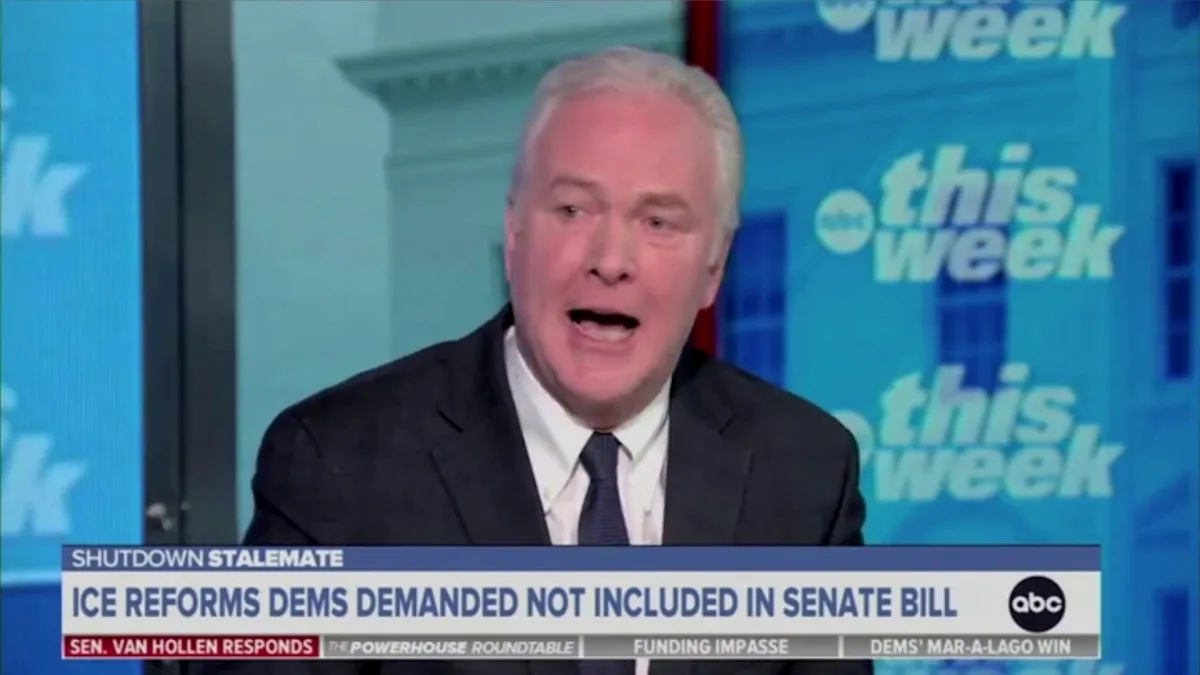
That tension boiled over this weekend when Sen. Chris Van Hollen of Maryland ran into a blunt question from a television host: after weeks of leverage and headlines, what exactly did Democrats get from the fight over funding the Department of Homeland Security?
Join the Discussion
Shutdown as leverage
By the time Van Hollen sat down for the interview, the partial shutdown had stretched to 44 days, with DHS at the center of the standoff. That timeline matters because a shutdown is not a policy seminar. In practice, it functions as leverage, a way for lawmakers to try to force movement by conditioning what gets funded and what does not.
The host’s question was the kind that makes politicians squirm because it treats the shutdown like an experiment that needs measurable results. Van Hollen had issued a statement that Republicans had “finally relented.” The follow-up, in essence, was simple: relented to what?
“What did Democrats get out of this?” the host asked. “What have you gotten for it?”
Van Hollen’s case
Van Hollen’s answer tried to draw a bright line between DHS’s core services and the agency within DHS that Democrats say needs structural correction: Immigration and Customs Enforcement.
He argued Democrats were pushing to fully fund components the public actually feels immediately, including:
- TSA, where staffing shortfalls translate into longer airport lines.
- FEMA, which becomes a political crisis the moment a disaster strikes.
- The Coast Guard, which does not stop being essential because Congress is arguing.
Then he pivoted to ICE, calling it a “lawless operation,” and said Democrats were not willing to add another $10 billion on top of what ICE already has.
“We have said repeatedly, repeatedly, repeatedly, we should fund TSA, we should fund FEMA, we should fund the Coast Guard. We are not prepared to give ICE another $10 billion on top of the money they already have and are using in many of these lawless operations,” Van Hollen said.
The pushback
The host’s pushback went straight to the mechanics of appropriations. If your fight is with ICE, but ICE keeps operating with existing money, are you actually squeezing the institution you want to change, or are you squeezing everyone else?
He noted that ICE funding was not the only money stream involved, pointing to a larger pot already enacted: $75 billion that had passed in a prior budget bill. That detail became the fulcrum of the argument. The strategy, as the host framed it, looked like a mismatch between stated goal and practical effect: ICE continues to have the money, while the rest of DHS sits in the crossfire.
Van Hollen objected strongly, accusing the host of making a “false statement” when he said Democrats were holding up DHS funding. But the host kept narrowing the point to a single sentence of political math: if funding is blocked unless the bill drops money for ICE, then in real-world terms, DHS remains unfunded because of that condition.
“You’re holding up unless it doesn’t include money for ICE. That’s just a fact,” the host told him.

A constitutional lens
This is where the civics lesson lives, beneath the television sparring.
Congress’s leverage is real because Article I gives it control over appropriations. But that leverage is blunt. Members can try to target one program and end up stalling a whole department. Meanwhile, the executive branch still has administrative flexibility, including the ability to sustain certain operations through previously appropriated funds or other funding streams.
So the question the host asked is not only partisan. It also brushes up against a constitutional problem: what does “winning” look like when the tool you are using cannot precisely hit the target?
If Democrats want reforms to ICE, the public will judge the strategy on whether the outcome changes ICE’s behavior or structure, not only on whether essential DHS functions stay in limbo. And if Republicans want to argue Democrats are reckless with essential services, they will point to disruptions people actually feel, like longer airport lines, and say: look who pulled the pin.
What comes next
The immediate legislative landscape is messy. The House passed a stopgap that would temporarily fund DHS for two months. But it is widely seen as unlikely to clear the Senate, where any funding bill needs to overcome a 60-vote threshold, meaning buy-in from a handful of Democrats.
House Speaker Mike Johnson explained his caucus’s posture in plain terms: “We’re not going to split apart two of the most important agencies in the government and leave them hanging like that. We just couldn’t do it.”
Now comes the harder question, and it is the one the host was really asking. Not who talked tougher, or who “relented,” but what changed on the ground. If ICE reform is the demand, the scorecard has to show more than a shutdown clock and a press release. Otherwise, the shutdown becomes what it so often becomes: a civics lesson in how separation of powers can look like separation from consequences.