
You can tell a lot about a Constitution by the arguments people make when it feels like a problem needs solving fast. In the early 1990s, gun violence near schools was not an abstract policy debate. Congress responded with a broad federal ban on gun possession in designated school zones, subject to statutory exceptions.
Then United States v. Lopez (1995) arrived and asked a question the country had not heard from the Supreme Court in a long time: even if a law is popular, and even if the goal is urgent, does the Constitution actually give Congress the power to do it?
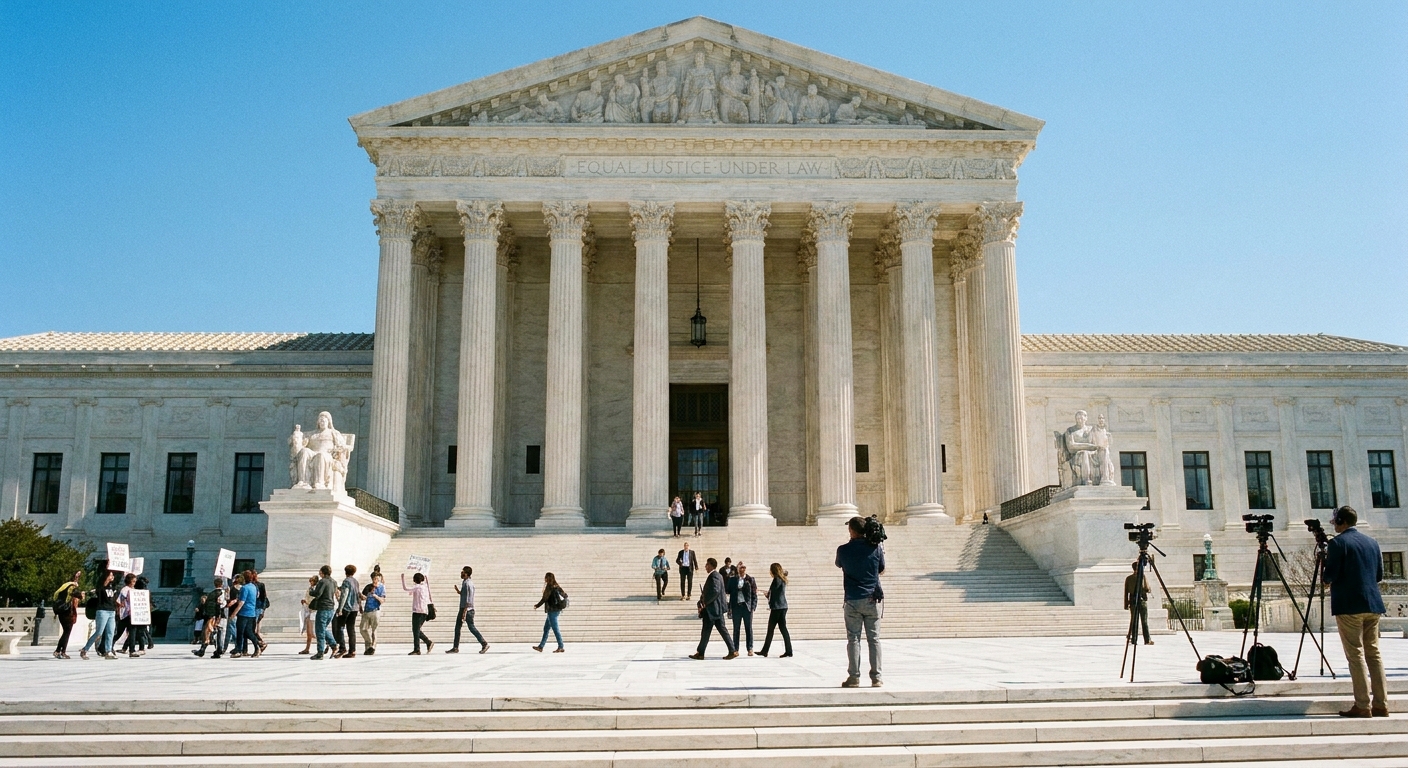
That question turns on a single phrase in Article I: the power to regulate “Commerce… among the several States.” This is the Commerce Clause, the workhorse of modern federal law. In Lopez, the Court put that workhorse back in its stall, at least a little.
Join the Discussion
The facts
In March 1992, a high school senior named Alfonso Lopez Jr. brought a concealed handgun and bullets to Edison High School in San Antonio, Texas. He was initially charged under Texas law. In many accounts, the state charges were dropped shortly after federal authorities pursued the case instead.
Federal prosecutors charged him under a new statute: the Gun-Free School Zones Act of 1990.
The federal law made it a crime “for any individual knowingly to possess a firearm” in a school zone. It did not require proof that the gun moved across state lines. It did not require proof that the possession was connected to a business, sale, or other economic transaction. It was a straightforward possession ban tied to a location, with specified exceptions written into the statute.
Lopez challenged the federal charge on constitutional grounds. His argument was not that guns were harmless, or that school safety was unimportant. It was that Congress used the wrong constitutional tool. The Commerce Clause, he said, was not a general police power that lets Congress regulate anything it thinks affects society.
The holding
In a 5 to 4 decision, the Supreme Court struck down the Gun-Free School Zones Act as beyond Congress’s Commerce Clause authority. Chief Justice William Rehnquist wrote the majority opinion.
The key point was structural: the Constitution gives Congress enumerated powers, and leaves a general police power to the states. If Congress can regulate simple gun possession near schools merely by saying it might affect the national economy in the aggregate, then the limit on federal power becomes hard to locate and even harder to enforce.
The Court acknowledged that education and crime can have economic consequences. But it refused to accept a chain of reasoning that went like this: guns near schools lead to crime, crime affects education, education affects economic productivity, productivity affects interstate commerce. If that logic is enough, almost anything becomes “commerce.”
One important clarification: Lopez was not a Second Amendment decision. It was about Congress’s power under the Commerce Clause, not whether gun possession is constitutionally protected.

The three categories
Lopez is famous not only for striking down a law, but for organizing Commerce Clause doctrine into a simple framework. The Court said Congress may regulate three broad categories of activity:
-
Channels of interstate commerce
These are the pathways commerce uses: highways, railroads, navigable waters, air routes, and similar conduits. Congress can keep the channels open and safe. Think of rules governing shipping lanes or prohibiting certain goods from being transported across state lines.
-
Instrumentalities of interstate commerce, and persons or things in interstate commerce
This covers the vehicles and items involved in commerce itself, even if the specific threat is local. Planes, trucks, trains, and goods moving across state lines fit here. Congress can protect them from harm or misuse.
-
Activities that substantially affect interstate commerce
This third category is the big one. It is where most modern Commerce Clause fights live, because it asks how close the relationship must be between the regulated activity and interstate commerce.
The Gun-Free School Zones Act did not regulate the channels of commerce. It did not protect an instrumentality of commerce. So the government’s case depended on category three: possession of a gun near a school, the government argued, substantially affects interstate commerce in the aggregate.
What “non-economic” meant
One reason Lopez matters is that it made “economic versus non-economic” activity do real work in the analysis.
The statute regulated simple possession of a firearm in a specific place. The Court treated that as non-economic activity, meaning it was not itself a commercial transaction or a market activity like production, distribution, or exchange.
That label was not a rhetorical flourish. It was a constitutional boundary line. When the activity is non-economic, the Court was less willing to accept a long chain of inferences connecting it to interstate commerce. The majority worried that allowing Congress to regulate non-economic, local conduct based on cumulative economic effects would effectively convert the Commerce Clause into a general power to regulate anything.
Two additional details amplified the Court’s skepticism:
No jurisdictional hook. The law did not require the government to prove a case-specific connection to interstate commerce, such as that the firearm had traveled in interstate commerce.
Thin findings in the statute. The Act itself did not include explicit congressional findings explaining the commerce connection. Findings are not strictly required, and Congress did discuss the issue in other materials, but the statute did not do much to show the link the government was relying on.
Put simply: Congress asked the Court to accept “guns near schools affect the national economy” as enough. The Court refused to make that a constitutional rule.
Why it mattered
Lopez did not create federalism. Federalism is the Constitution’s original architecture: some powers are national, many are reserved to the states. What Lopez did was make that architecture judicially enforceable again in the Commerce Clause context.
For decades before 1995, the Court had broadly upheld federal regulation under the substantial effects idea, especially in New Deal era cases like Wickard v. Filburn. Lopez signaled that there are limits, and that the Court is willing to draw them.
The ripple effects show up quickly in later cases, especially those dealing with the outer edge of the Commerce power:
-
United States v. Morrison (2000)
The Court struck down part of the Violence Against Women Act that created a federal civil remedy for gender-motivated violence. The reasoning echoed Lopez: violent crime is serious, but regulating it as such is traditionally state business, and the regulated conduct was non-economic.
-
Gonzales v. Raich (2005)
The Court upheld federal regulation of homegrown medical marijuana permitted by state law. Here the activity was treated as part of an economic market in a broader regulatory scheme. Raich did not overrule Lopez, but it showed that Lopez is not a simple anti-federal trump card. Context matters, especially whether Congress is regulating an economic market comprehensively.
-
NFIB v. Sebelius (2012)
In the Affordable Care Act case, the Court rejected the idea that the Commerce Clause allows Congress to compel people to enter commerce by buying insurance. The ACA ultimately survived largely under Congress’s taxing power, even though the Commerce Clause theory failed.
In other words, Lopez became a citation point for a renewed constitutional instinct: Congress must point to a real constitutional power, and courts will sometimes say “not this one.”
Aftermath
Congress did not abandon the policy goal. In 1996, it amended the Gun-Free School Zones Act to add a jurisdictional element tying the firearm to interstate commerce, the kind of case-by-case link the original statute lacked. That change helped the law fit more comfortably within Commerce Clause doctrine in later prosecutions.
The dissent
The closeness of the 5 to 4 split matters. In dissent, Justice Breyer argued that Congress could reasonably conclude that guns in school zones substantially affect interstate commerce, especially when considering aggregate effects like costs of crime and harms to education. The majority’s response was that accepting that reasoning would leave no stopping point, collapsing the distinction between national powers and general police power.
What it did and did not do
What Lopez did: It invalidated a federal gun possession law because the regulated conduct was local and non-economic, the statute lacked a clear jurisdictional link to interstate commerce, and the government’s theory depended on an open-ended chain of economic effects. It also crystallized the three-category Commerce Clause framework that still anchors modern doctrine.
What Lopez did not do: It did not rewrite the Commerce Clause into a narrow, 18th-century shipping provision. It did not end the substantial effects test. And it did not prevent Congress from regulating guns in other ways that are tied to commerce, such as regulating firearm sales across state lines or laws that include a concrete interstate commerce element. Lopez is best understood as a boundary marker, not a demolition crew: the Commerce Clause remains broad, but not limitless.