
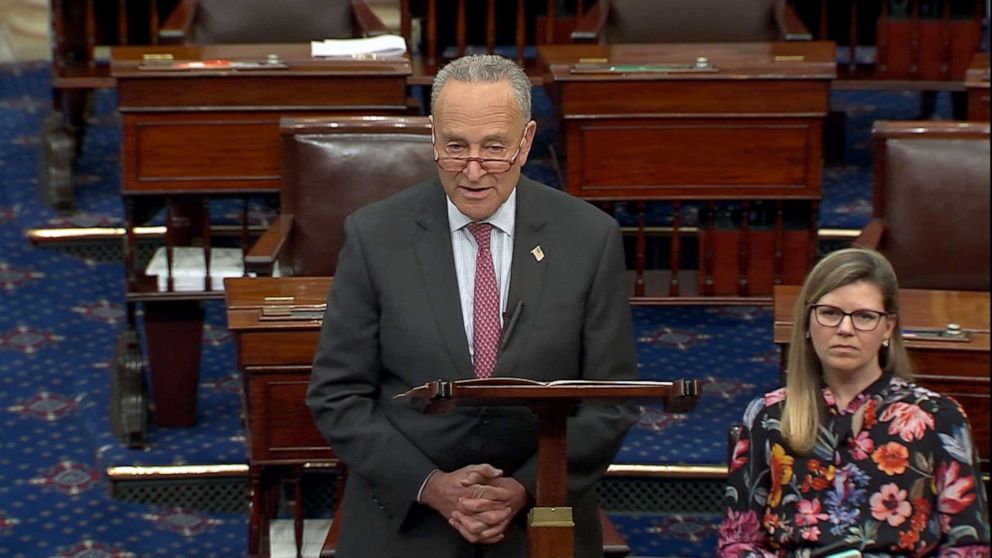
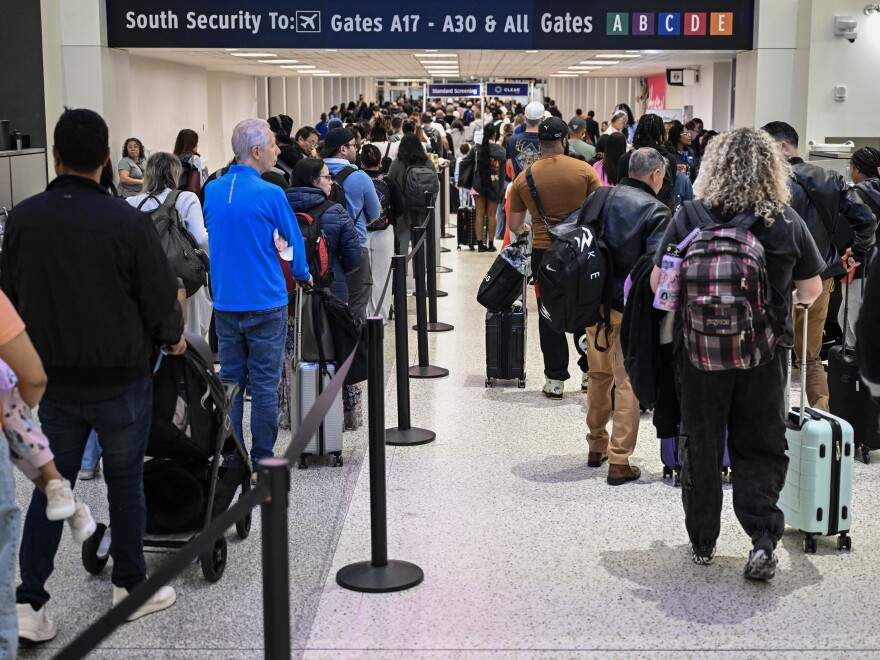
Washington has a knack for turning a funding lapse into a made-for-TV moment: airport security lines get longer, leaders trade blame on the Senate floor, and a quick verbal stumble becomes the headline. This week, Senate Minority Leader Chuck Schumer argued Republicans bear responsibility for the Department of Homeland Security funding shutdown that has travelers stuck in longer TSA lines. In the middle of that pitch, he misspoke and then immediately fixed it.
President Donald Trump jumped on the moment. On Truth Social, he wrote: "Schumer got 'discombobulated' in the Senate yesterday, and said, 'WE MUST FUND ICE,' prior to correcting himself,"
then added, "Thank you Chuck, I agree!"
Join the Discussion
The slip
The moment was brief. On the Senate floor, Schumer blurted out: "We must fund ICE"
before quickly pivoting to what he meant: "We must fund TSA now."
With the shutdown already translating into long checkpoint lines, the mix-up landed because it swapped the day’s most visible travel headache for the day’s most politically charged acronym.
The context mattered, too. Schumer and Senate Democrats are filibustering the SAVE America Act, which Republicans promote as an election integrity bill. Even as that fight plays out, Schumer has tried to keep the spotlight on what passengers can see and feel: swelling TSA waits at airports across the country, and his argument that Republicans are to blame for the shutdown behind them.
How it began
The current impasse traces to a February agreement that funded most of the federal government but left DHS on a separate track. Democrats in Congress agreed to that broader funding deal in exchange for withholding funds from DHS following an incident in Minnesota involving the fatal shootings of two anti-ICE agitators by immigration authorities. With DHS funding lapsed, the effects are increasingly spilling into day-to-day travel.
What gets hit
The shutdown is not felt evenly across DHS. TSA has become the public flash point because slowdowns at airport screening are immediate. ICE, by contrast, is not experiencing the same real-time operational squeeze, since it received full funding in last summer’s One Big Beautiful Bill Act.
That uneven impact has shaped the arguments. Democrats have tried to foreground the disruption passengers notice first. Republicans say the answer is reopening the entire department, not carving out one component at a time.
Votes and blocks
In the Senate, the 60-vote threshold is the gatekeeper. Earlier in March, a Republican proposal to fund the entire Department of Homeland Security failed to reach that supermajority. Separately, Sen. Bernie Moreno, R-Ohio, objected to an earlier Democratic effort to fund TSA on its own. Moreno later proposed a two-week DHS funding extension, but Democrats blocked that as well.
That same TSA-only strategy also became a key talking point in the current flare-up. Schumer’s call to "fund TSA now"
was tied to Democrats’ push to isolate a funding package solely for TSA, an effort Republicans blocked while arguing the rest of DHS that remains unfunded is essential to national security, and pointing to strikes on Iran as part of the broader backdrop for why the department should not remain shuttered.
The result is a familiar Washington scene: lawmakers argue over leverage while travelers stand in line.
Security stakes
Republicans argue the story is bigger than airport frustration. They say DHS responsibilities extend well beyond TSA, including cyber operations, and they warn that leaving large parts of the department unfunded carries national security risks. In their telling, those risks look sharper amid concerns involving Iran.
Talks and timing
DHS funding lapsed on Feb. 13, and the crunch is colliding with spring break travel. Over the last week, absences among TSA officers have already thrown operations off at some major airports, prompting airlines to sound the alarm as terminals fill up during the seasonal rush.
Airlines are expecting a record-breaking spring travel stretch. The expectation is 171 million passengers will fly, which is 4% higher than the same two-month period last year. When volumes run that high, even modest staffing gaps can ripple into significant delays.
Negotiations continued Sunday among Republicans working on a path forward. Two of the lawmakers involved include Senate Appropriations Chair Susan Collins of Maine and Homeland Security Subcommittee Chair Katie Britt of Alabama.
Senate Majority Leader John Thune, R-S.D., told reporters, "There are lots of ideas swirling right now, some of which you know my colleagues are talking about, but obviously what my sense is at least the good news, and all that is people realizing this has to get fixed,"
adding, "It has to get solved, but the best way again, to solve it is to get Democrats to support funding the entire Department of Homeland Security, you know, not picking and choosing certain aspects of it."
What it shows
Trump’s jab worked because it put a spotlight on a simple contrast. TSA is where the shutdown is most tangible when lines balloon. ICE is where the politics are hottest, and it is also the agency Trump noted is not facing immediate operational disruption because of how it was funded last summer.
At minimum, the episode underscores how quickly a funding fight turns into a framing fight. A near-gaffe can become a proxy battle over which part of government each side wants voters to focus on, even as passengers absorb the inconvenience while negotiations drag on.