
In the annals of U.S. governance, few topics elicit as much debate as the balance of power between the executive branch and Congress. The recent actions of former President Donald Trump, particularly following a significant Supreme Court ruling, serve as a contemporary illustration of this enduring tension.
On February 27, 2026, just days before the Supreme Court issued a pivotal decision against Trump’s tariff program, his campaign sent out an email to supporters, suggesting the possibility of $2,000 rebate checks for Americans.
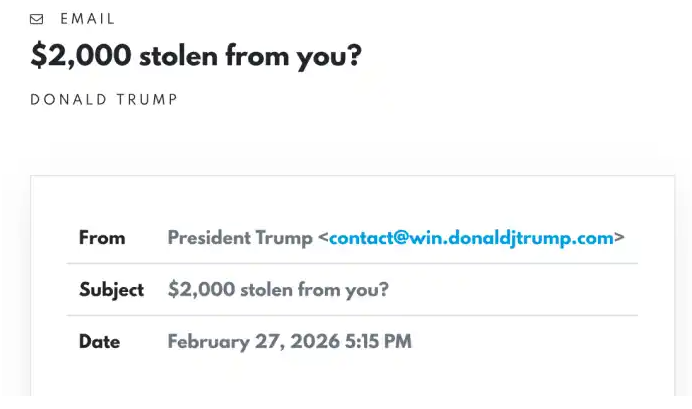
This email, laden with political undertones, claimed a direct connection between tariff revenues and financial relief for the populace.
The Supreme Court’s ruling, delivered with a 6-3 majority, underscored a critical judicial perspective on executive authority. The justices determined that Trump had overstepped his constitutional boundaries by invoking the International Emergency Economic Powers Act (IEEPA) to impose tariffs.
The IEEPA, originally designed to empower the president during true national emergencies, does not provide a legal foundation for broad tariff implementation. As a result, Trump’s strategy to fund rebate checks through tariff revenue now finds itself in jeopardy.
The Tariff Program and Its Legal Basis
Trump’s tariff program, initiated during his presidency, aimed to reshape trade relations, particularly with China. The president’s rationale centered on protecting American industries and addressing perceived economic injustices. However, the legal framework he employed has come under scrutiny.
The Supreme Court’s decision highlighted the distinction between national security measures and economic policy, clarifying that the IEEPA does not grant the president the unilateral power to levy tariffs as a tool for economic strategy.
This ruling not only has implications for Trump’s proposed rebate checks but also raises questions about the extent of executive power in trade matters. In the absence of congressional approval for these tariffs, the administration’s approach sidestepped the traditional legislative process, thereby igniting constitutional concerns regarding the proper scope of executive authority.
The Messaging and Political Strategy
In the wake of the Supreme Court decision, the email sent by Trump’s campaign was not merely an announcement but a strategic maneuver aimed at galvanizing support.
The subject line, “$2,000 stolen from you?” reflects an effort to resonate with constituents who are experiencing economic hardship.
Polls indicate considerable public backing for financial relief initiatives, particularly in the context of rising prices and a turbulent job market.
Trump’s message positions him as a champion of the American people, promising to deliver financial assistance while simultaneously framing Democrats as obstructive forces. His assertion, “I’m the only one who can do it,” seeks to consolidate his political base by suggesting that only he can navigate the complexities of economic policy.
This rhetoric aligns with a broader populist strategy aimed at emphasizing a stark divide between his supporters and opposing political factions.
Implications of the Supreme Court Ruling
The Supreme Court’s decision not only impacts Trump’s immediate plans for rebate checks but also sets a precedent regarding executive power in economic matters. The ruling, which saw all liberal justices voting against the tariff program alongside three conservative justices, indicates a rare convergence on a significant constitutional issue. This bi-partisan judicial consensus reflects a growing concern over the unchecked expansion of executive authority.
In his post-ruling comments, Trump expressed discontent with the Court’s decision, lamenting that it could lead to financial windfalls for foreign entities at the expense of American interests.
Such commentary underscores the political ramifications of judicial rulings, especially as they relate to national economic policies. Trump’s framing of the issue as a betrayal of American workers serves to rally his base while simultaneously expressing grievances against the judiciary.
Future Prospects and Economic Considerations
The prospect of issuing rebate checks, once tied to tariff revenues, now appears uncertain. Analysts, including those from the Committee for a Responsible Federal Budget, have estimated that distributing such payments could cost around $600 billion—far exceeding the anticipated revenue from the tariffs, which was projected at $300 billion annually.
This financial strain raises critical questions about fiscal responsibility and the potential for increased inflation in an already precarious economic environment.
As Trump continues to advocate for these rebate checks, the intersection of executive ambitions and constitutional limitations remains a focal point of discussion. The political landscape is shifting, with economic pressures compelling leaders to navigate a complex terrain of public expectations and legal boundaries.
Conclusion: Navigating Constitutional Waters
The unfolding situation exemplifies the dynamic interplay between executive action, judicial review, and public sentiment. As former President Trump moves forward with his proposals in the wake of the Supreme Court’s ruling, the legal frameworks governing executive power will be tested.
The implications of this case extend beyond immediate financial policies, reinforcing the importance of constitutional integrity in the face of evolving political strategies.
As the nation observes these developments, the constitutional principles at play serve as a reminder of the foundational checks and balances designed to guide governance. The ongoing dialogue surrounding these issues emphasizes the need for a nuanced understanding of the law as it applies to contemporary governance challenges.