
With deportation facilities filling up and legal battles slowing down removals, the Trump administration is trying a new tactic to clear the backlog: cold, hard cash.
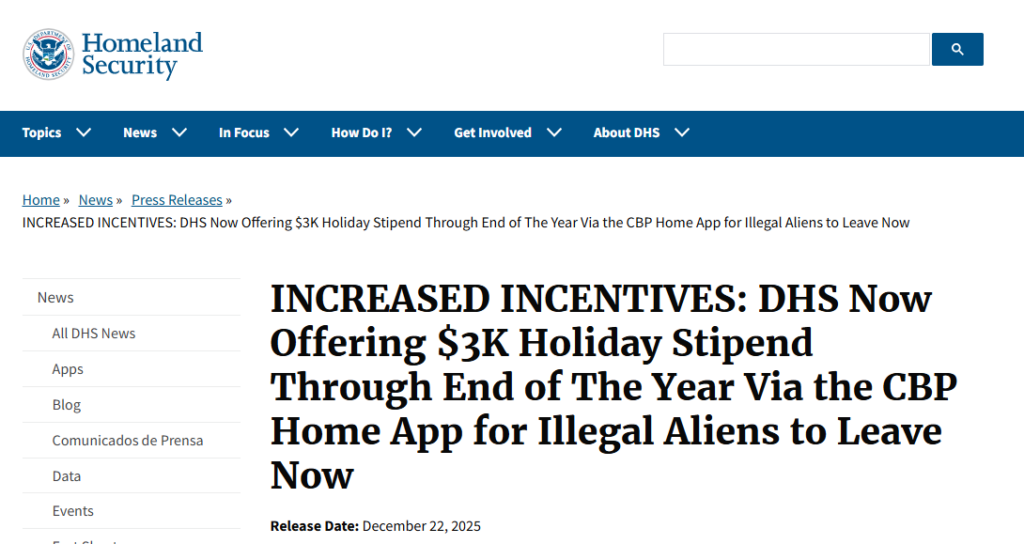
On Monday, Homeland Security Secretary Kristi Noem announced a “holiday stipend” of $3,000 for undocumented migrants who agree to leave the country voluntarily by the end of the year.
The offer—triple the amount proposed in a similar pilot program last spring—comes with a stark ultimatum. The administration is framing this not as a negotiation, but as a final “gift” before enforcement agents unleash a more aggressive crackdown in 2026.
At a Glance: The ‘Exit Bonus’
- The Offer: Migrants who “self-deport” by December 31 will receive $3,000, a free flight home, and forgiveness of civil fines.
- The Threat: Secretary Noem warned that those who refuse the offer will face arrest and a permanent ban: “If they don’t, we will find them… and they will never return.”
- The History: A similar program in May offered $1,000. Reports surfaced later that many participants struggled to collect the money or never received it.
- The Legal Warning: Immigration attorneys call the program a “trap,” warning that “voluntary” departure often still triggers multi-year bans on legally returning to the U.S.
‘Take Advantage of This Gift’
The administration is marketing the stipend as a compassionate off-ramp for those in the country illegally.
Secretary Noem pitched the “exit bonus” as a pragmatic solution for migrants who want to avoid the trauma of a raid or jail time. By offering a free flight and enough cash to restart their lives in their home countries, DHS hopes to induce thousands to self-deport without the government incurring the high cost of detention and court proceedings.
“Illegal aliens should take advantage of this gift and self-deport because if they don’t, we will find them, we will arrest them, and they will never return.” — DHS Secretary Kristi Noem

The Legal ‘Trap’
Legal experts and advocacy groups are urging extreme caution. The American Immigration Lawyers Association (AILA) has previously branded such schemes as deceptive.
The core issue is the fine print. While the government promises forgiveness of “civil fines,” accepting the offer and leaving often triggers an automatic 3-year or 10-year bar on re-entering the U.S. legally.
“It is deceptive and gives people the impression there are no consequences… No one should accept this without first obtaining good legal advice.” — AILA Statement
Attorneys warn that migrants who take the money effectively sign away their rights to fight for asylum or other legal relief, trading their day in court for a check that, based on the May pilot program, might be difficult to actually cash.
Desperation or Strategy?
The increase from $1,000 to $3,000 suggests that the administration is eager to boost its deportation numbers before the end of the year.
With courts recently blocking removal flights to El Salvador (the CECOT ruling) and limiting National Guard deployments, the White House is facing logistical bottlenecks in its mass deportation agenda. The cash incentive represents a pivot to “soft power”—using the treasury to achieve what the enforcement arm is struggling to do fast enough.
As the year closes, the choice for undocumented migrants is stark: take the cash and a one-way ticket now, or gamble on their ability to evade the “deportation force” promised in the new year.