
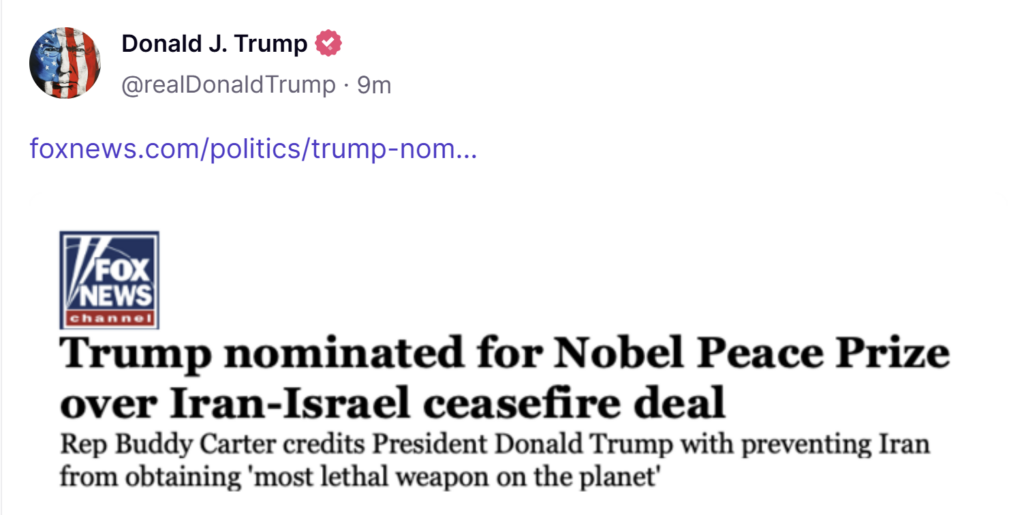
A Republican congressman has nominated President Donald Trump for the Nobel Peace Prize. The reason: his “extraordinary and historic role” in brokering a ceasefire that ended the “12 Day War” between Israel, Iran, and the United States. The nomination praises the President’s “bold, decisive actions” in achieving peace.
Every American desires peace. But in a constitutional republic, the process by which peace is achieved matters as much as the outcome itself. This nomination forces a profound and uncomfortable question upon the nation:
Can we, as a people committed to the rule of law, celebrate a peace if it was born from a war initiated in direct violation of the Constitution?
The “12 Day War”: A Conflict Without Consent
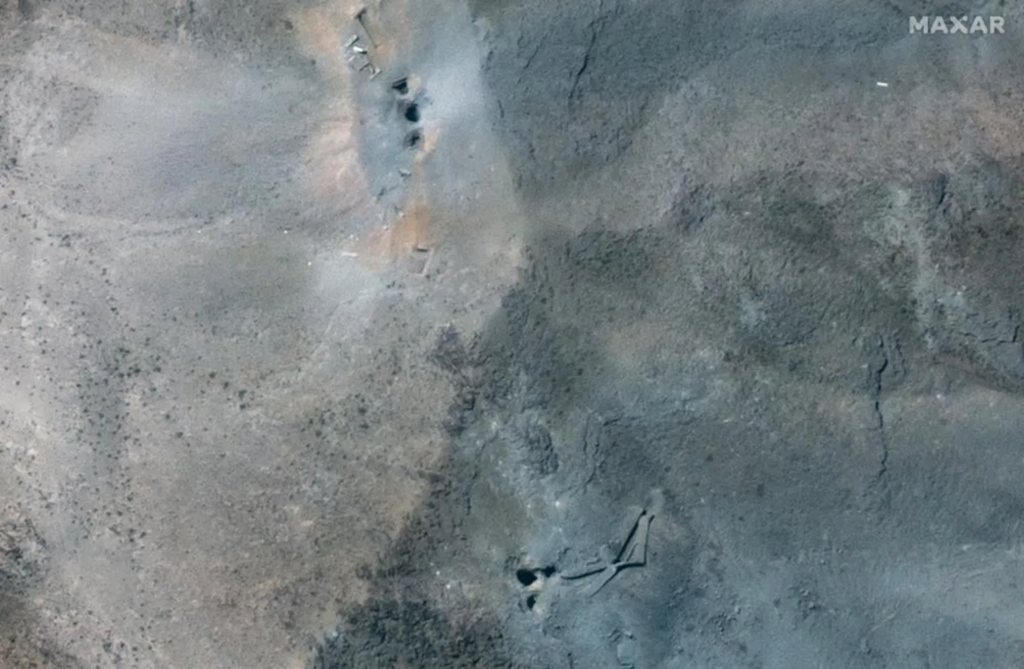
Before there could be a peace to celebrate, there was a war. This short but perilous conflict involved a preemptive U.S. airstrike on Iranian nuclear facilities and a direct, retaliatory ballistic missile attack by Iran on a major American air base. These are unambiguous acts of war.
At no point during this crisis did the President seek authorization from Congress to initiate hostilities, as is explicitly required by Article I, Section 8 of the U.S. Constitution. The power “to declare War” is not a suggestion; it is arguably the most solemn and significant power granted to the legislative branch.
It was deliberately placed there by the framers to prevent a single executive from unilaterally committing the nation to a conflict. That entire constitutional process was ignored.
Peace Through Unilateral Action
The Nobel nomination for the President’s “bold, decisive actions” does more than praise an individual; it validates a dangerous doctrine of executive unilateralism. It creates a perverse incentive for future presidents.
The message it sends is that a president can bypass Congress, commit the nation to a state of war, and then be celebrated as a peacemaker for ending the very crisis their unconstitutional action precipitated.
This fundamentally warps the system of checks and balances. It suggests that the deliberative, often slow, process of congressional debate and authorization is an obstacle to be circumvented by a “decisive” leader.
If a president can be lauded for single-handedly starting and stopping a conflict, what remains of Congress’s role? The “power to declare war” becomes a historical relic, and the President becomes the sole arbiter of when and where the nation uses military force.
A Tenuous Peace, A Lasting Precedent
As the nomination was being announced, reports emerged that the “tenuous peace is in danger of fraying,” with Israel already accusing Iran of violating the ceasefire. This should not be a surprise. A peace achieved outside of established constitutional and diplomatic norms is inherently fragile.
It is not a treaty ratified by the Senate, nor is it a broad international agreement. It is a temporary cessation of hostilities, dependent on the shifting calculations of the leaders involved.
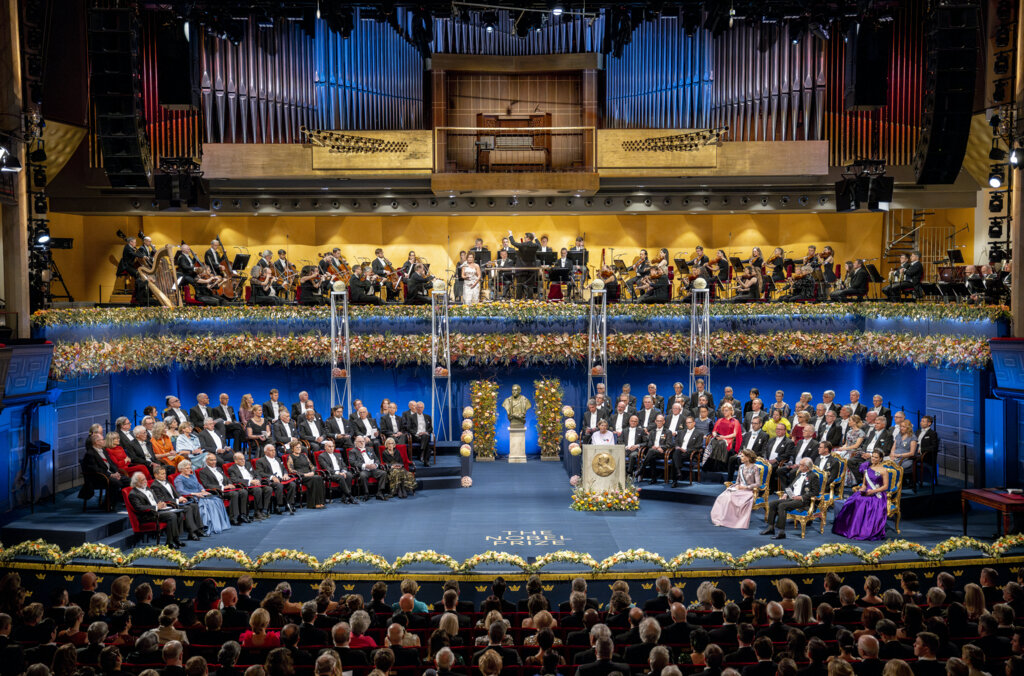
The peace may be fleeting, but the precedent is lasting and severe. The precedent is that a president can ignore the Constitution, engage in acts of war, expose American troops to direct attack, and then be nominated for a peace prize if the conflict doesn’t spiral into a regional catastrophe.
It normalizes a model of presidential power that the framers explicitly sought to prevent.
In our desire for peace, we must not lose sight of the principles that preserve our republic. We must ask ourselves a series of critical questions:
- In a constitutional democracy, do the ends of achieving a ceasefire justify the means of an unconstitutional war?
- What is the long-term cost to the rule of law if we celebrate a leader for solving a crisis that he alone had the power to start?
- Does true peace come from the “decisive action” of one person, or from the deliberative consent of a nation acting through its elected representatives?
To honor a peace achieved by violating our founding document is to suggest that the Constitution itself is an inconvenient obstacle to be overcome, rather than the very source of our nation’s enduring strength.