
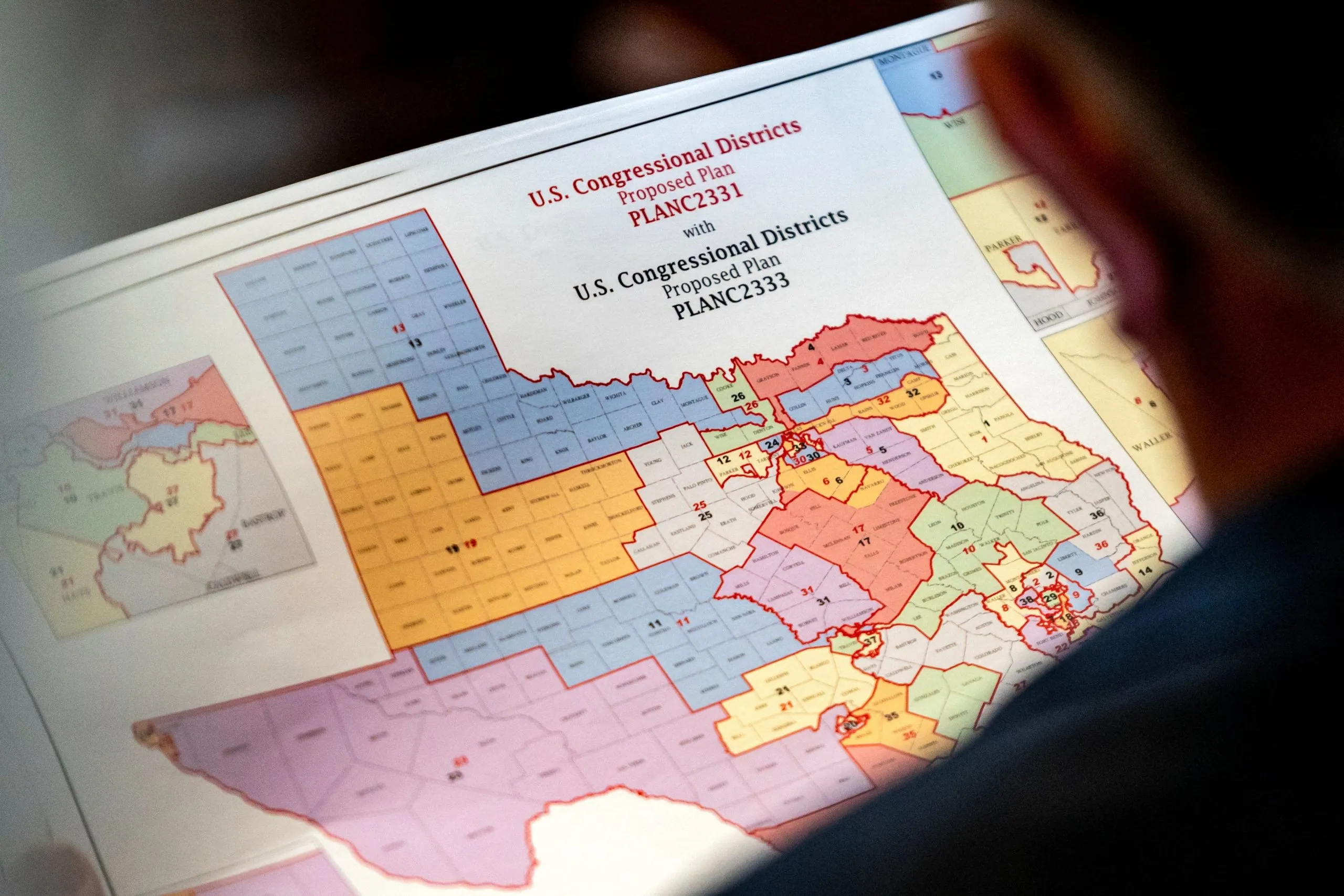
The Supreme Court just handed Texas Republicans a win with a move that was both simple and deeply consequential: it summarily reversed a lower-court ruling that had blocked Texas’ mid-cycle congressional redistricting plan. In other words, the Court struck down the block and left the new map standing.
The procedural choice matters. A summary reversal is not a long, fully explained opinion. It is the Court stepping in quickly, pointing back to existing precedent, and resolving the immediate dispute without extended elaboration.
The immediate result is straightforward: the Texas map stays in place. The longer-term result is the real story. This dispute is not only about Texas. It is about whether mid-decade redistricting is becoming the new normal and what legal rules, if any, can restrain it.
Join the Discussion
What the Court did
The justices reversed a decision from a three-judge federal panel in the Western District of Texas. That panel had found, by a 2-1 vote, that race played too large a role in the map and that Texas had improperly concentrated Latino and Black voters into newly drawn districts. The challengers, a coalition of voting and immigrant rights organizations, argued the map was an illegal racial gerrymander.
The Supreme Court hung its order on reasoning from an earlier case, Abbott v. League of United Latin American Citizens, but did not elaborate. The vote split 6-3, with Justices Sonia Sotomayor, Elena Kagan, and Ketanji Brown Jackson in dissent.
What the Court did not do is just as important. It did not write a long opinion spelling out a clean, public test for when mid-cycle maps cross the constitutional line. That leaves the country with an outcome, but not much of a roadmap.
The December setup
This was not the first time the Court touched the Texas map. In December, it temporarily allowed Texas to use the new plan while the litigation continued. Monday’s summary reversal came after that stay and keeps the new Texas map alive indefinitely.
In the December stay, the Court said the plaintiffs had made “at least two serious errors.” The first was failing to give the Texas Legislature what the Court called a “presumption of legislative good faith.” The second was failing to produce an alternative map that satisfied Texas’ stated political needs.
That second requirement is the kind of legal detail that can reshape an entire field. If challengers must not only show illegality but also propose a workable alternative that preserves the state’s asserted goals, the courthouse door does not close. But it gets a lot heavier.
Timing matters
The Court also faulted the lower court for interfering with an “active primary campaign,” warning that the intervention risked confusion and upset what it described as the “delicate federal-state balance in elections.”
This is the part that should make civics students sit up. The Constitution does not contain a “don’t rock the boat during primary season” clause. Yet election law often turns on timing, because the practical costs of switching rules midstream are real. Ballots have to be printed. Candidates need to know what district they are running in. Voters need to know what race they are voting in.
Still, there is an uncomfortable question buried inside that practical reality: if courts treat the election calendar as a shield, doesn’t that create an incentive to push aggressive maps as late as possible, daring opponents to challenge them while the clock runs out?
Race vs. party
Texas, backed by the U.S. Department of Justice in this fight, framed the map as driven by partisanship rather than race. That distinction is not rhetorical. It is often outcome-determinative.
Here is the tension in plain English:
- Racial gerrymandering can violate the Constitution and federal voting law when race is used in impermissible ways to sort voters.
- Partisan gerrymandering is widely viewed as politically ugly, but it has proven harder to police in federal court.
So the argument becomes a kind of shell game: was the legislature sorting voters because of how they vote, or because of who they are? In the real world, those categories can overlap, especially in places where race and party are closely correlated. Courts are asked to separate them anyway.

The dissent’s warning
Justice Elena Kagan’s dissent did not mince words about what the Court’s decision accomplishes in practice. “This Court’s stay guarantees that Texas’s new map, with all its enhanced partisan advantage, will govern next year’s elections for the House of Representatives,” she wrote.
Then she sharpened the constitutional point. “And this Court’s stay ensures that many Texas citizens, for no good reason, will be placed in electoral districts because of their race. And that result, as this Court has pronounced year in and year out, is a violation of the Constitution.”
The key word there is “ensures.” Read one way, the dissent is warning that the Court’s posture risks making the alleged harm effectively impossible to remedy on a practical timeline, even if challengers believe they are right on the law.
Beyond Texas
Mid-cycle redistricting used to be unusual enough to feel like an emergency. Now it is starting to look like a strategy.
The Supreme Court temporarily greenlit Texas’ map in December and California’s map in February. Both states spearheaded the mid-cycle redistricting fights that have now been cropping up across the country. The Court’s approval of both states’ maps, giving Republicans and Democrats five-seat advantages, respectively, served to cancel each other’s efforts out ahead of the 2026 midterms.
But democracy is not supposed to operate on the theory of mutual retaliation. “It’s fine because the other side did it too” is a political argument, not a constitutional one. The deeper issue is whether representative government can tolerate a world where district lines become a recurring tool of partisan maintenance rather than an occasional act of reapportionment.
The civics question
In my classroom days, I used to ask students a simple question that made them squirm: Who is a congressional seat supposed to belong to?
If the seat belongs to the voters, then the point of redistricting should be to reflect population changes while respecting legal limits. If the seat belongs to the party in power, then the map becomes a piece of equipment, like a better set of cleats.
Monday’s summary reversal does not settle that philosophical fight. But it does push the country toward a new normal where mid-cycle redistricting is less a rare exception and more a standing option. And when that happens, “the people choose their representatives” starts to sound a little backwards.