
The exclusionary rule is one of those legal ideas that feels backwards the first time you hear it: sometimes a court will keep reliable evidence out of a criminal trial because the government gathered it the wrong way.
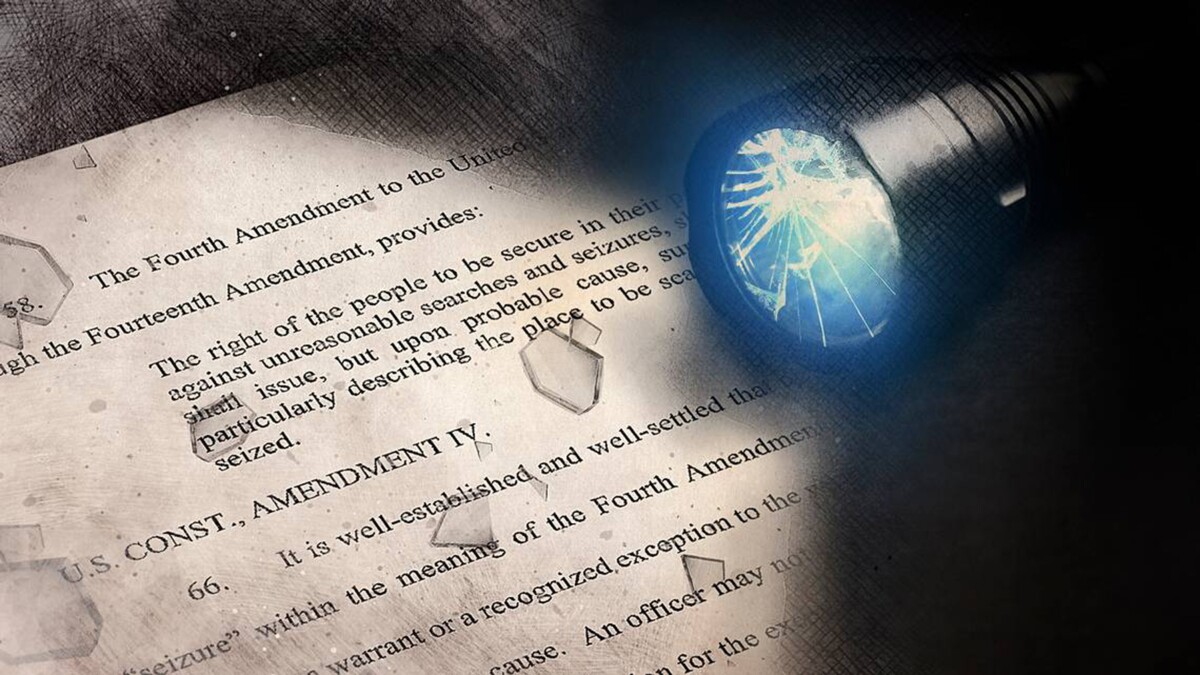
That sounds like a technicality. It is not. It is a constitutional pressure valve. The Fourth Amendment limits what the government can do when it searches and seizes. The exclusionary rule is one of the main ways courts try to make that limit real in practice.
Join the Discussion
What the rule is
The exclusionary rule generally means that evidence obtained in violation of the Constitution, most often the Fourth Amendment, cannot be used by the prosecution to prove guilt in its case-in-chief at trial.
It does not directly regulate searches in the moment. It changes what happens after an unconstitutional search, when the government tries to use what it found.
Courts often describe it as a remedy, not a right. The Fourth Amendment gives the right to be free from unreasonable searches and seizures. The exclusionary rule is the court’s tool for enforcing that right.
- Fourth Amendment right: protection against unreasonable searches and seizures.
- Exclusionary rule remedy: suppressing evidence to discourage unconstitutional searches.
Note: even when evidence is suppressed from the government’s main presentation, there are limited exceptions where it may still come in for other purposes, such as certain impeachment uses.
Constitutional roots
The Fourth Amendment does not contain the words “exclusionary rule.” Like privacy, like much of modern criminal procedure, it is largely judge-made.
The Supreme Court first applied an exclusionary remedy to federal agents in Weeks v. United States (1914). Decades later, in Mapp v. Ohio (1961), the Court held that states must follow it too, by applying the Fourth Amendment to the states through the Fourteenth Amendment.
The basic idea is straightforward: if courts routinely accept evidence gathered unconstitutionally, then the Fourth Amendment’s limits become optional. The government would get the benefit of the violation, and the constitutional command would be reduced to a scolding after the fact.
Although this article focuses on the Fourth Amendment, “exclusion” also shows up in other constitutional settings in more specialized ways, including certain Fifth and Sixth Amendment doctrines.
Why suppress evidence?
Suppression can feel like the system is rewarding wrongdoing. But the logic runs in the other direction. The remedy is aimed at government behavior, not at giving a bonus to a defendant.
1) Deterrence
The most common justification is deterrence: if officers know unconstitutional searches can make a case collapse, they have a reason to follow the rules next time.
2) Judicial legitimacy
There is also an institutional concern. Courts do not want to be the place where unconstitutional conduct becomes legally profitable. Excluding evidence is a way of saying: we will not convert a rights violation into a courtroom advantage.
3) A workable remedy
You cannot “un-search” a home. You cannot “un-seize” what was already learned. Money damages against officers are difficult to win in practice, and doctrines like qualified immunity often make them hard to obtain. Suppression is one of the few remedies that can be applied quickly and directly inside the criminal case itself.
Fruit of the poisonous tree
The exclusionary rule is not limited to the illegally obtained evidence itself. Courts also sometimes exclude evidence that was discovered because of the illegal search. This is the doctrine commonly called fruit of the poisonous tree.
Here is the intuition: if the government’s first step was unconstitutional, it should not be able to keep the downstream benefits.
A simplified example:
- Police illegally search a garage and find a handwritten note with an address.
- They go to that address, get more evidence, and build the case.
- A court may treat the later evidence as tainted by the original illegality.
This is not automatic. Courts ask how closely connected the later evidence is to the unlawful act.
Limits and exceptions
The exclusionary rule is powerful, but it is not absolute. Modern Fourth Amendment doctrine contains several limitations that reduce suppression when the connection to the constitutional violation is weak, or when suppression would not meaningfully deter misconduct.
Independent source
If the government later obtains the same evidence through a genuinely independent, lawful route, suppression may not apply. (Often associated with Murray v. United States.)
Inevitable discovery
If the government can show it would have found the evidence anyway through lawful means, a court may admit it even if an earlier step was unlawful. (Often associated with Nix v. Williams.)
Attenuation
If time, intervening events, or other factors break the chain between the illegality and the evidence, the taint may be considered “attenuated” enough that suppression is not required. (Often associated with Brown v. Illinois, and more recently Utah v. Strieff.)
Good-faith exception
Another major modern limitation is the good-faith exception.
In plain terms: if officers reasonably relied on something that appeared lawful, suppression may be denied even if a judge later determines a Fourth Amendment violation occurred.
The key Supreme Court case is United States v. Leon (1984), which held that evidence obtained with a warrant later found invalid can still be admitted if officers acted in objectively reasonable reliance on the warrant.
Why? Because the exclusionary rule is primarily about deterrence. If the mistake was not the officer’s deliberate or reckless constitutional violation, excluding evidence may not deter future misconduct in a meaningful way.
Good faith is not “the officer meant well.” Courts frame it as an objective reasonableness inquiry. And it does not cover everything. Suppression can still be on the table when, for example, a warrant is so obviously deficient that no reasonable officer should have relied on it, or when police mislead the judge who issued it.
Who can invoke it?
One more practical limit: not everyone can ask for suppression. Generally, a defendant must show that their own Fourth Amendment rights were violated. In other words, the exclusionary rule is tied to personal privacy interests, not to policing errors in the abstract.
That is why “standing” questions matter in real cases, such as whether a passenger can challenge a car search, or whether a guest can challenge a search of someone else’s home.
Is it a loophole?
It is a tempting sound bite, but it misses what constitutional criminal procedure is doing.
The exclusionary rule is not a reward for innocence or guilt. It is a rule about the government’s limits. The Fourth Amendment does not say, “be reasonable unless the evidence would be useful.” It says unreasonable searches and seizures are not what a free people should tolerate from their government.
From that perspective, suppression is the system choosing a priority: it would rather lose some prosecutions than normalize a method of policing that treats constitutional boundaries as optional.
How suppression works
In practice, the exclusionary rule usually shows up through a motion to suppress, filed by the defense. The defense argues that the search or seizure violated the Fourth Amendment and that the evidence should be excluded.
The judge then decides key questions like:
- Was there a “search” or “seizure” under the Fourth Amendment?
- Was it reasonable? Was there a warrant, probable cause, consent, or another recognized justification?
- If there was a violation, does the exclusionary rule apply, or does an exception apply?
At a high level, the defense typically has to identify the constitutional problem, and the government often bears the burden of showing an exception or limitation applies. The details can vary by jurisdiction and context.
This is why Fourth Amendment law is so fact-specific. Tiny details matter, like who consented, what the officer knew at the moment, what the warrant said, and how the search unfolded.
And because many criminal cases end in plea deals, suppression practice often matters long before trial. A strong suppression issue can reshape negotiations or even end a case.
Why it still matters
The exclusionary rule sits at the uncomfortable intersection of two American instincts:
- We want effective law enforcement.
- We do not want a government that can invade privacy on suspicion alone.
Fourth Amendment rights are easiest to praise in the abstract and easiest to compromise in a hard case. The exclusionary rule forces a concrete question: if the government got the evidence by violating the rules, should the government still get to win with it?
Different courts, and different eras, have answered that question with different levels of willingness to suppress. That is part of what makes the topic worth learning. It is not only a rule about evidence. It is a running argument about what constitutional limits should cost, and what it costs to ignore them.
Key takeaways
- The exclusionary rule generally blocks the prosecution from using evidence obtained through unconstitutional searches or seizures in its case-in-chief.
- It is rooted in the Fourth Amendment, even though the amendment does not explicitly mention exclusion, and it is a judicially created remedy with significant limits.
- Courts justify it mainly as a deterrent to constitutional violations and as a way to keep courts from benefiting from unlawful conduct.
- Related doctrines include “fruit of the poisonous tree,” along with major exceptions and limitations like independent source, inevitable discovery, attenuation, and the good-faith exception.
- Not everyone can invoke it. A defendant generally must show their own Fourth Amendment rights were violated.