
The Electoral College is the system the United States uses to elect a president and vice president. It is not a separate election that happens instead of the popular vote. It is the mechanism that turns state popular votes into the official votes that legally choose the president.
Every four years, Americans cast ballots in November. But what those ballots usually do is instruct each state on how to award its “electoral votes.” Those electoral votes are then cast by real people called electors, counted by Congress in early January, and used to determine the winner.

What the Electoral College is
Think of the Electoral College as a 50-state tallying system layered on top of a national election.
Instead of adding up one nationwide popular vote total and declaring the candidate with the most votes the winner, the Constitution directs each state to appoint electors, and those electors cast the votes that formally elect the president.
The key takeaway is simple: the presidency is won by winning electoral votes, not by winning the national popular vote total.
Why the Founders created it
The Electoral College was a compromise built out of competing fears and competing priorities at the Constitutional Convention of 1787.
A compromise between big states and small states
Larger states wanted presidential elections to track population, because they had more voters. Smaller states worried they would be permanently ignored if the president were chosen purely by a national popular vote.
The solution mirrored Congress itself. Representation would be partly based on population and partly based on equal state status. That blend shows up in how electoral votes are allocated.
A compromise between Congress and the people
Some delegates wanted Congress to pick the president. Others thought a direct national election was the best expression of popular sovereignty.
The Electoral College split the difference: the people could vote, but states would appoint electors who cast the official ballots. It is also worth noting a constitutional nuance that often gets skipped: the Constitution does not require states to use a popular vote to choose electors. In practice, all states do today, but the method of appointment is a state decision.
Practical realities in an 18th century nation
In a world without instant communication, national campaigns, and uniform voting rules, the Founders also worried about how information and manipulation could travel. The elector system was imagined as a buffer, although today it functions mostly as a state-by-state counting method rather than a deliberative council of independent decision makers.
How many electoral votes each state gets
Each state’s electoral vote total equals its total representation in Congress:
- Senators: 2 for every state
- House members: based on population (apportioned after each census)
So a state’s electoral votes = 2 + its House seats.
Washington, DC also gets electoral votes under the 23rd Amendment, even though it is not a state.
That is how we reach the modern total: 538 electors. A candidate needs a majority of those electoral votes to win, which is 270.
If you have ever wondered why the total is 538, a big part of the answer is the modern size of the House. The House has been capped at 435 seats for more than a century (with limited temporary exceptions), so the math becomes 435 House-based electors + 100 senators + 3 for DC = 538.

Who the electors are
Electors are people chosen under state rules, usually nominated by political parties. They are often party activists, local officials, or community leaders. The Constitution sets the broad framework, but states run the selection process.
The Constitution also sets one major restriction. Under Article II, no senator or representative can be an elector, and neither can any person holding an “Office of Trust or Profit under the United States.”
How electors are chosen
On Election Day, you are typically voting for a party’s slate of electors, even if the ballot shows only the presidential candidates’ names.
Here is the practical chain of events:
- Parties nominate elector slates in each state (the exact method varies).
- Voters cast ballots for president in November.
- The state awards its electors based on the state’s rules.
- Electors meet in mid-December in their respective states to cast electoral ballots for president and vice president (the date is set by federal law).
Those electoral ballots are the constitutional votes that decide the outcome.

Winner-take-all and two exceptions
Most states use a winner-take-all system: whichever candidate wins the state’s popular vote wins all of the state’s electoral votes.
That winner-take-all rule is not required by the Constitution. It is a choice states made over time, and it is often justified on the grounds that it maximizes the impact of the statewide winner.
A quick example shows the practical effect. If a candidate wins a state by 1 vote, that candidate still typically receives every one of that state’s electoral votes. A narrow statewide margin can produce a large Electoral College swing.
The exceptions: Maine and Nebraska
Maine and Nebraska use a district-based method:
- They award one electoral vote to the winner of each congressional district.
- They award two electoral votes to the statewide popular vote winner (reflecting the state’s two Senate-based electors).
This is why it is possible, though uncommon, for those states to split their electoral votes between candidates.
Faithless electors
Electors almost always vote the way their state expects, but a small number in U.S. history have not. These are called faithless electors, meaning electors who vote for someone other than the candidate who won their state (or whom they pledged to support).
States handle this differently. Many states require electors to pledge their vote and impose penalties or replacement rules if an elector breaks that pledge. In 2020, the Supreme Court upheld state laws that bind electors and enforce those pledges (Chiafalo v. Washington). In modern elections, faithless electors are rare and have not changed the outcome of a presidential race.
How the votes are counted
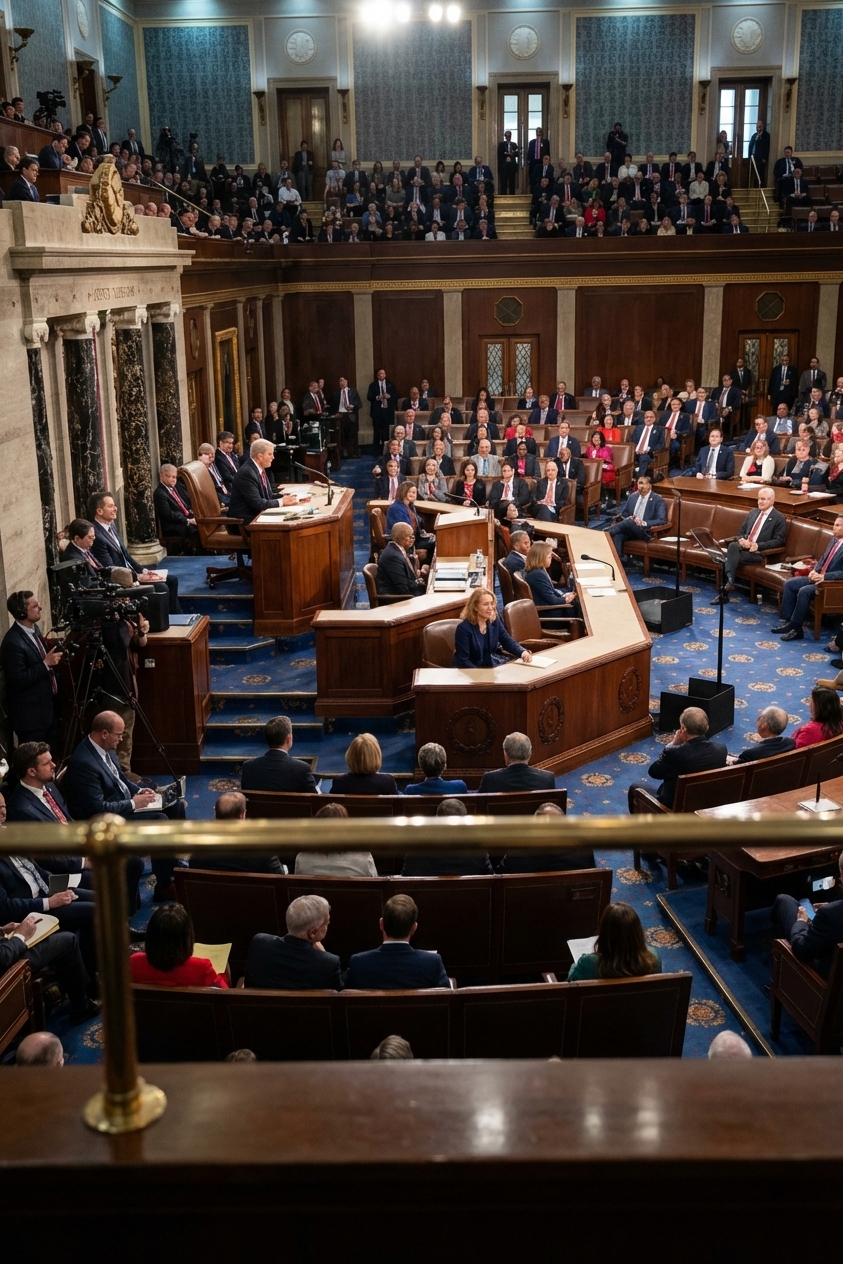
After the electors cast their votes in mid-December, the results are certified and sent to federal officials. In early January, Congress meets in a joint session to count the votes. By federal statute, this count is set for January 6 following the election, though the date can shift if the law is changed or if Congress sets a different schedule consistent with the rules.
This count is the official moment when the Electoral College outcome becomes the declared presidential winner.
If a candidate receives 270 or more electoral votes, that candidate wins the presidency.
What happens if no one gets 270
If no candidate wins a majority of electoral votes, the Constitution provides a backup method. This can happen if there is a tie, or if multiple candidates split the electoral vote so that no one reaches a majority.
No majority: the House chooses
Under the 12th Amendment, the election goes to the House of Representatives, but with an unusual rule: each state delegation gets one vote. The House chooses among the top three electoral vote recipients for president.
That means California’s House delegation and Wyoming’s House delegation each cast one state vote, even though their sizes are dramatically different. To win, a candidate must receive a majority of state votes, which is currently 26 states.
The Senate chooses the vice president
The Senate chooses the vice president from the top two electoral vote recipients for vice president, with each senator casting one vote.
Why it shapes campaigns
Because most states are winner-take-all, the presidency can turn on relatively small margins in a handful of competitive states. That reality affects where candidates travel, where campaigns spend money, and which issues get emphasized.
These competitive states are commonly called swing states or battleground states.
It also explains a feature that surprises many voters: it is possible to win the national popular vote but lose the presidency, because the Electoral College is decided by state outcomes, not the national total.
Is it in the Constitution?
Yes, though not in the neat, modern form people imagine.
- Article II sets up the basic framework for electors and state appointment.
- The 12th Amendment revises the voting process after early elections revealed flaws.
- The 23rd Amendment gives Washington, DC electoral votes.
- Federal statutes fill in procedural details, including timelines, certifications, and counting rules (updated in recent years).
The result is a system that is both constitutional in origin and heavily shaped by state choices and federal election law.
Quick facts
- Total electors: 538
- Electoral votes needed to win: 270
- Electors per state: House seats + 2 senators
- Washington, DC: 3 electors (23rd Amendment)
- Most states: winner-take-all
- Exceptions: Maine and Nebraska can split electoral votes
- If no majority: House chooses president by state delegations (26 states to win), Senate chooses vice president
- Faithless electors: rare; many states bind electors; Supreme Court upheld enforcement (2020)
The question it forces
The Electoral College is often discussed like a trivia rule. It is not. It is a constitutional choice about what kind of union the United States is: a single national electorate, or a republic where states act as the key units of decision.
Every election tests that design. And every debate about reform turns on the same underlying question the Founders never fully resolved: when we say “the people choose the president,” which people do we mean, and how should their votes be counted?