
The Bill of Rights is only ten amendments long, but it quietly defines what “freedom” means in American law. These amendments were added in 1791 to answer a fear that the new federal government would grow teeth faster than the people could grow protections.
One catch that surprises students every year: the Bill of Rights originally limited the federal government, not the states. Over time, the Supreme Court used the Fourteenth Amendment to apply most of these protections to the states too, a process called incorporation.
Important footnote: not every provision is fully incorporated. For example, the Seventh Amendment civil jury right generally does not apply to state courts, and the Fifth Amendment grand jury indictment rule is not required of states (many states use a prosecutor’s “information” instead).
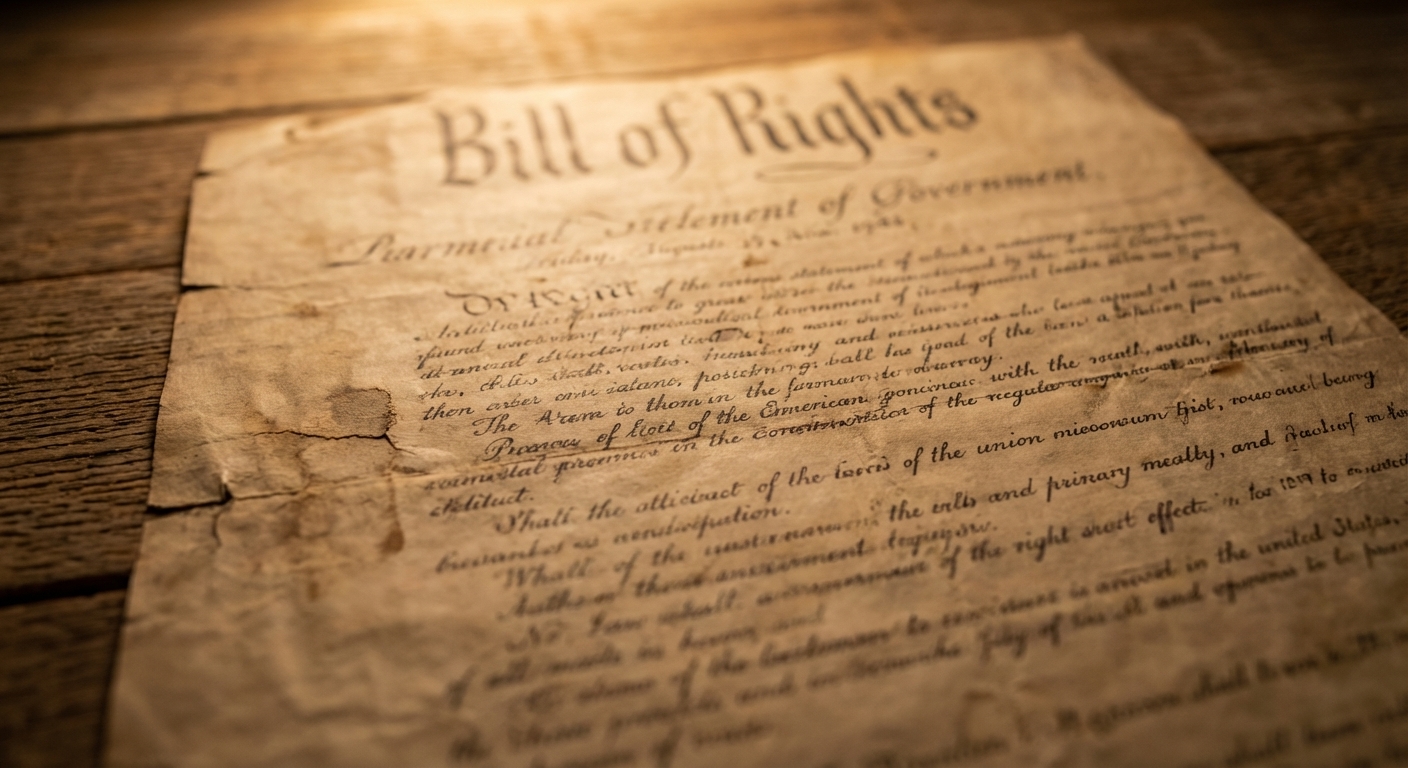
Below, you will find each amendment’s original text, a plain-English translation, a real-world example, and landmark Supreme Court cases that shaped how it works today.
1) First Amendment
Original text
“Congress shall make no law respecting an establishment of religion, or prohibiting the free exercise thereof; or abridging the freedom of speech, or of the press; or the right of the people peaceably to assemble, and to petition the Government for a redress of grievances.”
Plain English
As a rule, the government generally cannot:
- Set up an official religion or formally favor one faith over others (the exact legal tests here have shifted over time, but the core idea is government religious neutrality).
- Stop you from practicing your religion (with limits when needed to protect public safety and others’ rights).
- Punish you simply for what you say, publish, or believe, with narrow exceptions.
- Ban peaceful protests and meetings.
- Stop you from asking the government to fix a problem.
Real-world example
A city cannot require a permit fee so high that it effectively shuts down a peaceful protest. That is a burden on assembly. Likewise, the government generally cannot punish a newspaper for printing criticism of the mayor just because it is embarrassing.
Landmark cases
- Brandenburg v. Ohio (1969): Speech can be punished as incitement only if it is intended and likely to produce imminent lawless action.
- New York Times Co. v. Sullivan (1964): Public officials must prove “actual malice” to win many defamation claims, a major protection for press freedom.
- Tinker v. Des Moines (1969): Students do not “shed their constitutional rights” at the schoolhouse gate, though schools can regulate disruptions.
- Engel v. Vitale (1962): Official school-sponsored prayer violated the Establishment Clause.
- Wisconsin v. Yoder (1972): The Free Exercise Clause protected Amish parents from compulsory high school attendance laws in that context.
2) Second Amendment
Original text
“A well regulated Militia, being necessary to the security of a free State, the right of the people to keep and bear Arms, shall not be infringed.”
Plain English
Individuals have a constitutional right to possess and carry firearms, and the government’s ability to regulate guns has constitutional limits. The hard part is defining those limits.
Real-world example
A state may require certain licensing rules for carrying firearms in public, but it cannot use a licensing system as a disguised ban for ordinary, law-abiding citizens.
Landmark cases
- District of Columbia v. Heller (2008): Held the Second Amendment protects an individual right to possess a handgun in the home for self-defense.
- McDonald v. Chicago (2010): Applied the Second Amendment to the states through the Fourteenth Amendment.
- New York State Rifle & Pistol Association v. Bruen (2022): Struck down New York’s “proper cause” carry requirement and emphasized a history-and-tradition test for gun regulations.

3) Third Amendment
Original text
“No Soldier shall, in time of peace be quartered in any house, without the consent of the Owner, nor in time of war, but in a manner to be prescribed by law.”
Plain English
The government cannot force you to house soldiers in your home during peacetime. In wartime, it can only happen under rules passed by law.
Real-world example
Hypothetical: If a state tried to require residents to let troops stay in spare bedrooms during a domestic emergency, the Third Amendment would be an obvious constitutional obstacle. Real Third Amendment fights are rare, which is part of why it feels like the amendment everyone forgets until a weird fact pattern shows up.
Landmark cases
- Engblom v. Carey (2d Cir. 1982): A federal appeals court held the Third Amendment applies to the states and that “houses” can include certain residences like staff housing.
4) Fourth Amendment
Original text
“The right of the people to be secure in their persons, houses, papers, and effects, against unreasonable searches and seizures, shall not be violated, and no Warrants shall issue, but upon probable cause, supported by Oath or affirmation, and particularly describing the place to be searched, and the persons or things to be seized.”
Plain English
Police generally need a good reason and often a warrant to search you or your property. Warrants must be specific, and searches must be reasonable. At the same time, the law recognizes several common exceptions, such as consent, emergencies, and certain vehicle-related searches.
Real-world example
Police usually cannot search your phone during an arrest just because they have the phone in hand. In practice, courts have treated modern digital life as functionally similar to “papers and effects,” and they typically require a warrant before digging through it.
Landmark cases
- Mapp v. Ohio (1961): Applied the exclusionary rule to the states, meaning illegally obtained evidence is often suppressed.
- Katz v. United States (1967): Fourth Amendment protections can apply without physical trespass; introduced the modern idea of “reasonable expectation of privacy.”
- Terry v. Ohio (1968): Allowed brief stop-and-frisk searches with reasonable suspicion, not full probable cause.
- Carpenter v. United States (2018): Police generally need a warrant for historical cell-site location data.
- Riley v. California (2014): Police generally need a warrant to search a cell phone seized during an arrest.

5) Fifth Amendment
Original text
“No person shall be held to answer for a capital, or otherwise infamous crime, unless on a presentment or indictment of a Grand Jury, except in cases arising in the land or naval forces, or in the Militia, when in actual service in time of War or public danger; nor shall any person be subject for the same offence to be twice put in jeopardy of life or limb; nor shall be compelled in any criminal case to be a witness against himself, nor be deprived of life, liberty, or property, without due process of law; nor shall private property be taken for public use, without just compensation.”
Plain English
This amendment packs in several protections:
- For serious federal crimes (traditionally, felonies), prosecution generally begins with a grand jury indictment. States are not required to use grand juries and often use an “information” instead.
- You cannot be tried twice for the same offense by the same sovereign (double jeopardy).
- You have a right not to incriminate yourself.
- The government must follow fair procedures before taking your life, liberty, or property (due process).
- If the government takes private property for public use, it must pay for it (takings clause).
Real-world example
If police interrogate you while you are in custody, you can invoke your right to remain silent. Separately, if a city takes your land to expand a highway, it must pay fair compensation.
Landmark cases
- Miranda v. Arizona (1966): Required warnings about the right to remain silent and the right to an attorney during custodial interrogation.
- Benton v. Maryland (1969): Applied double jeopardy protections to the states.
- Hurtado v. California (1884): Held the Fifth Amendment grand jury requirement does not apply to the states, allowing states to prosecute by information.
- Kelo v. City of New London (2005): Allowed economic development takings under a broad view of “public use,” triggering major political backlash and state reforms.
6) Sixth Amendment
Original text
“In all criminal prosecutions, the accused shall enjoy the right to a speedy and public trial, by an impartial jury of the State and district wherein the crime shall have been committed, which district shall have been previously ascertained by law, and to be informed of the nature and cause of the accusation; to be confronted with the witnesses against him; to have compulsory process for obtaining witnesses in his favor, and to have the Assistance of Counsel for his defence.”
Plain English
If you are accused of a crime, you have the right to:
- A speedy, public trial.
- An impartial jury in the proper location.
- Know what you are charged with.
- Question the witnesses against you.
- Call witnesses in your defense.
- Have a lawyer help you defend yourself.
Real-world example
If prosecutors delay a case for years without good reason, that can violate the speedy-trial right. If a key witness testifies, your lawyer generally gets to cross-examine that witness instead of the state relying on secret statements.
Landmark cases
- Gideon v. Wainwright (1963): Required states to provide counsel in serious criminal cases for defendants who cannot afford a lawyer (a Sixth Amendment right applied to the states through the Fourteenth Amendment).
- Crawford v. Washington (2004): Strengthened confrontation rights by limiting the use of testimonial hearsay when the defendant cannot cross-examine the witness.
- Barker v. Wingo (1972): Established a balancing test for speedy-trial claims.
7) Seventh Amendment
Original text
“In Suits at common law, where the value in controversy shall exceed twenty dollars, the right of trial by jury shall be preserved, and no fact tried by a jury, shall be otherwise re-examined in any Court of the United States, than according to the rules of the common law.”
Plain English
In many civil lawsuits in federal court, you have a right to a jury trial. And once a jury decides the facts, courts cannot casually redo that fact-finding.
Practical limitation: this is largely a federal-court guarantee. It is generally not incorporated against the states, so state civil jury rules can look different.
Real-world example
If you sue a company in federal court for damages and the case fits the categories covered by the amendment, you can ask for a jury to decide key factual disputes, not just a judge.
Landmark cases
- Tull v. United States (1987): Recognized a jury-trial right in certain civil penalty cases, while allowing judges to decide some remedies.
- Beacon Theatres, Inc. v. Westover (1959): Protected the jury-trial right when legal and equitable claims overlap.
8) Eighth Amendment
Original text
“Excessive bail shall not be required, nor excessive fines imposed, nor cruel and unusual punishments inflicted.”
Plain English
The government cannot set bail or fines at absurd levels, and it cannot impose punishments that are inhumane. It also limits wildly disproportionate penalties in some contexts, with the strongest proportionality rules showing up in death penalty and certain extreme sentencing cases.
Real-world example
A local government cannot treat fines as a revenue machine by imposing extreme penalties for minor infractions, especially when the punishment is out of proportion to the offense.
Landmark cases
- Timbs v. Indiana (2019): Applied the Excessive Fines Clause to the states.
- Furman v. Georgia (1972): Temporarily halted death penalty schemes that were applied in arbitrary ways.
- Gregg v. Georgia (1976): Allowed the death penalty under revised procedures aimed at reducing arbitrariness.
- Atkins v. Virginia (2002): Barred execution of intellectually disabled defendants.
- Roper v. Simmons (2005): Barred execution for crimes committed by minors.
9) Ninth Amendment
Original text
“The enumeration in the Constitution, of certain rights, shall not be construed to deny or disparage others retained by the people.”
Plain English
Just because a right is not listed in the Constitution does not mean it does not exist. The people retain other rights beyond the written list.
Real-world example
If a court treats the Bill of Rights like an exclusive menu of freedoms, the Ninth Amendment is the reminder that the menu is not the whole kitchen. It does not automatically decide which unlisted rights exist, but it warns against assuming they do not.
Landmark cases
- Griswold v. Connecticut (1965): Cited the Ninth Amendment as part of the Court’s discussion of unenumerated rights in the context of marital privacy and contraception.
10) Tenth Amendment
Original text
“The powers not delegated to the United States by the Constitution, nor prohibited by it to the States, are reserved to the States respectively, or to the people.”
Plain English
The federal government only has the powers the Constitution gives it. Everything else belongs to the states or the people, unless the Constitution forbids states from doing it.
Real-world example
States run most elections, licensing, family law, and local policing because the Constitution does not hand those general powers to the federal government. Federal power grows when Congress can tie a law to an enumerated power such as commerce, spending, or taxation.
Landmark cases
- New York v. United States (1992): Limited Congress’s ability to “commandeer” state governments into carrying out federal regulatory programs.
- Printz v. United States (1997): Held the federal government cannot require state officers to administer or enforce federal regulatory schemes in certain contexts.
- Murphy v. NCAA (2018): Reinforced anti-commandeering principles by striking down a federal law that restricted state authorization of sports gambling.
Why it still matters
The Bill of Rights is not just a civics checklist. It is a set of friction points built into the system, places where government power is supposed to slow down and justify itself.
And it is not static. The text is short. The world is not. The distance between the two is where most constitutional fights live: What counts as a “search” in an age of phones? What counts as “speech” in an age of platforms? What counts as “arms” in an age of rapid technological change?
If you want to read the Bill of Rights like a living part of your daily life, start here: whenever you see a conflict between security and liberty, or between majority rule and individual rights, you are probably watching one of these ten amendments do its job.