
The Bill of Rights is the Constitution’s first ten amendments. Think of them as America’s original set of limits on federal power: rules the government must follow even when it has good intentions, even when the public is afraid, and even when the majority would rather not.
They were written to answer a very practical question: How do you build a strong national government without building the kind of government the Revolution was fought against?
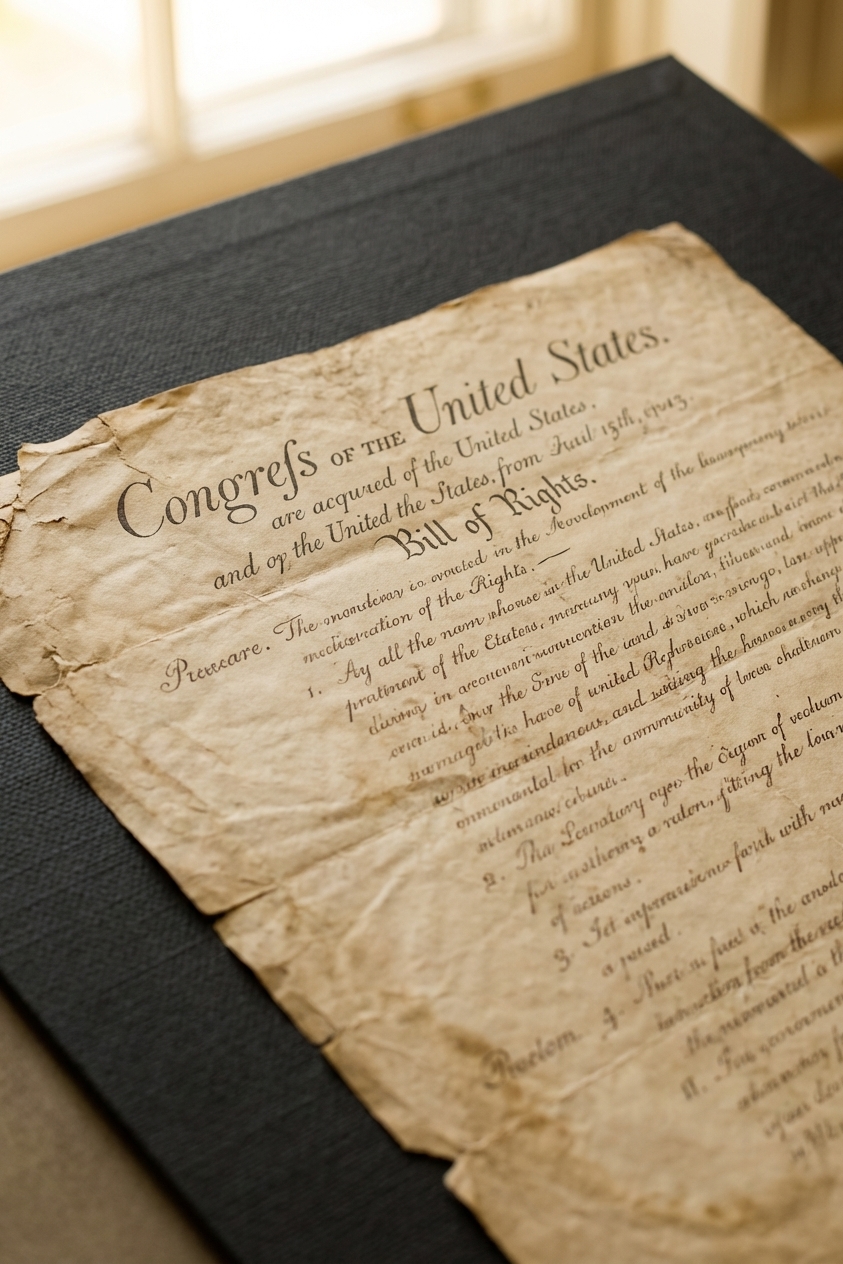
Below is each amendment in three layers: the original text, a plain-English translation, and a real-world example that shows how it still matters.
Quick facts
- Proposed by Congress: September 25, 1789
- Ratified: December 15, 1791
- Why it exists: Many states agreed to ratify the Constitution only if it would be quickly amended to protect individual liberties and restrain the new federal government.
- Important context: Originally, the Bill of Rights limited the federal government. Over time, much of it was applied to the states through the Fourteenth Amendment, a process called “incorporation.” Not every provision is incorporated the same way. For example, the Seventh Amendment jury-trial right is not fully applied to the states.
All 10 amendments, explained
First Amendment
Original text:
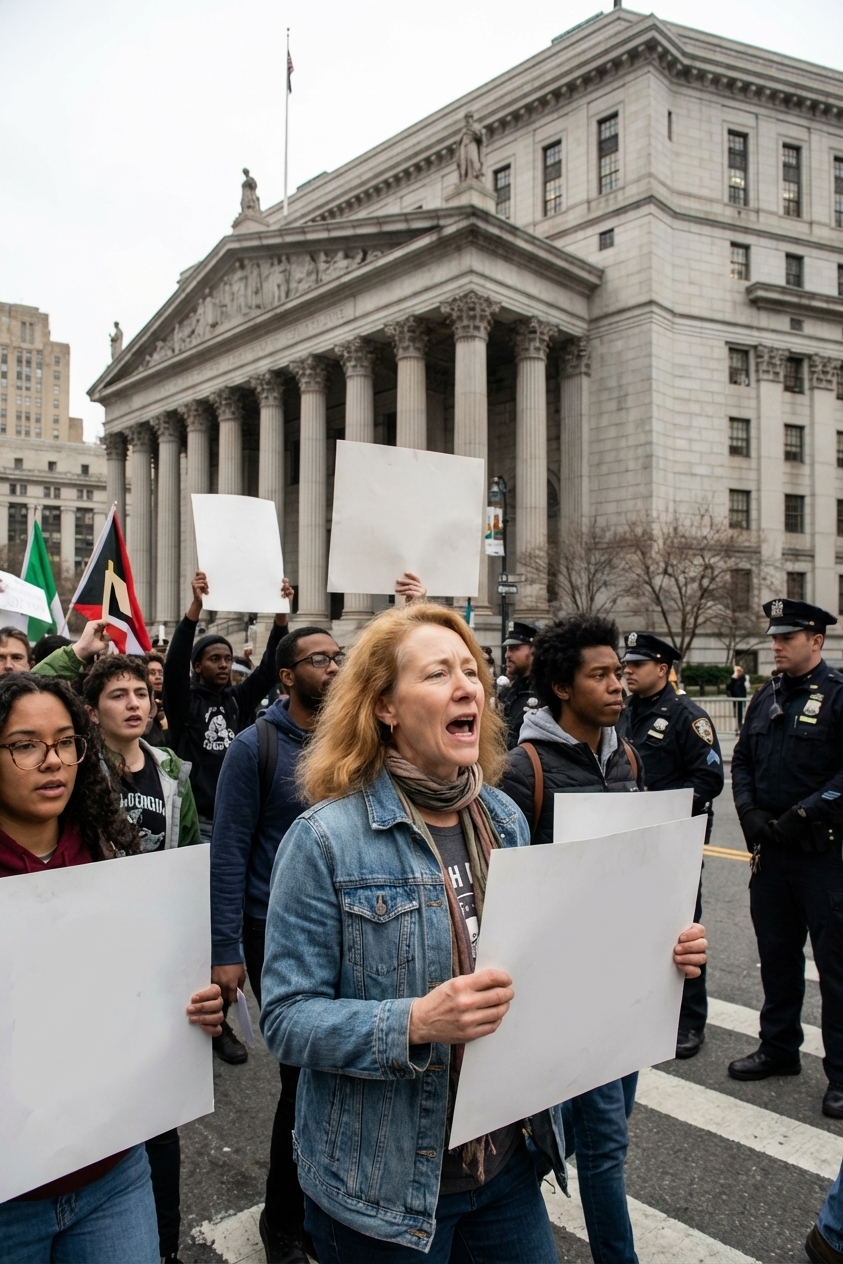
“Congress shall make no law respecting an establishment of religion, or prohibiting the free exercise thereof; or abridging the freedom of speech, or of the press; or the right of the people peaceably to assemble, and to petition the Government for a redress of grievances.”Plain English: The government cannot set up an official religion, stop you from practicing your religion (within limits), or punish you just because it dislikes your speech, your writing, your journalism, or your peaceful protests. There are important exceptions, including certain unprotected categories (like true threats, incitement, and obscenity) and content-neutral rules about time, place, and manner. You also have the right to ask the government to fix problems.
Real-world example: A public school cannot require students to participate in a state-composed prayer. And a city generally cannot deny a protest permit because it dislikes the protest’s message. But it can impose or enforce neutral rules tied to safety and logistics, like routes, crowd size limits, staffing needs, or conflicts with other events.
Second Amendment
Original text:
“A well regulated Militia, being necessary to the security of a free State, the right of the people to keep and bear Arms, shall not be infringed.”Plain English: People have a constitutional right to possess firearms and, under modern doctrine, to carry them for self-defense. That said, the right is not unlimited. Laws restricting guns in certain “sensitive places,” limiting possession by certain people (such as felons), and other longstanding forms of regulation have generally been treated as compatible with the amendment, even as courts debate the details.
Real-world example: After District of Columbia v. Heller (2008) and New York State Rifle & Pistol Association v. Bruen (2022), many gun restrictions are challenged by asking whether the law fits the nation’s historical tradition of firearm regulation.

Third Amendment
Original text:
“No Soldier shall, in time of peace be quartered in any house, without the consent of the Owner, nor in time of war, but in a manner to be prescribed by law.”Plain English: The government cannot force you to house soldiers in your home in peacetime. In wartime, it can only happen under rules set by law.
Real-world example: This issue rarely arises today, but it stands for a core principle: your home is not a government resource. When it does show up, it is often in unusual disputes, such as Engblom v. Carey (2d Cir. 1982), a case involving government housing and National Guard troop quartering. More broadly, scholars and some courts sometimes point to the Third Amendment as part of the Constitution’s deep respect for the home.

Fourth Amendment
Original text:
“The right of the people to be secure in their persons, houses, papers, and effects, against unreasonable searches and seizures, shall not be violated, and no Warrants shall issue, but upon probable cause, supported by Oath or affirmation, and particularly describing the place to be searched, and the persons or things to be seized.”Plain English: Government agents generally need a strong reason to search you or your property, and often need a warrant. A warrant must be specific, not a blank check. There are also major exceptions, including consent, exigent circumstances (emergencies), some searches incident to arrest, and certain vehicle-related searches.
Real-world example: If police want to search a home, they typically need a warrant signed by a judge based on probable cause. Modern disputes often involve phones and data: courts regularly ask what counts as a “search” when law enforcement seeks digital information or uses new surveillance tools.

Fifth Amendment
Original text:
“No person shall be held to answer for a capital, or otherwise infamous crime, unless on a presentment or indictment of a Grand Jury, except in cases arising in the land or naval forces, or in the Militia, when in actual service in time of War or public danger; nor shall any person be subject for the same offence to be twice put in jeopardy of life or limb; nor shall be compelled in any criminal case to be a witness against himself, nor be deprived of life, liberty, or property, without due process of law; nor shall private property be taken for public use, without just compensation.”Plain English: For serious federal crimes, charges generally require a grand jury indictment (with listed exceptions). The government cannot try you twice for the same crime after an acquittal or conviction. You can refuse to incriminate yourself. The government must follow fair legal procedures before taking your life, freedom, or property. And if it takes your property for a public project, it must pay you fairly.
Real-world example: You can invoke the right to remain silent during a police interrogation. Separately, if a city uses eminent domain to take land for a highway expansion, the owner is entitled to “just compensation,” often fought over in appraisals and court.

Sixth Amendment
Original text:
“In all criminal prosecutions, the accused shall enjoy the right to a speedy and public trial, by an impartial jury of the State and district wherein the crime shall have been committed, which district shall have been previously ascertained by law, and to be informed of the nature and cause of the accusation; to be confronted with the witnesses against him; to have compulsory process for obtaining witnesses in his favor, and to have the Assistance of Counsel for his defence.”Plain English: If the government prosecutes you for a crime, you have the right to a timely, open trial with an unbiased jury near where the crime happened. You must be told what you are accused of. You can challenge the witnesses against you, call witnesses for your defense, and have a lawyer help you.
Real-world example: If a person cannot afford an attorney, the state must provide one in criminal cases where jail time is on the line. This principle is central to modern public defender systems and is one reason convictions can be overturned when counsel was ineffective.

Seventh Amendment
Original text:
“In Suits at common law, where the value in controversy shall exceed twenty dollars, the right of trial by jury shall be preserved, and no fact tried by a jury, shall be otherwise re-examined in any Court of the United States, than according to the rules of the common law.”Plain English: In many federal civil lawsuits seeking money damages, you have a right to a jury. And once a jury decides key facts, courts cannot casually redo those fact findings. This is primarily a federal court guarantee and is not fully incorporated against the states.
Real-world example: In a federal lawsuit over an allegedly defective product, either side may demand a jury trial for claims seeking money damages. Many cases settle because both sides are weighing what a jury might do.

Eighth Amendment
Original text:
“Excessive bail shall not be required, nor excessive fines imposed, nor cruel and unusual punishments inflicted.”Plain English: The government cannot set bail or fines that are wildly disproportionate, and it cannot use punishments that are inhumane or out of line with basic standards of decency.
Real-world example: Courts review whether a punishment is grossly disproportionate to the offense, and whether certain prison conditions cross constitutional lines. The Supreme Court has also held that some large financial penalties can violate the “excessive fines” clause, including through state and local governments (see Timbs v. Indiana, 2019).

Ninth Amendment
Original text:
“The enumeration in the Constitution, of certain rights, shall not be construed to deny or disparage others retained by the people.”Plain English: Just because a right is not listed in the Constitution does not mean the people do not have it.
Real-world example: The Ninth Amendment is often discussed in debates about unenumerated rights, meaning rights not spelled out word for word in the text. It is part of the constitutional backdrop for arguments about personal autonomy, even when courts anchor specific rulings in other amendments or in the Fourteenth Amendment’s liberty language.
Tenth Amendment
Original text:
“The powers not delegated to the United States by the Constitution, nor prohibited by it to the States, are reserved to the States respectively, or to the people.”Plain English: The federal government only has the powers the Constitution gives it. Everything else belongs to the states or to the people, although those granted powers can still reach broadly through doctrines like the Necessary and Proper Clause.
Real-world example: Many fights over federalism live here. When Congress passes a law, courts sometimes ask whether it is tied to an enumerated power like regulating interstate commerce, taxing, or spending. If it is not, the law may be struck down as beyond federal authority.

What it does and does not do
It does: Set hard boundaries on government power, especially in speech, religion, criminal procedure, and the sanctity of the home. These are not promises that life will be easy. They are promises about what the state cannot do to you.
It does not: Solve every policy fight. It does not guarantee jobs, healthcare, or education. It also does not stop private companies from limiting speech on their own platforms, because the First Amendment generally restricts government actors, not private ones. And even when the government is involved, rights can be limited by generally applicable laws and established constitutional tests, such as content-neutral time, place, and manner rules.
If you want a useful habit: when a constitutional controversy breaks out in the news, ask two questions.
- Who is restricting the right? A government actor or a private actor?
- Which amendment is doing the work? The text itself, or later interpretation through court doctrine?
That is how the Bill of Rights stays alive: not as a poster on a classroom wall, but as a set of rules we keep applying to new facts.