
Most Americans can name the three branches of government. Fewer can explain what each one actually does without slipping into civics class shorthand like “Congress makes laws” and “the President enforces them.”
That shorthand is not wrong. It is just incomplete. The Constitution does not build three neatly separated lanes. It builds three power centers that overlap on purpose, then wires them together with friction.
That friction has a name: separation of powers. And its companion system, checks and balances, is the reason no single branch is supposed to be able to govern alone.
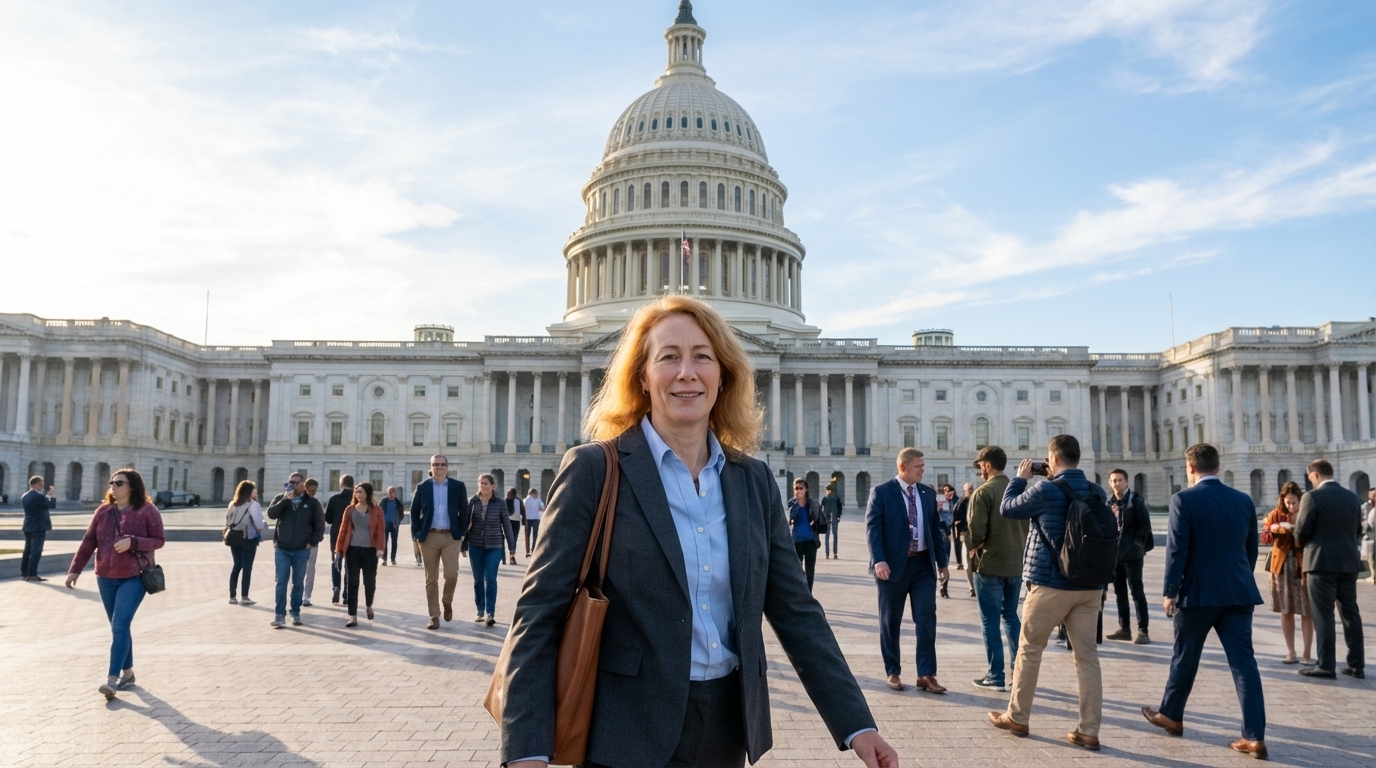
Below is how the legislative, executive, and judicial branches work, where the Constitution gives them their authority, and what it looks like when they collide in real life.
Quick facts
Simple diagram concept:
- Legislative (Congress) → makes federal law
- Executive (President and agencies) → implements and enforces federal law
- Judicial (Courts) → resolves cases and interprets law
Key constitutional anchors:
- Article I: Congress (House and Senate)
- Article II: President and executive power
- Article III: Supreme Court and federal judiciary
Core powers, simplified:
- Congress: passes laws, levies taxes and authorizes and appropriates spending, declares war, confirms or rejects key appointments, can impeach and remove officials
- President: executes laws, commands the military, negotiates treaties, appoints judges and officers, can veto legislation
- Courts: decide cases and controversies, can invalidate unconstitutional laws or executive actions through judicial review in decided cases
The Legislative Branch
What it is
The legislative branch is Congress, made up of two chambers:
- House of Representatives, designed to reflect the people more directly through smaller districts and shorter terms.
- Senate, designed to reflect the states equally and move more slowly.
The Constitution opens with Congress for a reason. The Founders feared concentrated executive power. They made lawmaking the first branch and then fragmented it into two houses so that passing a law would be intentionally difficult.
What it does
- Makes federal law. A bill generally must pass both the House and Senate in the same form and then go to the President.
- Controls taxing and spending. Congress authorizes programs and appropriates money, shaping fiscal policy through budget resolutions, appropriations bills, and tax laws. The President proposes a budget, but federal spending ultimately flows through congressional authorization and appropriation.
- Controls the purse, with real-world nuance. As a rule, agencies cannot spend federal money without congressional permission under the Appropriations Clause. Some programs operate through standing or mandatory appropriations, and some agencies spend user fees when Congress has authorized them.
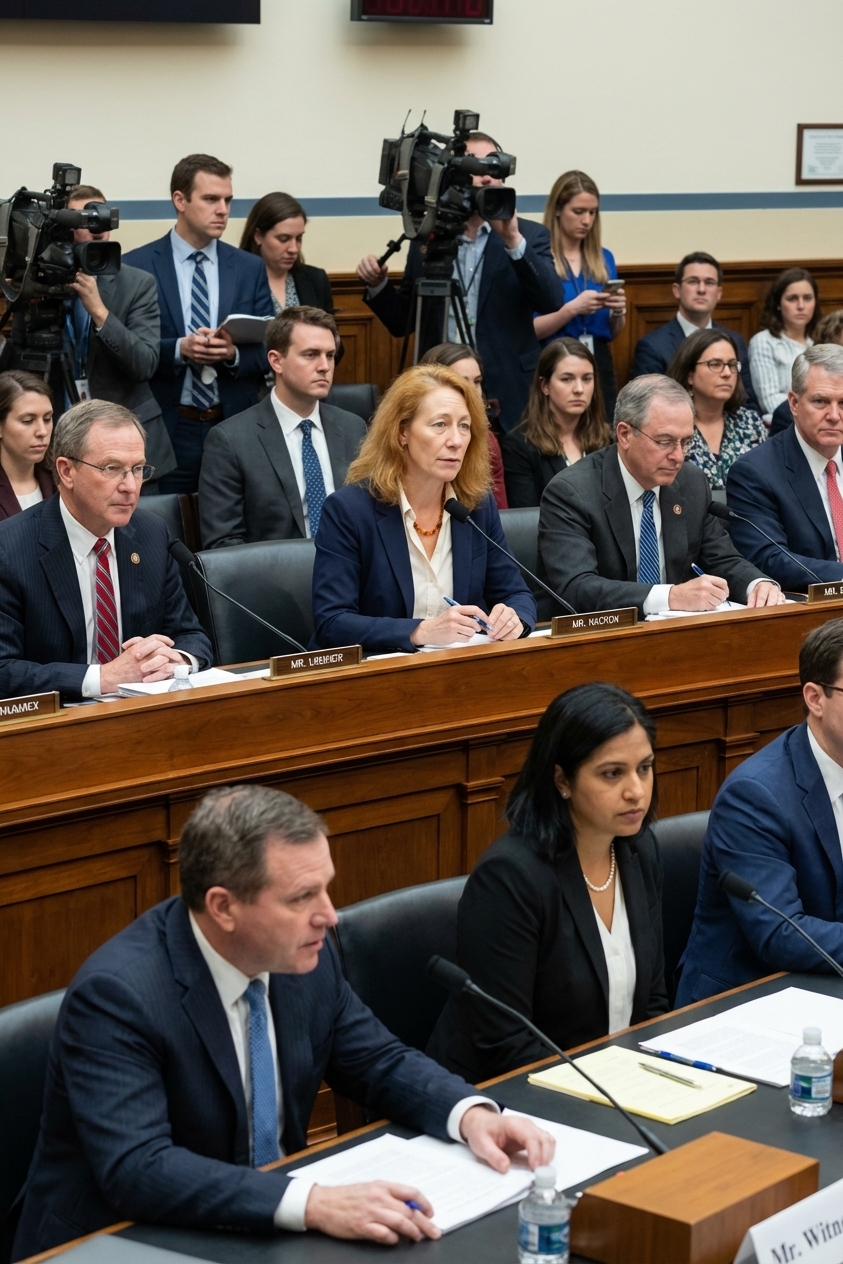
- Oversees the executive branch. Committees investigate, subpoena witnesses, and demand documents.
- Confirms appointments and treaties through the Senate.
- Impeaches and removes officials. The House impeaches. The Senate tries the case.
Checks Congress has
- On the President: override vetoes, control funding, approve appointments, give advice and consent on treaties, investigate wrongdoing, impeach and remove.
- On the courts: create and organize lower federal courts, set jurisdiction rules within constitutional bounds, confirm judges, and propose constitutional amendments that supersede judicial rulings.
Real checks in action
1) Overriding a presidential veto
When a President vetoes a bill, Congress can still make it law with a two-thirds vote in both chambers. That threshold is intentionally high because it forces broad agreement before Congress can overrule the executive.
A concrete example: in 2016, Congress overrode President Obama’s veto of the Justice Against Sponsors of Terrorism Act (JASTA).
2) Impeachment
Impeachment is not a criminal trial. It is a constitutional remedy for public officials. The House votes on articles of impeachment by a simple majority. The Senate conducts a trial, and removal requires a two-thirds vote. Even when removal does not happen, impeachment functions as a public accounting mechanism that can constrain future behavior.
The Executive Branch
What it is
The executive branch is the President plus the departments and agencies that carry federal law into effect, from the Department of Justice to the Environmental Protection Agency to the Department of Defense.
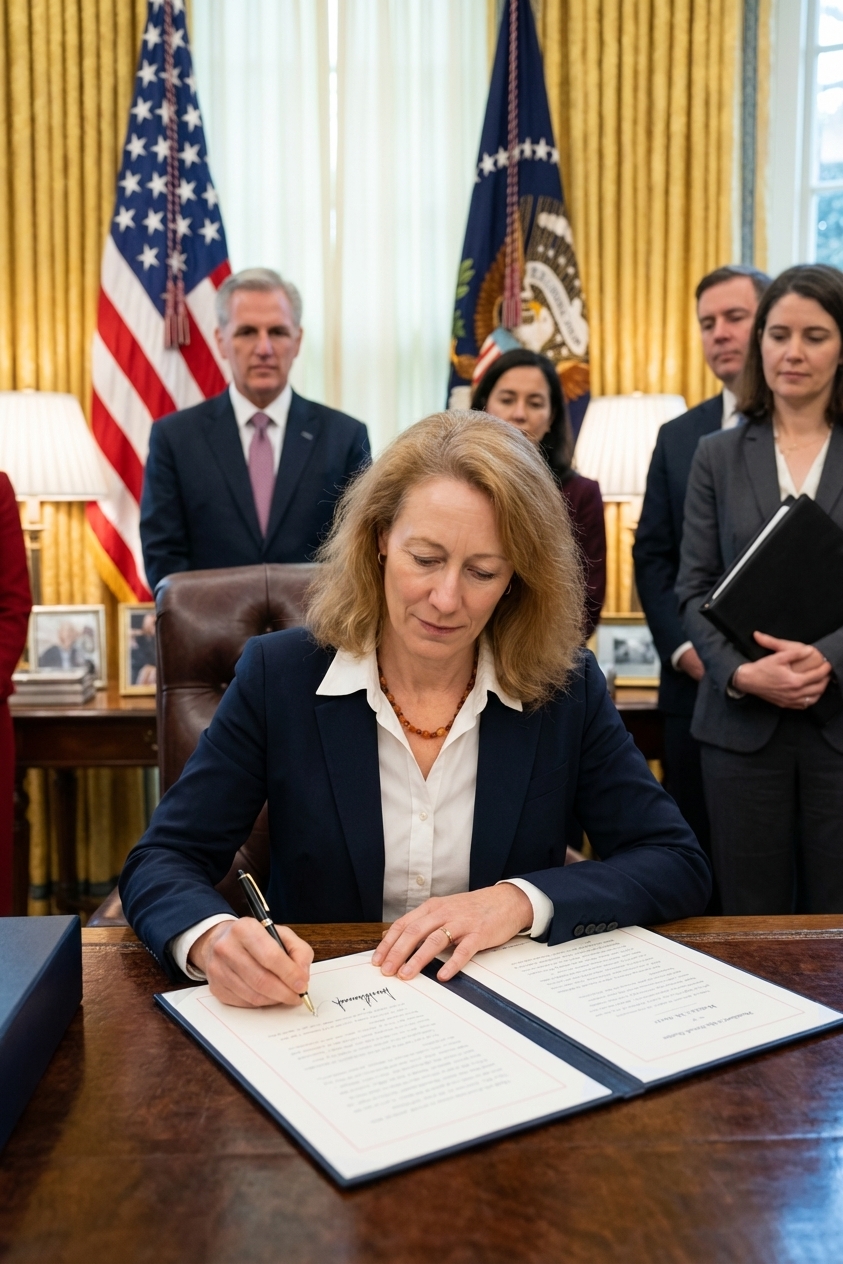
Article II begins with a short phrase: “The executive Power shall be vested in a President of the United States of America.” That brevity has fueled two centuries of debate about how much independent power a President has, especially in emergencies, foreign affairs, and enforcement discretion.
What it does
- Enforces federal law. The executive branch decides how to prioritize investigations, prosecutions, and regulatory enforcement.
- Runs the federal bureaucracy. Agencies write regulations, issue permits, and administer programs Congress has authorized and funded.
- Leads diplomacy and executes foreign policy. The President negotiates treaties, but they take effect only with Senate advice and consent, requiring approval by two-thirds of Senators present. In modern practice, Presidents also rely heavily on executive agreements, which do not go through the treaty process but still operate within constitutional and statutory limits.
- Commands the military. The President is Commander in Chief, while Congress retains key war powers and controls military funding.
- Appoints officials and judges, generally with Senate confirmation.
- Vetoes legislation. A veto forces Congress to revise a bill or gather the votes to override.
Checks the President has
- On Congress: veto and veto threat, recommend legislation, call special sessions in limited circumstances, execute laws in ways that can shape policy outcomes.
- On the courts: appoint judges (with Senate consent), influence litigation positions through the Department of Justice, grant pardons for federal offenses.
Real checks in action
1) The veto
The veto is more than a no. It is leverage. Presidents often use the credible threat of a veto to change a bill before it ever reaches their desk. Congress, anticipating the veto, may compromise earlier. The check functions even when the veto is never formally used.
2) Appointments as a long-term check
A President’s judicial appointments can shape constitutional interpretation for decades. This is a slow-moving check, but it is one of the most consequential. A single term can remake the federal courts’ approach to executive power, federalism, criminal procedure, and civil rights.
The Judicial Branch
What it is
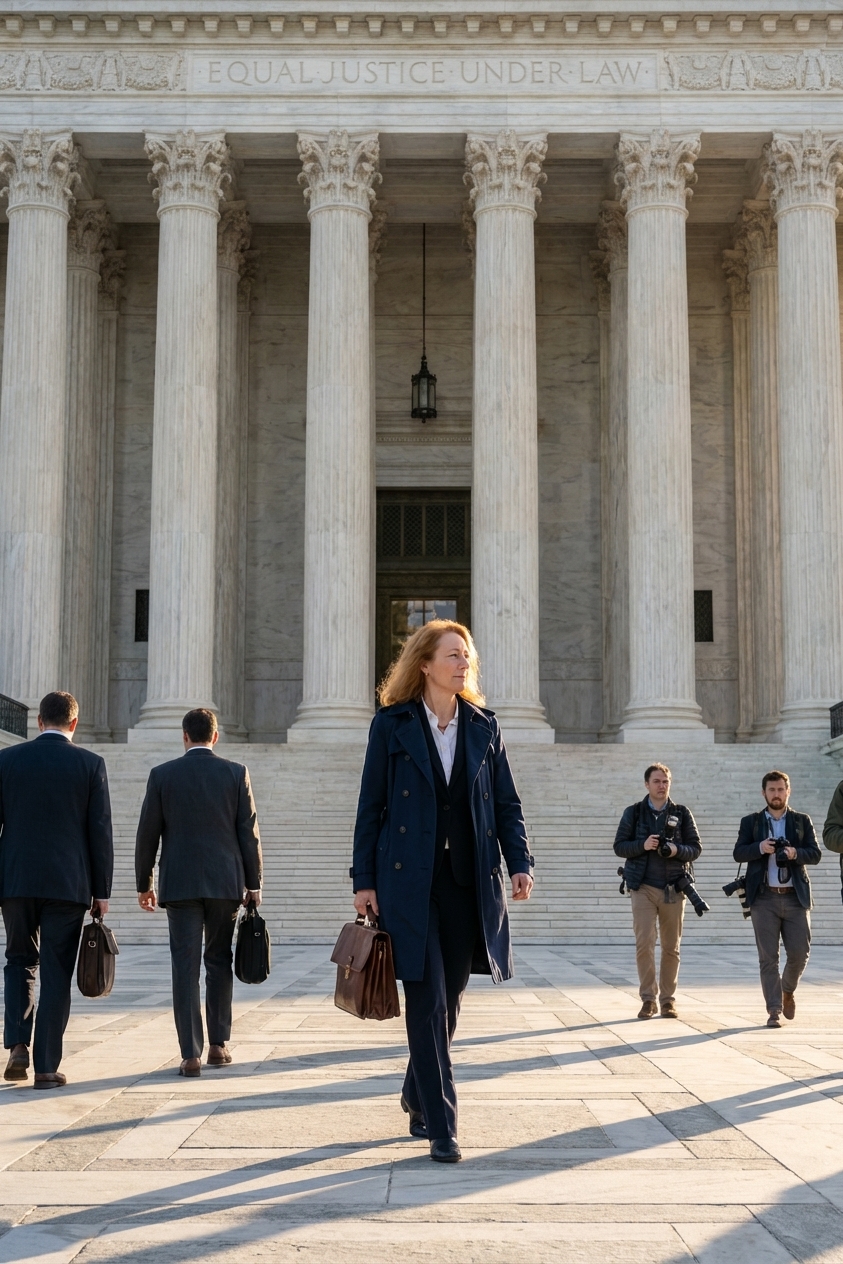
The judicial branch is the federal court system, led by the Supreme Court and supported by lower federal courts Congress has created.
Unlike Congress and the President, federal judges do not stand for election. The Constitution instead protects their independence through life tenure during “good Behaviour” and limits on salary reductions. The point is not to make judges unaccountable. It is to insulate constitutional interpretation from day-to-day political retaliation.
What it does
- Decides “cases” and “controversies.” Federal courts do not issue advisory opinions. They resolve disputes brought by parties with standing.
- Interprets the Constitution and federal law. That interpretation binds the parties and, through precedent, shapes future cases.
- Reviews government action. Courts evaluate whether Congress and the President acted within constitutional limits, but only in the context of actual litigation, not as a freestanding supervisory power.
Judicial review
The Constitution never uses the phrase “judicial review.” But in Marbury v. Madison (1803), the Supreme Court asserted the authority to declare a law unconstitutional in a case before it. In practice, judicial review is the judiciary’s main checking tool.
This is sometimes described as “the Court is supreme.” That is not quite right. The Constitution is supreme.
Courts are the institution assigned to apply it in real disputes, with decisions that other branches generally treat as binding unless changed by later rulings, new legislation within constitutional bounds, or constitutional amendments.
Limits on the courts
The judicial branch is powerful, but fenced in. Beyond the ban on advisory opinions, doctrines like standing, mootness, and the political question doctrine often keep federal courts from reaching the merits of a dispute.
Checks the courts have
- On Congress: invalidate statutes that violate constitutional limits, interpret statutes in ways that narrow or expand their reach.
- On the President: invalidate executive orders and agency actions, enforce due process limits, and require compliance with statutory procedures.
Checks against the courts
The judiciary is independent, not untouchable. Other branches still have real checks:
- Appointments: Presidents nominate, and the Senate confirms.
- Legislation: Congress can rewrite statutes the Court has interpreted, as long as the new law is constitutional.
- Jurisdiction and structure: Congress sets the size and organization of the lower federal courts and can shape the Supreme Court’s appellate jurisdiction within constitutional limits. It cannot eliminate the Court’s original jurisdiction, and the scope of jurisdiction-shaping is contested at the edges.
- Impeachment: Federal judges can be impeached and removed for misconduct.
- Amendments: The ultimate override is changing the Constitution itself.
Real checks in action
1) Striking down a law
When the Court invalidates a statute, it is not vetoing Congress. It is declaring that the statute conflicts with a higher authority: the Constitution. Congress can respond by rewriting the law to fit constitutional boundaries, or by pursuing an amendment if it wants to change the boundary itself.
A well-known example of the rewrite cycle: after the Court’s decisions limiting parts of the Violence Against Women Act (notably United States v. Morrison), Congress and states pursued other routes to address the same underlying harms through different legal tools.
2) Blocking executive action
Courts frequently review executive branch actions, especially agency rulemaking and presidential directives. A court can pause a policy through an injunction, require the executive to follow proper procedures, or hold that the executive exceeded statutory authority.
For instance, in 2022 the Supreme Court limited the EPA’s approach to power-plant emissions in West Virginia v. EPA, prompting renewed legal and regulatory battles over what the Clean Air Act authorizes.
How it works
In textbooks, the branches are presented as three distinct job descriptions. In reality, checks and balances look like a recurring negotiation over who gets to decide, who gets to stop, and what happens next when they disagree.
Scenario 1: Law and veto
- Congress: passes a bill.
- President: vetoes it.
- Congress: either revises the bill to satisfy objections or attempts a two-thirds override.
The system forces coalition-building. A bare majority can propose policy, but durable policy often requires wider agreement.
Scenario 2: Action, review, response
- President and agencies: issue an order or regulation.
- Courts: determine whether the action fits statutory and constitutional constraints.
- Congress: can clarify the statute, restrict funding, or broaden authority by passing new legislation.
This loop is one reason constitutional conflict does not always end in a single Supreme Court decision. Often it triggers a legislative rewrite and a second round of litigation.
Scenario 3: Impeachment
Impeachment exists for moments when ordinary politics and elections are not enough to address alleged high-level misconduct. It is intentionally difficult to complete because removal is a profound act. But the process itself is a check: it compels evidence-gathering, public testimony, and formal judgment by elected representatives.
Why it matters
Separation of powers is not a polite suggestion. It is a design choice based on a blunt view of human nature.
The Framers assumed ambition, faction, and self-interest would always exist. So they built a system where power counters power. Congress wants to legislate. Presidents want to lead. Courts want to interpret. Each branch has tools to resist the others, and each depends on the others to complete its work.
When the system is functioning well, it feels slow. That is the point. The Constitution is not optimized for speed. It is optimized to prevent a single decision maker from becoming the only decision maker.
And if you ever want to know whether a debate is truly constitutional, ask one question: Which branch is claiming the power to decide, and what check is supposed to restrain it?
Common questions
Is the Supreme Court above Congress and the President?
No. The Constitution is above all of them. The Court has the authority to interpret the Constitution in cases before it, and its rulings are treated as binding. But Congress and the President still check the judiciary through appointments, legislation, and the amendment process.
Can the President make laws?
The President cannot pass statutes. But the executive branch can shape policy through enforcement priorities, executive orders, and agency regulations. Those actions must rest on constitutional authority or authority Congress has delegated by statute.
Why is it so hard to get anything done?
Because the system is meant to require broad agreement for major change. Gridlock can be frustrating, but it is also a safeguard. The same obstacles that slow good ideas also slow reckless ones.
Does the Senate filibuster come from the Constitution?
No. The filibuster is a Senate rule and practice, not a constitutional requirement. It matters because it can raise the effective vote threshold for many bills, adding another layer of friction inside Congress itself.