
“The draft” is one of those phrases that can make American politics feel instantly existential. It raises a blunt question: can the federal government compel you to fight?
Constitutionally, the answer has long been yes. But the practical reality in 2026 is narrower and more bureaucratic than many people assume. The United States does not currently draft people into military service. What it does maintain is the Selective Service System, a registration framework designed to make a future draft possible if Congress and the President choose to revive it.
As of April 2026, the rules described below reflect current federal law and Selective Service policy. Because this area can change by statute, regulation, or agency implementation, it is always worth checking the Selective Service site for the latest.
Quick takeaway: if you are a man in the U.S. age 18 through 25, you likely must register. Registration is not the same thing as being drafted.
This page separates what the law actually requires today from what people think it requires, then zooms out to the constitutional logic underneath it all.
Join the Discussion
Draft vs. Selective Service
A lot of confusion disappears if you keep one distinction in mind:
- Selective Service registration is a standing administrative requirement for certain people. It collects basic identifying information so the government could run a draft if one were authorized later.
- A draft is the actual legal process of ordering people into military service. That requires new political decisions and legal authority, typically congressional legislation plus executive administration, along with the machinery to run induction.
Registration is the “just in case” framework. A draft is the “we are doing it” decision.
Who must register today
Under current federal law, Selective Service registration is required for most male U.S. citizens and male noncitizens in the U.S. who are 18 through 25.
Timing matters: in general, you are expected to register within 30 days of turning 18, entering the U.S., or changing into a status that requires registration.
In general, required
- Male U.S. citizens age 18 through 25
- Male lawful permanent residents (green card holders) age 18 through 25
- Male refugees, asylees, and many other male noncitizens residing in the U.S. age 18 through 25
- Men in the U.S. without lawful status are generally required to register if they are 18 through 25
- Transgender policy (per Selective Service guidance): registration is generally tied to sex assigned at birth. That means many transgender women (assigned male at birth) are required to register, and many transgender men (assigned female at birth) are not. Because documentation and exceptions can be fact specific, check current Selective Service instructions if you are unsure.
Generally not required
Some categories are excluded by statute or policy, and eligibility details can be fact specific. Common examples include:
- Those on active duty in the U.S. Armed Forces
- Cadets and midshipmen at service academies
- Some individuals in certain nonimmigrant visa categories who are in the U.S. temporarily. Commonly discussed examples include certain temporary visitors and some students, but this is status specific, and people misapply it. Use the Selective Service “Who Must Register” guidance to confirm.
Women are not currently required to register under federal law (as of April 2026). There have been repeated policy and legislative debates about expanding registration, but the legal requirement today remains sex specific.
If you are looking for your own exact status, the safest approach is to check Selective Service guidance directly and, if needed, get legal advice. This article is a constitutional overview, not individualized eligibility counsel.

How to register or check status
You can register and verify your status through the official Selective Service website. If you are past the usual window, Selective Service also provides instructions for late registration and status information for people who have aged out. Because missed registration can show up later in employment or benefits paperwork, it is usually better to resolve questions early than to guess.
What happens if you do not register
Registration is not symbolic. Failing to register can have real consequences. Depending on your situation, it can affect:
- Federal jobs, where proof of registration may be required
- Some job training programs, where Selective Service status can still matter
- Some state benefits, because several states link state programs (and sometimes driver’s license processes) to Selective Service status
- State-level student aid in some places, depending on how your state structures eligibility rules
- Naturalization issues for some noncitizens, where failure to register can be raised in evaluating good moral character
Important update: failing to register is not a barrier to federal student aid eligibility. Congress removed Selective Service registration as a condition of federal financial aid eligibility through FAFSA simplification changes that took effect beginning with the 2021 to 2022 award year.
Criminal prosecutions for non-registration have been rare in recent decades, but the civil and administrative consequences above are the primary way the requirement is felt in real life. The details vary and the consequences are not identical for everyone, but the takeaway is simple: if you are required to register, it is usually best to address it early, not when you are already filling out an employment or benefits form.
Common myths
Myth: “If you register, you consented to being drafted”
Registration is not a contract. It is compliance with a federal requirement. A draft would still require Congress to authorize a system of conscription and the executive branch to implement it.
Myth: “The President can draft people whenever he wants”
The President cannot unilaterally create a draft out of thin air. The constitutional architecture runs through Congress. The President is Commander in Chief of the armed forces that exist, but the power to create the legal framework for compulsory service belongs to the legislature.
Myth: “The Constitution bans involuntary service”
The Thirteenth Amendment prohibits slavery and involuntary servitude, but the Supreme Court has long held that military conscription is not the kind of “involuntary servitude” the amendment was aimed at. The draft is treated as a traditional incident of national defense powers, not forced labor for private benefit.
Myth: “Draft laws are unconstitutional because war must be declared first”
The Constitution gives Congress power to declare war, but it also gives Congress power to raise and support armies. Historically, the draft has been justified as part of that broader war and defense authority, whether or not a formal declaration of war exists in a given conflict. In modern practice, Congress often authorizes and sustains military action through statutes, authorizations to use military force, and appropriations, even when it does not issue a formal declaration.
Where the draft power comes from
The Constitution never says, “Congress may draft.” What it does say is the key.
Article I: Congress builds the framework
Several clauses in Article I, Section 8 do the heavy lifting:
- Raise and support armies
- Provide and maintain a navy
- Make rules for the government and regulation of the land and naval forces
- Provide for calling forth the militia and for organizing, arming, and disciplining it
- Necessary and Proper Clause, which lets Congress choose practical means to carry its enumerated powers into execution
If you want the constitutional logic in one sentence: if Congress has the power to raise armies, it has power to choose mechanisms to raise them, including conscription, so long as those mechanisms do not violate other constitutional protections.
Article II: the President commands
The President’s Commander in Chief power is real, but it is not a blank check to create military manpower policy independently of Congress. Conscription has been treated as a legislative tool, implemented by the executive.
A short history
American conscription has not been a single continuous program. It has appeared in bursts, usually during moments of mass mobilization.
Early America and the Civil War
- Militia traditions dominated early defense policy, alongside voluntary enlistment.
- The Civil War produced the first major federal conscription effort, and also some of the earliest large scale political backlash against it.
World War I and World War II
- World War I ushered in modern national draft administration.
- World War II brought mass conscription on an even larger scale, deeply shaping the idea of military service as a shared national obligation.
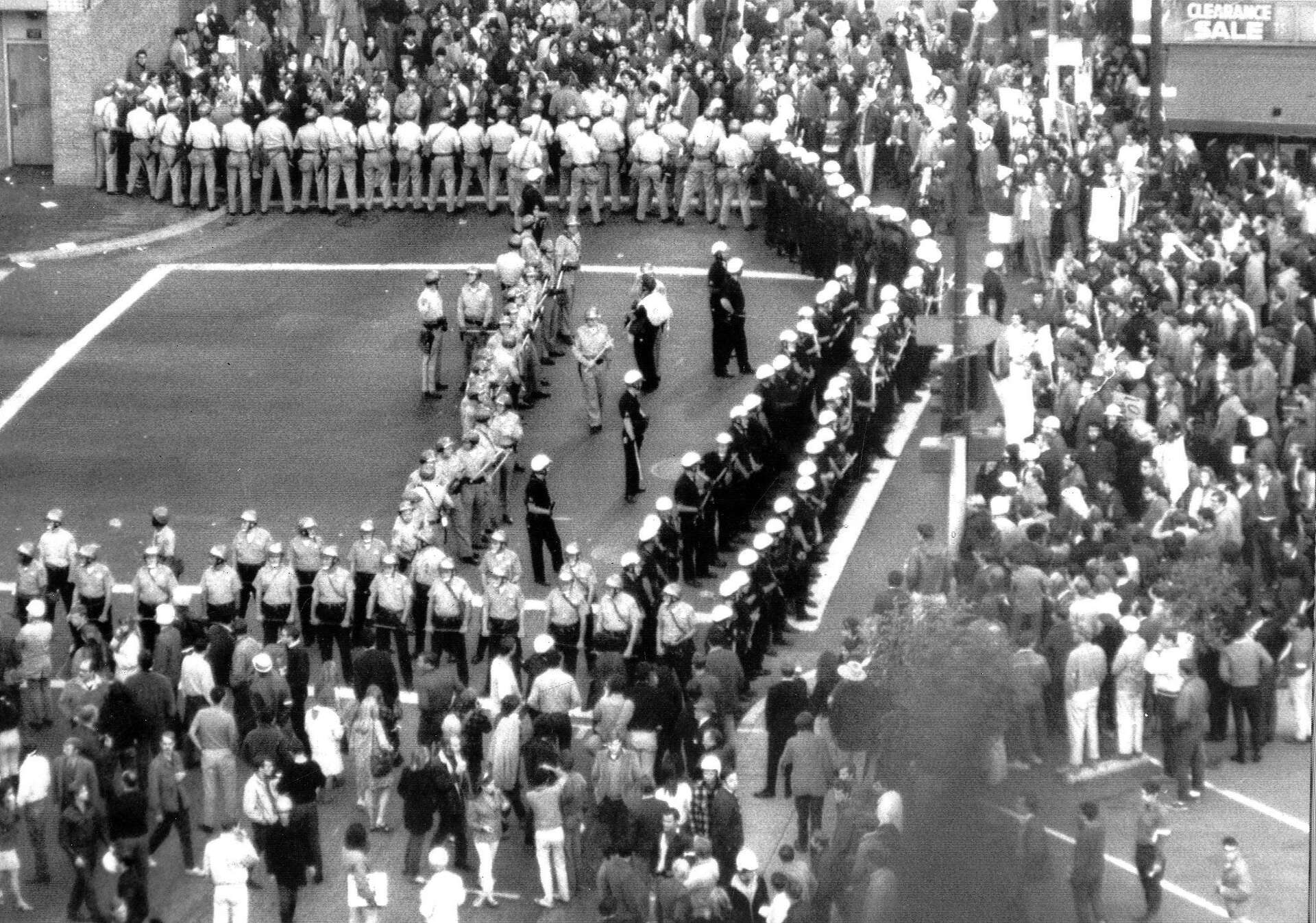
The Cold War and Vietnam
- The draft continued through much of the Cold War era.
- Vietnam made conscription politically radioactive for a generation, in part because of perceived unfairness in how service burdens were distributed.
1973 and after
The U.S. shifted to an All Volunteer Force in the early 1970s. But Selective Service registration returned in the late 1970s and continues today as a standby framework.
The Supreme Court
Conscription has been litigated repeatedly, and the Court’s basic position has been consistent: Congress’s power to raise armies is broad enough to include the draft.
Selective Draft Law Cases (1918)
During World War I, challengers argued that conscription exceeded congressional power and violated individual liberty. In the Selective Draft Law Cases (Arver v. United States, 1918), the Supreme Court upheld the federal draft, treating it as a valid exercise of Congress’s power to raise armies, supported by the Necessary and Proper Clause. The Court also rejected the argument that conscription was prohibited “involuntary servitude” under the Thirteenth Amendment.
Registration and equal protection (1981)
Rostker v. Goldberg addressed the constitutionality of requiring only men to register. The Court upheld the male-only registration system at the time, leaning heavily on two ideas:
- Deference to Congress in military affairs
- The combat restrictions on women that existed at the time, which the Court treated as relevant to Congress’s judgment about registration
Two important caveats for modern readers:
- Rostker did not say sex classifications in military policy are automatically constitutional. It said Congress had a sufficient basis on the record before it.
- The factual landscape has changed since 1981, including expanded roles for women in combat. That does not automatically overturn Rostker, but it is part of why Congress keeps revisiting the issue.
Conscientious objection
Other cases have wrestled with who may be exempted or accommodated, particularly for religious or moral objections to war. Over time, the law and the Court’s decisions have generally recognized that conscientious objection can be grounded in sincere moral belief, not only membership in a traditional church (see, for example, United States v. Seeger (1965) and Welsh v. United States (1970)). The constitutional tension here is perennial: how to respect free exercise and liberty of conscience without letting exemptions swallow the power to raise forces.
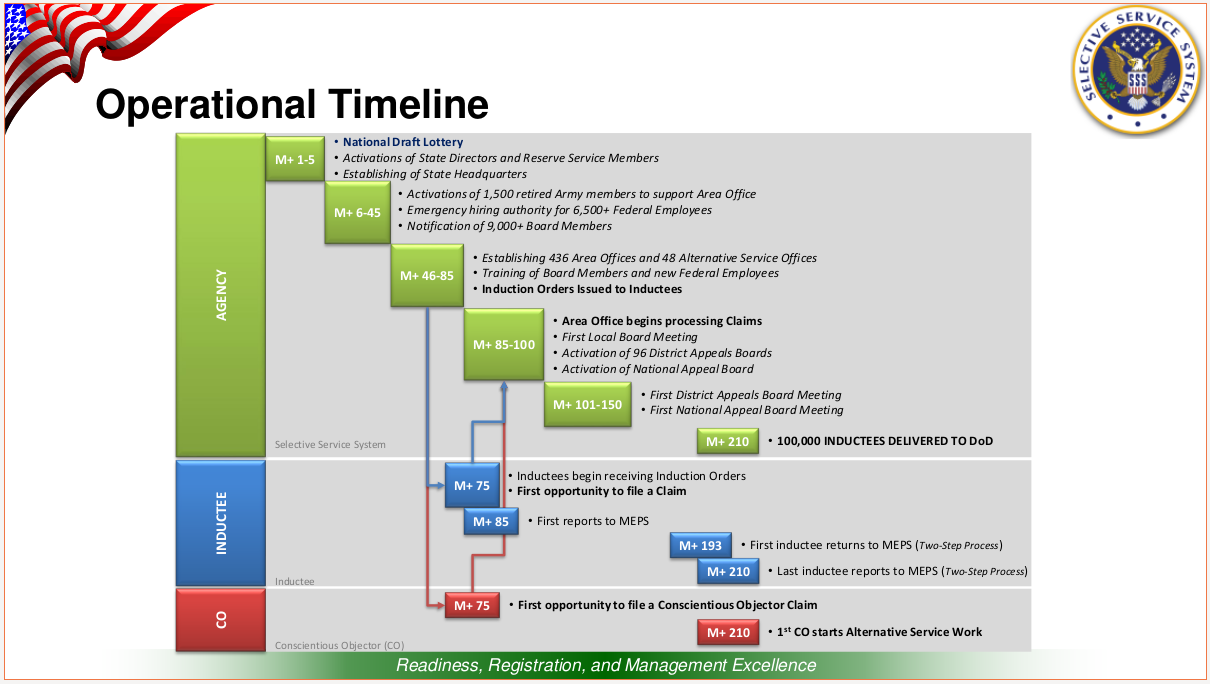
How a draft would happen
If the U.S. were to restart conscription, it would not be triggered by a single dramatic presidential announcement and a line of buses.
Historically, a functioning draft has depended on:
- Congressional legislation authorizing conscription and setting key rules, including who is eligible and how deferments or exemptions work
- Executive administration through agencies that run registration, classification, and induction
- Appropriations, because manpower programs are expensive and require infrastructure
Selective Service exists because building that infrastructure after an emergency begins can be too slow. Registration is an attempt to keep the first step ready.
How selection works
If a draft were authorized, selection would likely rely on a lottery-style process (historically tied to birth dates), followed by classification decisions that determine who is actually inducted and who is deferred, exempted, or found ineligible. The core point is that a draft is not one moment. It is a process.
Drafts and war powers
The draft sits at the intersection of two constitutional realities that Americans often mentally separate:
- War powers are shared. Congress raises, funds, regulates, and can declare war. The President commands and directs military operations.
- Modern conflict blurs traditional categories. The U.S. has repeatedly used force without a formal declaration of war, while still relying on congressional statutes to authorize, fund, and structure the military.
That means the draft debate is rarely just “can Congress do this,” because the Court has largely answered that. The sharper modern questions are democratic and institutional:
- Under what conditions should Congress use that power?
- How should burdens be distributed fairly?
- What safeguards should exist for conscience, family obligations, disability, and equal treatment?
The Constitution provides the tools. It does not provide the policy answer.
What to watch
Selective Service is a constitutional topic that evolves less through dramatic Supreme Court reversals and more through slow political decision-making. Three pressure points keep returning:
- Sex and registration: whether Congress will extend registration to women, and what constitutional challenges would look like in light of today’s military roles.
- Fairness and exemptions: how any future draft would handle deferments and conscientious objection without recreating the inequities that helped discredit conscription during Vietnam.
- Civic legitimacy: whether a modern democracy can demand compulsory service without a clear congressional mandate and transparent justification.
The Selective Service System is quiet on purpose. Its constitutional significance is the opposite. It is one of the clearest places where the republic’s first principles become painfully concrete: when national survival is claimed, what can the government require of the individual, and who decides?