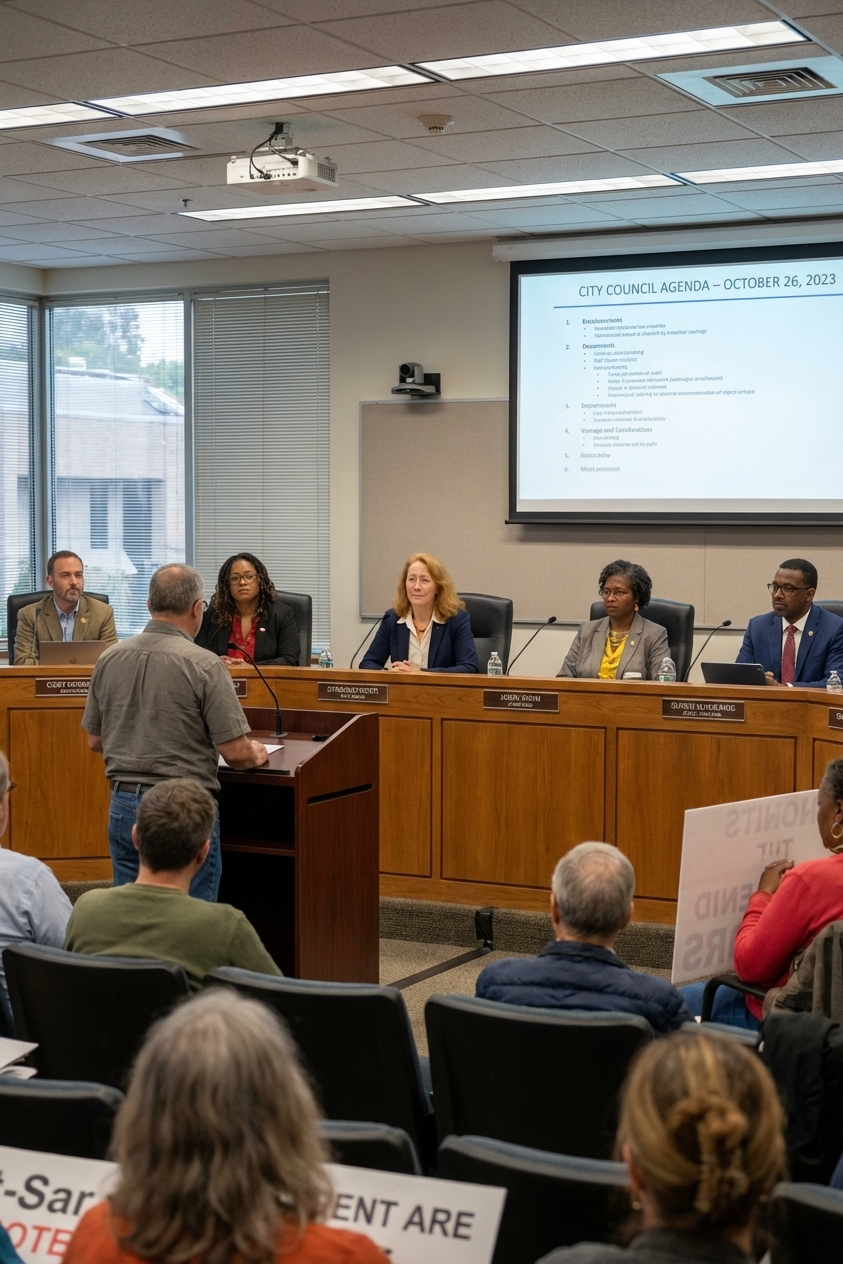
"Sanctuary city" sounds like a legal status. It is not. There is no checkbox in federal law that turns a city into a sanctuary, no formal certification from Washington, no constitutional clause that blesses or bans the label.
What the term usually means is much narrower and much more technical: a state, county, or city has adopted a policy that limits how its own employees and resources will be used for federal immigration enforcement. The federal government enforces immigration law. The local government decides how far it will help.
Last updated: March 29, 2026. Because these policies change, always confirm details in the current municipal code, sheriff policy, or state guidance.

What is a sanctuary city, county, or state?
In practice, sanctuary policies are non-cooperation or limited-cooperation rules. They vary by place, but they often address a few recurring questions.
Common policy features
- Limits on immigration questioning. Local police and jail staff may be told not to ask about immigration status unless it is relevant to a crime, needed for a specific benefit, or required by state law.
- Limits on honoring ICE detainers. Immigration and Customs Enforcement (ICE) may request that a jail hold someone longer than their release time so ICE can take custody. Many jurisdictions treat detainers as voluntary requests and decline them unless ICE provides a judicial warrant or court order.
- Limits on notifying ICE. Some policies restrict proactively informing ICE about a person’s release date, again unless a warrant, court order, or a specific triggering offense is involved.
- Limits on ICE access in local facilities. Some jurisdictions regulate when ICE agents may interview people inside jails or courthouses through neutral access rules that apply to all outside agencies.
- Separation of roles. Local officers are directed to prioritize local policing, not civil immigration enforcement.
None of those rules prevent the federal government from enforcing federal law directly. They determine whether local government will serve as an extra set of hands.
What these policies do not do
- They do not make someone “immune” from deportation.
- They do not stop federal agents from operating in the jurisdiction.
- They do not nullify federal immigration statutes.
- They do not typically bar cooperation in serious criminal cases, especially with judicial warrants.
One important limit: local governments can set access rules for their property and employees, but they cannot legally veto a federal arrest that federal law otherwise authorizes. Most policies are written to avoid that kind of prohibition and instead control local participation and facility access.
Quick terms
- Detainer: an ICE request to a jail to hold someone briefly beyond their local release time so ICE can assume custody.
- Judicial warrant: a warrant signed by a judge or magistrate.
- Administrative ICE warrant: an ICE document (often on forms like I-200 or I-205) signed by an immigration officer, not by a judge. Some jurisdictions treat these as insufficient for additional detention; others treat them as adequate for certain steps like notification or transfer. Policies vary.
The legal backbone: the 10th Amendment
The constitutional argument for sanctuary policies rests largely on a simple federalism point: the federal government can enforce federal law, but it generally cannot commandeer state and local governments to run federal programs.
This idea is tied to the 10th Amendment, which reserves powers not delegated to the United States to the states or the people. Over time, the Supreme Court has turned that broad principle into a more specific rule: Congress may not require states to use their legislative or executive machinery to carry out federal directives.
Key Supreme Court cases
- New York v. United States (1992). Congress cannot force a state legislature to enact or administer a federal regulatory program.
- Printz v. United States (1997). Congress cannot require state executive officials, including local law enforcement, to carry out federal background-check duties.
- Murphy v. NCAA (2018). Anti-commandeering applies not only to commands to act, but also to federal attempts to dictate what states may and may not legislate in certain areas. The Court reaffirmed that states are not mere administrative units of the federal government.
Sanctuary policies often describe themselves as an application of that doctrine: local governments are not obligated to spend their budgets, jail space, or officer time on civil immigration enforcement unless state law chooses to do so.
A related concept is preemption. Federal law can override conflicting state and local laws, especially where Congress has occupied the field or where local rules affirmatively obstruct federal enforcement. Many sanctuary-style policies are drafted to stay on the safer side of that line by focusing on local resource allocation and employment rules, rather than attempting to block federal officers from enforcing federal law.

Detainers and the jail focus
The flashpoint is often the ICE detainer. A detainer is typically a request that a local jail hold a person for up to 48 hours past their scheduled release time, excluding Saturdays, Sundays, and holidays, so ICE can take custody. Exact practices can vary by jurisdiction and by how a jail calculates release time.
Many jurisdictions treat detainers as voluntary because, in many cases, they are not signed by a judge. That matters for two reasons.
- Fourth Amendment risk. Holding someone past their release time can become a new seizure. Courts have repeatedly flagged liability concerns when localities hold people solely on detainers without judicial process. Commonly cited examples include Miranda-Olivares v. Clackamas County (D. Or. 2014) and Galarza v. Szalczyk (3d Cir. 2014), which helped accelerate policy changes in many areas.
- Resource choices. Even when legally permitted, detention space and staffing are finite. Some jurisdictions choose not to allocate them to civil immigration holds.
As a result, many sanctuary policies draw a common line: cooperate with judicial warrants and court orders, but decline purely administrative requests. That said, this is not universal. Some jurisdictions will honor certain administrative ICE warrants, and others use offense-based thresholds, notification-only cooperation, or case-by-case review.
A concrete example
Imagine someone is booked into a county jail on a misdemeanor and posts bail at 6 p.m. ICE sends a detainer asking the jail to hold the person for pickup. In a limited-cooperation jurisdiction, staff may release the person at 6 p.m. unless ICE provides a judicial warrant or court order. In a more cooperative jurisdiction, staff may hold the person for the detainer window or facilitate a direct transfer to ICE, depending on local policy and state law.
Cooperation and information sharing
Federal immigration law includes provisions designed to prevent states and localities from restricting the sharing of certain information with federal authorities. The best-known is 8 U.S.C. § 1373, which purports to bar state or local policies that prohibit officials from sending to, or receiving from, federal immigration authorities information about citizenship or immigration status.
Important caveat: §1373’s enforceability and constitutionality are heavily disputed after Murphy v. NCAA. Several courts have concluded that §1373 is unconstitutional as applied to states and localities under anti-commandeering principles, or that the federal government has limited tools to enforce it against them. A frequently cited example is City of Philadelphia v. Attorney General (3d Cir. 2019), which addressed §1373 in the context of federal grant conditions and emphasized limits on the executive branch’s leverage. The precise outcomes across cases depend on posture and program, and the doctrine is still a live area.
In practice, many jurisdictions attempt to draft policies that still allow some types of communication, while limiting detention time, jail access, or proactive assistance absent judicial process.
Funding pressure
When the federal government cannot directly command state or local officials, it often tries a different lever: conditions on federal grants.
Congress has broad power to spend for the general welfare. It can attach conditions to federal funds, but there are constitutional limits.
Spending power limits
- Clarity. Conditions generally must be stated clearly so recipients know what they are agreeing to.
- Relatedness. The condition must be related to the purpose of the grant program.
- No independent constitutional violations. The condition cannot require the recipient to violate the Constitution.
- No coercion. A financial threat cannot be so extreme that it effectively forces states to comply. The Supreme Court described this anti-coercion idea in NFIB v. Sebelius (2012) when it limited how far Congress could go in pressuring states to expand Medicaid.
Sanctuary fights often become spending fights: can the executive branch withhold funds unless localities assist immigration enforcement, and did Congress actually authorize those conditions?
Notable court battles
Several federal courts have blocked or limited attempts by the executive branch to condition certain law-enforcement grants on immigration cooperation, often reasoning that the conditions were not authorized by Congress or were imposed in a way that violated administrative law principles. Some of the most cited cases include:
- City and County of San Francisco v. Trump (9th Cir. 2018), limiting an executive order that threatened to withhold federal funds from sanctuary jurisdictions.
- City of Chicago v. Sessions (7th Cir. 2018), rejecting certain immigration-related conditions on a Justice Department grant program.
- City of Philadelphia v. Attorney General (3d Cir. 2019), addressing immigration-related conditions and the limits of executive authority, with §1373 appearing as part of the surrounding legal dispute.
The big theme is consistent: the Constitution gives Congress the power of the purse, and federal agencies cannot unilaterally rewrite grant conditions to pressure local immigration policy.
What about 287(g)?
Many readers associate “sanctuary” with whether a jurisdiction has a 287(g) agreement. Under section 287(g) of the Immigration and Nationality Act, DHS can partner with state or local law enforcement agencies and delegate certain immigration enforcement functions to trained local officers under federal supervision.
In practice, a jurisdiction with an active 287(g) agreement is usually signaling a higher level of cooperation than a typical sanctuary-style policy. Conversely, many sanctuary jurisdictions explicitly decline to enter 287(g) partnerships as a matter of policy and priorities.
Where these policies exist
There is no official federal list, and the label is contested. Some states and cities proudly use the term. Others adopt similar policies while rejecting the branding.
States (examples)
States frequently described as having statewide sanctuary-style laws or directives include California, Illinois, New Jersey, Oregon, and Washington. Depending on the definition used, Colorado and Connecticut are also often discussed. The details differ significantly, and state rules often include exceptions for certain serious crimes and warrant-based cooperation.
Cities and counties
Many major cities and counties have some form of non-cooperation policy, including places like New York City, Los Angeles, San Francisco, Chicago, Philadelphia, Seattle, and Denver.
Because policies change, the most reliable way to confirm a jurisdiction’s approach is to look up its current municipal code, sheriff policy, or state attorney general guidance.
Arguments on both sides
Sanctuary policy debates are often emotionally charged, but the constitutional arguments can be stated plainly. They turn on federalism, public safety, and the line between civil immigration enforcement and local policing.
The case for sanctuary policies
- Federalism. Under the anti-commandeering doctrine, states and localities argue they cannot be forced to administer federal immigration enforcement.
- Policing priorities and trust. Some officials argue that cooperation policies can discourage victims and witnesses from reporting crimes, weakening public safety.
- Constitutional liability. Jurisdictions point to Fourth Amendment concerns about holding people without judicial warrants.
- Resource allocation. Local governments argue they should control how their budgets, staff time, and detention space are used.
The case against sanctuary policies
- Supremacy Clause framing. Critics argue that immigration is a federal domain and that local non-cooperation undermines federal law in practice, even if it does not legally nullify it.
- Public safety concerns. Opponents argue that refusing detainers or release notifications can result in removable noncitizens being released back into the community.
- Uniformity. Some argue that a patchwork of local policies produces inconsistent enforcement and encourages forum-shopping.
- Information sharing. Critics contend that restrictions on communication, even if limited, conflict with federal statutes designed to facilitate immigration enforcement.
A credibility note: claims about crime, trust, and public safety have been studied, but findings are mixed and often depend on the measure and the jurisdiction. It is one reason this debate persists even when people agree on the legal vocabulary.
How it works day to day
Most sanctuary policies are not broad declarations. They are operational rules for frontline decision-making. Here is what implementation often looks like.
- Traffic stop or street encounter. Local police handle the state or local offense. They may not ask about immigration status as a routine matter.
- Jail booking. The jail books the person on the local charge. If ICE submits a detainer, staff check whether the jurisdiction honors detainers and under what conditions, for example judicial warrant only, offense-based exceptions, or notification-only rules.
- Release. If charges are dropped, bail is posted, or a sentence ends, the person is released under local rules. Some jurisdictions will notify ICE if a judicial warrant exists or if state law requires notification for certain offenses.
- Federal action. ICE can still arrest the person using federal authority, including in public places, at homes (subject to constitutional limits), or at local facilities if access is permitted.
That is the core reality: sanctuary policies shape the handoff. They do not erase federal power.
A quick contrast
Two counties can both reject the “sanctuary” label and still operate very differently. County A might refuse all detainer holds without a judge’s signature and bar ICE interviews in the jail absent consent. County B might refuse detainer holds but allow in-jail interviews and routinely share release dates when asked. Both are limiting cooperation, but at different points in the pipeline.
The bottom line
“Sanctuary city” is a political label attached to a real constitutional tension.
On one side is the federal government’s supremacy in immigration law and its authority to enforce federal statutes. On the other is a strong modern line of Supreme Court cases saying the federal government cannot require state and local governments to run federal enforcement efforts for it.
Most legal fights happen in the space between those truths: what counts as commandeering, how preemption applies, what conditions Congress can attach to funding, and what the Fourth Amendment permits when local officials hold someone at the federal government’s request.
If you take only one thing away, make it this: sanctuary policies are less about declaring independence from federal law and more about drawing boundaries around local participation in federal enforcement.