
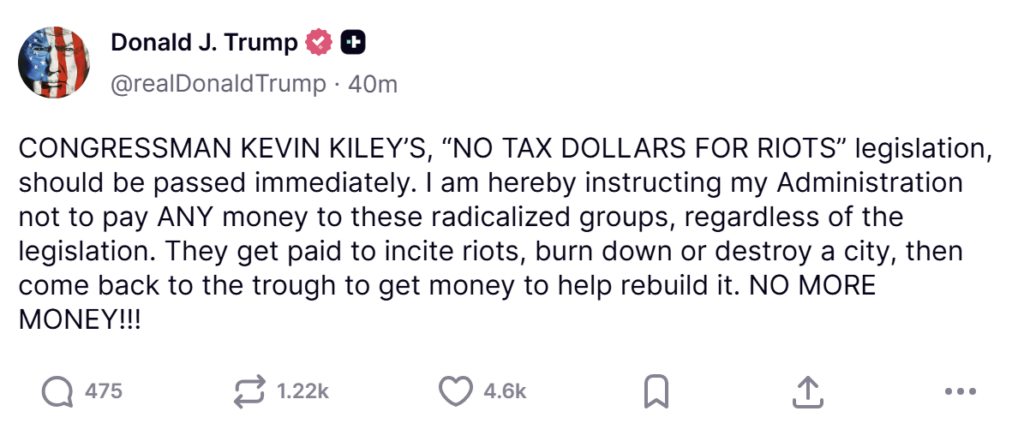
In a social media post this week, the President of the United States issued a stunning directive. Endorsing Rep. Kevin Kiley’s proposed “No Tax Dollars for Riots” legislation, he then went a step further, declaring: “I am hereby instructing my Administration not to pay ANY money to these radicalized groups, regardless of the legislation.”
This is more than a tough-on-crime stance or a fiscal policy statement. The phrase “regardless of the legislation” is a direct and unambiguous challenge to the U.S. Constitution. It is a declaration of intent to usurp Congress’s most fundamental authority—the power of the purse—and to act as judge, jury, and executioner against groups the President deems political enemies.
The issue is not whether rioters should receive taxpayer funds; it is whether a president can unilaterally rewrite the federal budget by decree.
The Power of the Purse
At the very heart of our system of limited government is a simple principle: Congress, and only Congress, controls federal spending. Article I of the Constitution grants the legislative branch the power to appropriate money from the Treasury.
The President’s duty, under the Take Care Clause of Article II, is to ensure that the laws passed by Congress—including the laws that allocate funding—are faithfully executed.
A president cannot simply choose which spending laws to follow and which to ignore based on his own policy preferences.
This very issue was at the center of a constitutional crisis in the 1970s, when President Nixon refused to spend funds appropriated by Congress for programs he opposed.
In response, Congress passed the Impoundment Control Act of 1974 to explicitly forbid a president from unilaterally withholding funds that have been lawfully appropriated.
The President’s recent directive to act “regardless of the legislation” is a clear echo of this fraught history. It is an assertion of a monarchical power to impound funds, a power that has been checked and balanced by both the legislative and judicial branches for half a century.
Punishment Without Process
Beyond the violation of the separation of powers, the President’s proclamation raises profound due process concerns. He is unilaterally declaring entire groups “radicalized” and guilty of inciting riots, and on that basis alone, stripping them of any access to federal funds.
This action functions as a modern-day bill of attainder. The Constitution, in Article I, Section 9, explicitly forbids Congress from passing any “Bill of Attainder”—a legislative act that declares a person or group guilty of a crime and imposes punishment without a trial.
The framers included this prohibition to prevent the government from using its lawmaking power to persecute political opponents.
If Congress cannot do this, the President certainly cannot. To declare a group guilty by presidential fiat is to abandon the Fifth Amendment’s guarantee of due process. In our constitutional system, guilt is determined in a court of law, with evidence and a chance for defense, not by a social media post from the White House.
The Proper Path: Legislation, Not Proclamation
The contrast between the President’s directive and the actions of Representative Kiley could not be starker, and it provides a vital constitutional lesson. One may agree or disagree with the goal of Kiley’s proposed “No Tax Dollars for Riots” act, but his method is the constitutionally correct one.
He is attempting to persuade his colleagues and pass a law through the legislative process established by the Constitution. He is working within the system.
The President, by stating he will act “regardless” of that process, shows a fundamental contempt for it. He is claiming the authority to achieve by proclamation what a lawmaker is rightly attempting to achieve through legislation. This is the difference between the rule of law and the rule of one man.
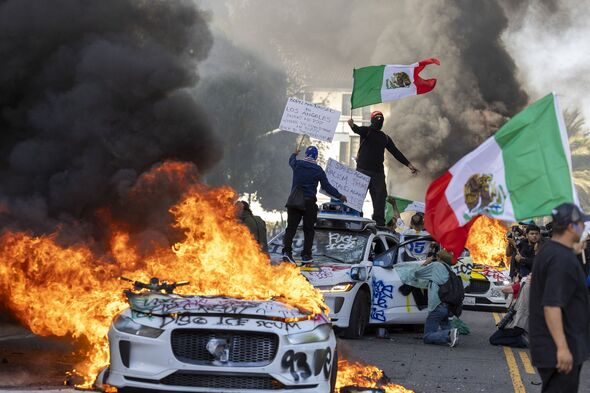
While all responsible Americans condemn the violence and lawlessness seen in recent riots, we must remain vigilant about the methods used to combat them. A president who claims the power to defund his political enemies by decree, in open defiance of laws passed by Congress, is claiming a power that no American president has ever rightfully held.
The statement “NO MORE MONEY!!!” is not just a political slogan; it is a declaration of intent to operate outside the constitutional limits of the office. This path does not lead to order, but to a crisis of the rule of law itself.