
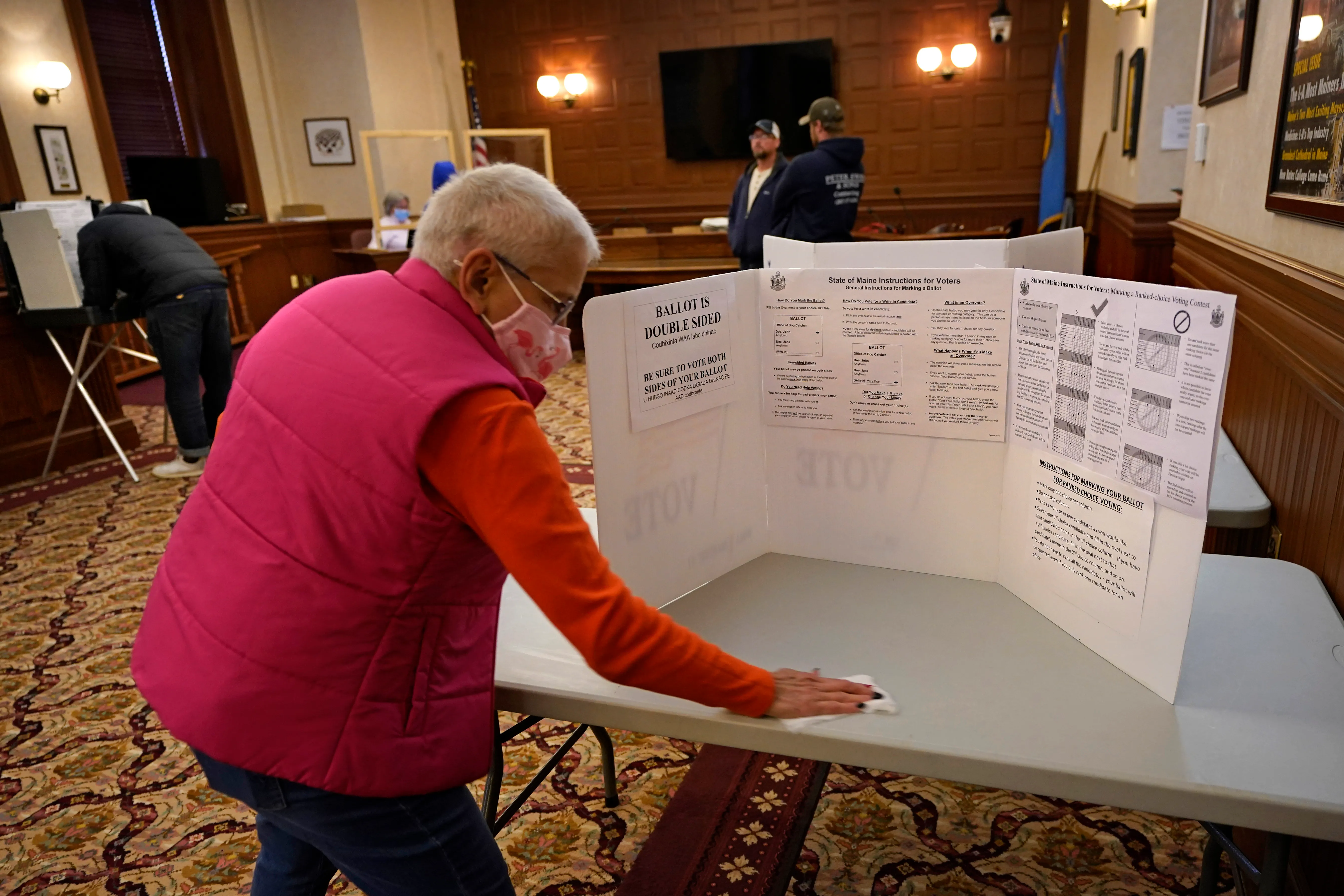
Ranked-choice voting sounds like a simple promise: instead of choosing one candidate and hoping your vote “counts,” you rank candidates in the order you prefer them. If your first choice cannot win, your ballot can still help decide between the remaining options.
That is the sales pitch. The civics lesson is more interesting. Ranked-choice voting, often shortened to RCV, changes the tabulation rule, not the underlying right to vote. It is a different way of converting ballots into a winner, and that conversion process raises practical questions: How many rounds are there? What happens if a voter does not rank every candidate? What does it mean when a ballot is “exhausted”? And why does the answer sometimes depend on whether the election is choosing one officeholder or several?
Join the Discussion
What ranked-choice voting is
In a ranked-choice election, voters list candidates in preference order, usually first choice, second choice, third choice, and so on. Your ballot does not become multiple votes at once. Instead, it is a single ballot that can be counted for different candidates across tabulation rounds if your higher-ranked choices are eliminated (or if later rankings are treated as unusable under local rules).
RCV is used in different ways, but most U.S. discussions focus on two formats:
- Single-winner RCV: used when the election chooses one winner, like a mayor or governor. This is also called instant-runoff voting (IRV) because it simulates a runoff election without holding a second election day.
- Multi-winner RCV: used when the election fills multiple seats at once, like a city council elected at-large. The most common multi-winner form is the single transferable vote (STV), which uses a vote threshold (quota) and transfers surplus votes.
One terminology note: internationally, “ranked-choice voting” and “preferential voting” can refer to several related methods. In U.S. debates, RCV usually means IRV for single-winner races and STV for multi-winner races.
How single-winner RCV counts
Single-winner RCV is easiest to understand if you picture a series of rounds of counting.
Round 1: count first choices
Election officials first tally everyone’s first-choice selections. If a candidate has a majority of the votes counted in that round, that candidate wins. A “majority” typically means more than 50 percent.
If no one has a majority: eliminate the last-place candidate
If no candidate crosses the majority threshold, the candidate with the fewest votes is eliminated.
Transfer: move those ballots to the next ranked choice
Ballots that had the eliminated candidate as their top remaining choice are not thrown away. They are transferred to the next highest-ranked candidate still in the race.
Repeat rounds until someone wins
Officials repeat the elimination and transfer process, round after round, until one candidate has a majority of the active ballots in that round.
Two important details often get missed:
- The “majority” can be a majority of active ballots, not necessarily a majority of all ballots originally cast. This matters when ballots become exhausted.
- RCV does not guarantee the winner is everyone’s first choice. It produces the winner that survives the jurisdiction’s transfer and elimination rules, often (though not always) a strong consensus option among the remaining candidates.
A quick example
Imagine 100 voters and four candidates: A, B, C, D.
- Round 1: A 35, B 30, C 20, D 15. No one has 51. D is eliminated.
- Transfer D ballots: suppose those 15 voters ranked C next. New totals: A 35, B 30, C 35.
- Next elimination: B is now last with 30 and is eliminated.
- Transfer B ballots: suppose 24 of those voters ranked C next and 6 ranked nobody else. New totals: A 35, C 59, and 6 ballots are exhausted. C wins with 59 of 94 active ballots.
If you are wondering why C won with 59 instead of needing 51 of the original 100, you are already thinking in the right denominators.
Exhausted ballots
An exhausted ballot is a ballot that can no longer be counted for any candidate in later rounds because it has no remaining valid ranking for a candidate still in contention.
This can happen for a few reasons:
- Undervoting by choice: The voter ranks only one or two candidates and leaves the rest blank. If those ranked candidates are eliminated, the ballot has nowhere to transfer.
- Rankings treated as unusable under local rules: Depending on jurisdiction rules and tabulation design, issues like repeated rankings, overvotes, or certain kinds of skipped ranks may prevent later preferences from being counted. Other jurisdictions interpret a skipped rank as harmless and continue to the next valid ranking. The details matter.
- Limits on how many candidates can be ranked: Some jurisdictions, especially in earlier implementations, capped the number of rankings even when more candidates were running. In that setup, a ballot can be exhausted even if the voter would have ranked additional candidates if permitted.
It also helps to separate terms that people mix up:
- Exhausted usually means the ballot was valid and counted in earlier rounds, but later runs out of usable rankings.
- Spoiled or invalid usually refers to a ballot, or a portion of a ballot, that cannot be counted at all because it fails basic validity rules. Jurisdictions differ in how they label and report these categories.
Why it matters: exhausted ballots shrink the pool of votes used to determine a majority in later rounds. That is why critics sometimes say RCV can produce a winner who receives “less than 50 percent of all ballots cast.” Supporters respond that the relevant measure is the majority of active ballots still expressing a preference between the remaining candidates.
Neither point is a trick. They are describing different denominators. In litigation, courts often focus less on choosing a “best” denominator and more on whether rules are applied uniformly and whether voters have an equal opportunity to participate, though parties do argue over denominators when describing burden and legitimacy.
RCV vs a runoff
RCV is commonly compared to a two-round runoff system, where the top candidates advance to a second election if no one wins outright in the first.
- Runoffs can produce a clear head-to-head contest, but they require a second election day, additional expense, and often lower turnout in the runoff round.
- RCV tries to capture the logic of a runoff using one election. Voters effectively pre-state how they would vote if their first choice fails.
RCV is not identical to a separate runoff. A later runoff may feature different campaign dynamics, endorsements, and turnout. RCV captures preferences on one day with one electorate, for better or worse.
How multi-winner RCV counts
Multi-winner ranked-choice elections fill several seats at once, and the goal is different. Instead of forcing the field down to one winner, the system tries to match representation to the electorate more proportionally.
The mechanics most often used are associated with the single transferable vote (STV). The broad structure looks like this:
- Set a winning threshold: A candidate needs to reach a specific number of votes to win a seat, often called a quota. A common choice is the Droop quota, though jurisdictions can use other formulas.
- Count first choices: Candidates who meet the threshold win seats.
- Transfer surplus votes: If a winning candidate has votes above the threshold, the surplus is transferred to voters’ next choices using a prescribed method. In modern STV counts this is typically done with fractional or weighted transfers rather than literally picking “extra ballots,” which helps keep the process consistent and auditable.
- Eliminate the lowest candidate: If seats remain unfilled, the last-place candidate is eliminated and those ballots transfer to next choices.
- Repeat until all seats are filled.
This is where RCV starts to feel less like a runoff and more like a carefully designed accounting method for political preference. Multi-winner RCV is less common in U.S. elections than the single-winner version, but it appears in local reforms because it can change coalition incentives and reduce vote-splitting in at-large contests.
Where RCV is used in the U.S.
RCV in the United States is real, but it is also fragmented. That is federalism in action. Election administration is mostly state and local, and different jurisdictions have adopted RCV for different offices and at different times.
State-level use
Some states use ranked-choice voting for specific statewide election contexts, but not necessarily for every office. Maine, for example, uses RCV in party primaries and in general elections for federal offices like U.S. House and U.S. Senate. Maine does not use RCV for the governor’s general election, following a state constitutional interpretation requiring plurality outcomes for that office unless the constitution is amended.
Alaska adopted a system that paired a nonpartisan top-four primary with ranked-choice voting in the general election for state and federal offices beginning in 2022. Alaska voters later approved a ballot measure to repeal that system. The timing and transition rules can matter for which election cycles are affected, so any discussion should be checked against current Alaska election law at publication time.
The key point is that adoption can vary not just by state, but by office and by election type, with rules changing over time.
Local use
Many of the most established RCV programs are municipal. Cities have adopted RCV for mayoral races, city council elections, and local primaries. Local adoption is where you most often see both single-winner RCV and, in some places, multi-winner forms.
Party and private elections
Political parties and private organizations can also use ranked-choice methods for endorsements, conventions, or internal leadership elections. Those are not public governmental elections, but they influence politics, and they are often where voters encounter ranking for the first time.
Who sets the rules
RCV is not mandated by the U.S. Constitution. The Constitution sets broad constraints and allocates authority, but it does not prescribe a single voting method for most elections.
In practice:
- State and local governments usually decide how their own elections are run, subject to state constitutions, state statutes, and federal constraints like equal protection and the Voting Rights Act framework.
- For federal elections, the Constitution gives states a primary role in administering elections, with Congress holding power to alter certain “Times, Places and Manner” rules for congressional elections. That means Congress can standardize some aspects for particular federal offices if it chooses, within constitutional bounds.
This division of authority is why you can see a patchwork of voting systems across the country without any single national rulebook. It is also why RCV debates often play out in state legislatures, city councils, and ballot initiatives rather than in Washington.
Common questions
Do I have to rank every candidate?
No. In most systems you can rank as many or as few as you want. Ranking more candidates can reduce the chance your ballot becomes exhausted.
Is ranking a second choice the same as voting twice?
No. Your ballot counts for one candidate at a time. It moves only if the candidate it is currently counting for is eliminated, or if your next ranking cannot be used under the jurisdiction’s rules.
Can my ballot hurt my first choice if I rank others?
In typical single-winner RCV designs, ranking additional candidates does not reduce the strength of your first-choice vote in the first round. Additional rankings only become relevant if your higher choices are eliminated.
Why do some results take longer?
RCV can take longer because tabulation is multi-round and may depend on processing absentee and mail ballots before final rounds are run. Some jurisdictions also release unofficial results in stages, or central-count batches after Election Day, which can make the timeline feel uneven even when procedures are normal.
Is RCV always logical?
No voting method is free of edge cases. Like other systems, RCV can produce counterintuitive outcomes in rare scenarios, and critics often point to issues like complexity, ballot exhaustion, and administration. Supporters point to benefits like reduced vote-splitting and broader incentive for coalition-building. The honest evaluation is about tradeoffs, not perfection.
Why RCV debates turn legal
Most arguments about ranked-choice voting are policy arguments about incentives, representation, and voter experience. But constitutional vocabulary shows up fast because election rules sit in the space where state authority, federal oversight, and individual rights overlap.
RCV can raise legal questions in areas like:
- Equal protection: whether similarly situated voters are treated the same under the counting rules.
- State constitutional guarantees: some state constitutions use language like “plurality” or “majority” for certain offices, which can become a battleground for whether RCV is permitted without amendment.
- Federal statutory constraints: especially when changes interact with minority voting strength and district design.
But the foundational point is simple: RCV is a method. The Constitution is mostly concerned with who has power to choose the method, and whether the method violates protected rights.
The takeaway
Ranked-choice voting is not magic, and it is not a gimmick. It is a different way of counting ballots that relies on rounds of tabulation and, in many elections, transfers of voter preferences. Once you understand exhausted ballots, the rest of the controversy starts to look less like chaos and more like disagreement over tradeoffs, including real concerns about voter learning curves, ballot design, and administration.
If you want to evaluate RCV in your own community, ask four questions first:
- Is this a single-winner or multi-winner election?
- How many rankings are allowed, and what causes a ballot to be exhausted?
- What is the win threshold: a majority of active ballots, a quota, or something else?
- Who has authority to adopt or repeal the system: the city, the state, or Congress for a specific office?
Those details are where the real civics lives.