
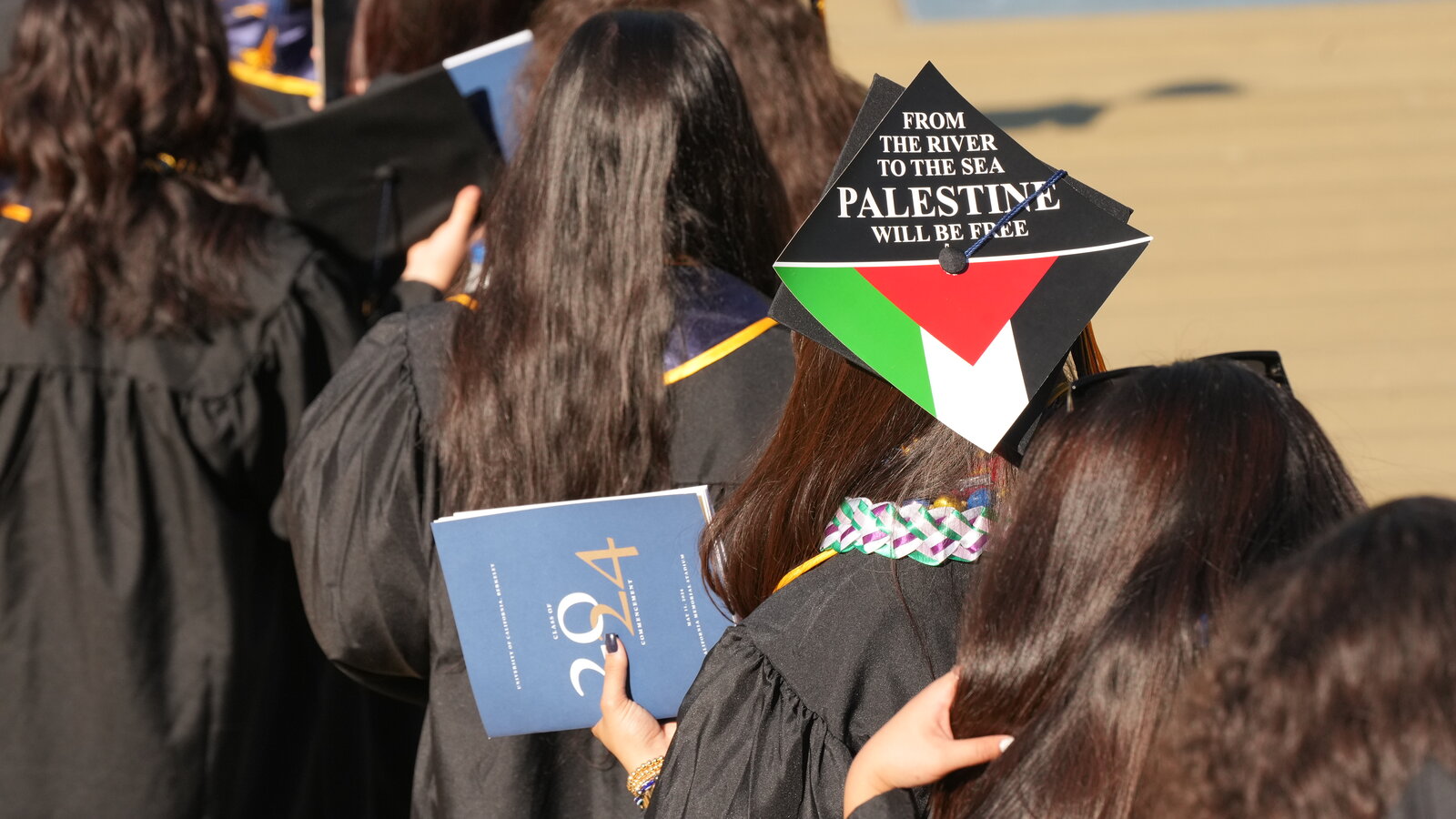
In some campus settings, you can imagine a familiar scene even without a headline attached. A commencement ceremony tends to follow its set rhythms: speeches about gratitude, gowns that never fit quite right, and a symbolic handoff from student to citizen. In some disputes, an additional layer appears: a graduation moment repurposed into a political stage, then defended with a shrug and a slogan: “It’s just speech.”
That claim is not entirely wrong. It is also incomplete. The First Amendment is not a permission slip to dissolve responsibility, and it is not a magic phrase that converts any chant into civic virtue.
If a commencement becomes a platform for rhetoric that celebrates attacks on civilians or romanticizes violence as “resistance,” the question is not only what a university may punish. It is also what a constitutional culture should be willing to tolerate, normalize, or quietly wave through as “the price of free expression.”
Join the Discussion
What It Covers
The Constitution draws a line that people often treat as either nonexistent or perfectly clear. In reality, it is neither.
- Political advocacy, even harsh advocacy, is generally protected.
- True threats are not.
- Incitement is not, but only under a narrow standard. The government typically must show advocacy is intended to produce imminent unlawful action and is likely to do so.
- Harassment and discriminatory conduct can become actionable depending on context, policy, and whether it crosses from expression into targeted interference with equal access.
One way to make this less abstract is to picture a graduation lawn in a purely illustrative, hypothetical case.
Imagine a student holding a sign that endorses a political faction, even a vile one. At a public university, that is likely protected speech. Now imagine a student using a bullhorn to single out a classmate by name, trail them across the lawn, and keep them from reaching their seat. That can cross into harassment or disruption. Imagine a student calling for immediate violence against a specific person. That is no longer mere “advocacy.” Context does not eliminate rights, but it can change what the law sees.
This is where debates get sloppy. A chant about “resistance” can be political advocacy in the abstract. The same chant shouted inches from a visibly targeted student, paired with following, cornering, or blocking exits, can become something else in practice. A banner praising a group is different from conduct that turns classmates into objects of targeted intimidation.
Two misconceptions people often bring to these debates are worth naming directly.
First, people talk about “free speech” as though it binds every institution equally. It does not. Public universities are state actors and are constrained by the First Amendment. Private colleges usually are not, though they may still be constrained by contracts, handbooks, accreditation pressures, or state laws.
Second, people treat “protected” as a kind of moral certification. It is not. The First Amendment restrains government power. It does not guarantee that a message is wise, humane, or compatible with liberal democracy.
The Exchange
In recurring campus controversies, the argument tends to follow a recognizable pattern.
- One side says: A graduation ceremony is not the place for slogans that endorse or excuse violence, and a campus that tolerates them risks treating cruelty as normal under the banner of liberty.
- The other side replies: However ugly the message is, it is still expression, and punishing it betrays the core civic lesson a university should teach.
Both points touch something real. The missing piece is the difference between what the government is allowed to do and what citizens and institutions should choose to honor.
The Civics Gap
When someone wraps harsh or violent slogans in constitutional language, it can reveal something more basic than ideology. It can reveal a civics gap.
Rights talk without constitutional structure can turn into a shortcut: a way to invoke the Bill of Rights as a shield while skipping the harder work of describing, plainly, what the speech is doing to other people in a shared space.
Constitutional citizenship is not one right. It is a system of rights and duties that exist in tension.
- The First Amendment protects dissent. It also protects religious minorities, unpopular newspapers, and political movements that the majority despises.
- The Fourteenth Amendment requires equal protection. That matters when expression becomes a tool to exclude classmates based on identity.
- The rule of law matters when protest shifts into intimidation, property destruction, or coercion.
In other words, our constitutional tradition is built to handle disagreement. It is not built to treat praising violence as inherently civic minded simply because it was delivered through a megaphone.
What Campuses Can Do
Campus leaders sometimes talk as if they have only two choices: total permissiveness or authoritarian crackdowns. That is a false choice.
Even at public universities, the First Amendment leaves room for neutral enforcement of rules that keep a campus functioning. Schools can apply time, place, and manner limits, require permits for certain events, and enforce rules against blocking entrances, disrupting ceremonies, or preventing others from attending class. They can also enforce student conduct codes when conduct crosses the line into threats, vandalism, or targeted harassment.
Universities can and should draw distinctions between:
- General political speech and targeted harassment.
- Peaceful protest and disruption that blocks others’ rights to attend, move freely, or access facilities.
- Controversial claims and speech tied to credible threats.
To keep this from staying abstract, campuses can put a few practical guardrails in writing and enforce them consistently. For example: a ceremony ticketing and seating policy that bars standing in aisles; a clear no amplification rule except for program audio; designated protest zones that preserve sightlines and entrances; and a conduct code category that treats doxxing, stalking, or persistent following as misconduct regardless of viewpoint. Those are not ideological positions. They are operational rules that protect access.
One additional test of consistency is whether the same rules would be enforced against a protest the administration quietly agrees with. If a group that shares the campus consensus blocks an entrance or overwhelms a ceremony with amplified sound, the response should be the same: warnings when feasible, documentation, and consequences tied to conduct, not viewpoint.
Campuses also have a role the First Amendment does not perform: education. If a university cannot explain the difference between protected advocacy and unlawful intimidation, it will keep producing graduates who treat constitutional language as a universal shield for any impulse.
Why It Matters
A commencement dispute can become a polarized spectacle, at least in the way campus flashpoints sometimes do. Even if a particular incident is narrow or local, the habit it trains is not.
Today’s students will become tomorrow’s jurors, prosecutors, school board members, journalists, and legislators. A society that cannot distinguish between liberty and license invites two bad outcomes: cynicism about public ideals, or pressure for coercive control, often swinging between the two.
If our civic reflex becomes, “Anything short of a prosecutable crime must be applauded as free speech,” we train ourselves to ignore the conditions that make pluralism possible: restraint, reciprocity, and the basic recognition that other citizens are not targets.
A Commencement Test
Commencement is supposed to mark entry into adult self-government. So here is the question I wish more speakers would ask directly:
What kind of citizen do you become when you treat constitutional rights as something you put on to avoid accountability?
The First Amendment protects speech precisely because power loves silence. But it does not ask the rest of us to suspend judgment. It asks the government to restrain itself.
Graduation should be where we remember the difference.