
As the man who admitted to the brutal murders of four Idaho college students awaits his final sentence, the case has taken a stunning turn, drawing public comment from the most powerful office in the world.
President Donald Trump has weighed in on the controversial plea deal for Bryan Kohberger. But his statement does more than just echo the frustrations of a grieving public.
It wades into a delicate constitutional territory, testing the unwritten rules that have long separated the immense political power of the White House from the independent administration of justice in courtrooms across America.
Join the Discussion
‘There is no NOTHING’
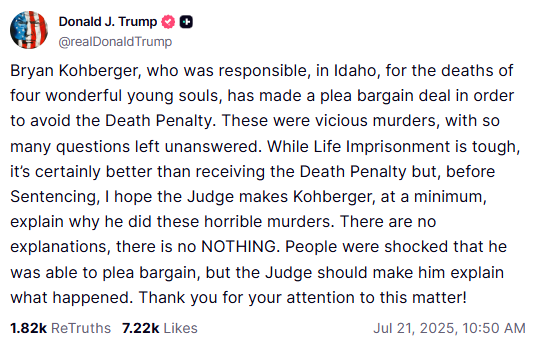
In a post on his Truth Social platform Monday, President Trump voiced the question that has haunted many Americans since Bryan Kohberger pleaded guilty earlier this month: Why?
The plea deal, which spares Kohberger the death penalty in exchange for four consecutive life sentences, did not require him to provide a motive or explanation for the savage 2022 slayings.
“While Life Imprisonment is tough, it’s certainly better than receiving the Death Penalty but, before Sentencing, I hope the Judge makes Kohberger, at a minimum, explain why he did these horrible murders. There are no explanations, there is no NOTHING.” – President Donald Trump on Truth Social
The President’s post channels a raw public anger over the deal, which some critics – including members of the victims’ families – have condemned for providing certainty at the cost of truth.
The President and the Courts
While a President, like any citizen, has a right to free speech, a sitting president commenting on the specifics of an active criminal sentencing is highly unusual and constitutionally perilous.
Our system of government is built on the principle of separation of powers. The judiciary is designed to be an independent branch, free from the political pressure of the executive or legislative branches. This independence is seen as essential for ensuring that every American receives a fair and impartial trial.
“This is a direct test of the unwritten norms that insulate our justice system from political influence. A president’s words carry the weight of the executive branch, even when directed at a state courtroom.”

When a president weighs in, even to echo public sentiment, it can be perceived as an attempt to influence a judge’s actions. This is further complicated by the principle of federalism. The Kohberger case is a state criminal proceeding in Idaho, and the President’s comments represent an intrusion by the head of the federal government into a state-level judicial affair.
A Nation’s Grief, A Family’s Pain
The President’s statement, while constitutionally fraught, is politically powerful because it taps into a deep well of public grief and a specific family’s anguish.
The family of victim Kaylee Goncalves has been particularly vocal in their opposition to the plea deal, pleading with the judge and prosecutors to reject any agreement that did not compel Kohberger to explain his actions.

By taking up their cause, the President aligns himself with the victims against a legal system that many feel has prioritized expediency over answers. It is a move that resonates powerfully with a public horrified by the senselessness of the crime.
The Logic of a Plea Deal
For prosecutors, the decision to offer a plea deal in such a horrific case is an agonizing calculation.
While the evidence against Kohberger – including DNA from a knife sheath left at the scene – appeared overwhelming, a death penalty trial is an incredibly complex, lengthy, and expensive process with no guarantee of success.
“The plea deal, while unsatisfying to many, represents a calculated choice by prosecutors to trade the possibility of the ultimate penalty for the certainty of a life sentence without parole.”
A plea deal provides a guaranteed conviction and spares the victims’ families the trauma of a graphic public trial and decades of mandatory appeals that are automatic in capital cases. It ensures the killer will die in prison, even if it leaves the question of “why” unanswered.
The Weight of the Presidency
President Trump’s post has undeniably amplified the public’s demand for answers in a case that has horrified the nation.
However, it also shines a harsh light on the fragile barrier between the political sphere and the judicial system. When the most powerful person on the planet weighs in on a local sentencing hearing, it forces a national conversation about the proper role of a president.
The incident is a stark reminder of the enduring importance of an independent judiciary, one that can administer justice without being swayed by the immense power and influence of the White-House.