
The U.S. Constitution
Archival records, profiles, and educational resources since 1995.
Constitution and Economic Stability
The Constitution, by safeguarding property rights, provides individuals and businesses the confidence to own, use, and transfer property freely. This freedom encourages investment and economic ventures. The Fifth Amendment's due process clause protects against arbitrary expropriation, creating a...
Read more →
Founders’ Vision of Virtuous Citizenry
The Founding Fathers, especially John Adams, George Washington, and Thomas Jefferson, understood virtue's importance in the new American republic. For them, self-governance wasn't just a governance style but reflected the people's moral fiber. Without virtuous citizens, the entire democratic system...
Read more →Arguments for and Against Constitution
The U.S. Constitution's ratification debate centered significantly on the issue of central government authority. Federalists contended that a strong national government was necessary for the nation's survival, with the capacity to enforce laws, regulate commerce, and provide for national defense....
Read more →Top Controversial Issues at the Constitutional Convention
The United States Constitution stands as a remarkable achievement in the history of governance. It established a framework that balanced the diverse interests of states while ensuring a fair and functional government. The Constitutional Convention brought together brilliant minds who addressed...
Read more →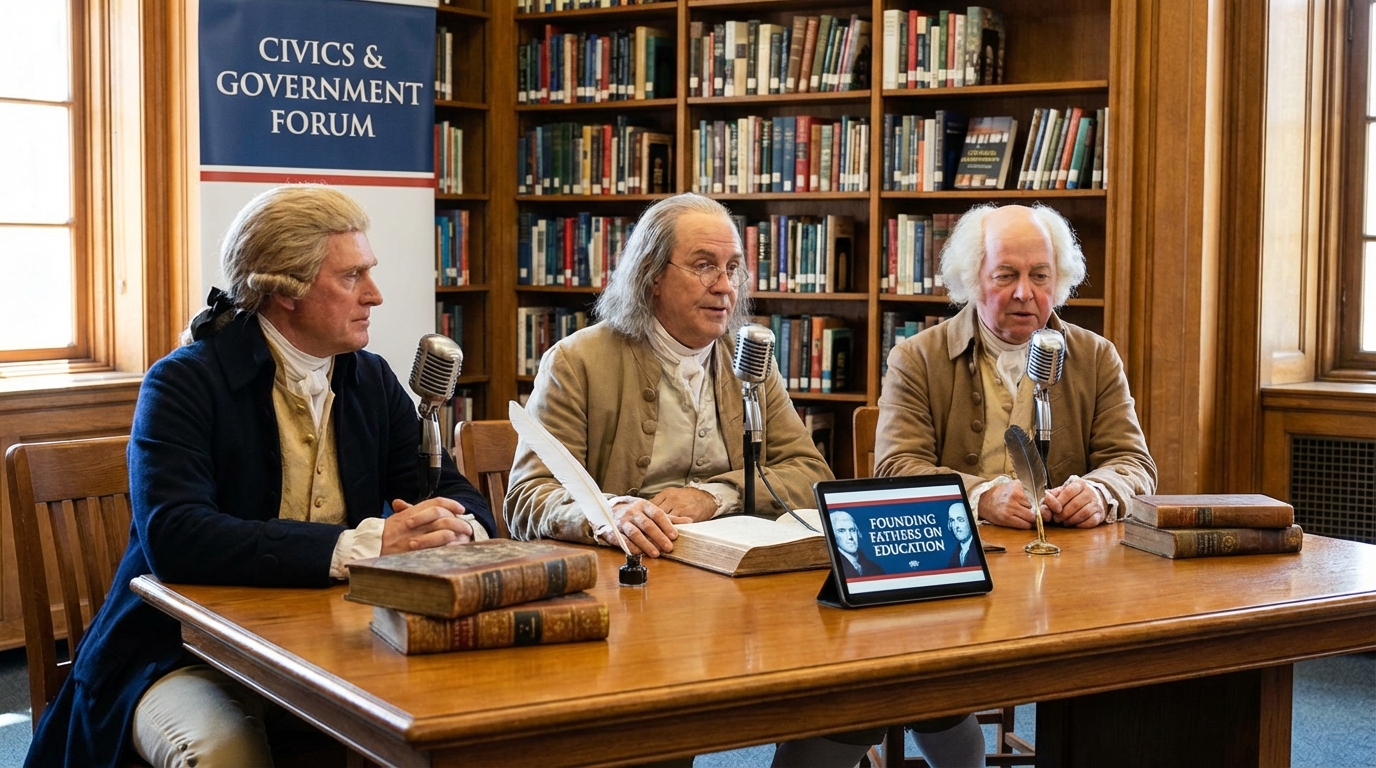
Founding Fathers on Education
Thomas Jefferson, John Adams, and George Washington laid the groundwork for an educational system that would support the principles of liberty and republicanism through their writings, legislative efforts, and advocacy. They understood that education was fundamental to the survival and prosperity...
Read more →
Key Contributions of Founders
George Washington's leadership at the Constitutional Convention was pivotal. His presence unified diverse delegates and provided a sense of purpose. Washington understood that a stronger central government was essential, and his experiences as a military leader informed his vision of national unity...
Read more →Constitution’s Impact on U.S. Diplomacy
The emoluments clause in Article I, Section 9 of the Constitution serves as a key defense. American officials, including the President, are barred from accepting gifts, emoluments, offices, or titles from foreign states without Congress’s consent. This provision was a direct effort to ensure that...
Read more →Top Influences on the Constitution
Enlightenment thinkers profoundly influenced the framers of the United States Constitution. John Locke's ideas about natural rights —life, liberty, and property—laid the groundwork for modern democracy. His theories emphasized the social contract and government by consent, furthering the...
Read more →Key Constitutional Amendments and Effects
The First Amendment guarantees freedoms concerning religion, expression, assembly, and the right to petition. It prohibits Congress from promoting one religion over others and restricting an individual's religious practices. It guarantees freedom of expression by prohibiting Congress from...
Read more →Top Legal Principles of the Constitution
The United States Constitution separates governmental power among three branches: Legislative , Executive , and Judicial . Each branch operates independently, ensuring no single entity holds unchecked power. Article I outlines Congress’s authority to make laws, Article II grants the President the...
Read more →Constitution and American Identity
The Constitution of the United States stands as a testament to the nation's founding principles, crafted during a time of revolutionary change and fervent debate. It laid the groundwork for a new form of governance, balancing individual liberties with the need for a cohesive national structure. The...
Read more →Supremacy Clause in Federalism
The Supremacy Clause, found in Article VI of the U.S. Constitution, is a pivotal component in the framework of federalism. It states that federal law takes precedence over state laws, creating a unified legal system under one national standard. However, its application is nuanced, and determining...
Read more →Constitutional Protections Against Tyranny
The Constitution’s architecture splits the federal government into three branches: legislative, executive, and judiciary. This setup hampers one branch from hoarding power. The legislative, or Congress, handles making laws with the Senate and the House of Representatives. The executive, led by...
Read more →Constitution’s Role in Limited Government
The roots of limited government stretch far back, intertwining with the influences of ancient civilizations. Ancient Greece and Rome serve as key examples, where the public was deeply involved in governance. In Greece, the concept of democracy was birthed, and in Rome, the Republic exemplified...
Read more →Republicanism’s Influence on US Politics
Republicanism, a significant political theory, originates from classical antiquity. In ancient Greece and Rome, the concept emerged, championing governance by the many rather than the one. Early notions of civic virtue and the common good took root, emphasizing citizen participation in public...
Read more →Checks and Balances in the Constitution
The U.S. Constitution establishes three branches of government: executive , legislative , and judicial . The President leads the executive branch, enforcing laws, commanding the military, and conducting foreign policy. The legislative branch, composed of the House of Representatives and the Senate,...
Read more →Impact of the Great Compromise
The Virginia Plan, championed by James Madison, envisioned a robust federal government with three branches: legislative, executive, and judicial. Within this structure, checks and balances would prevent any single branch from overreaching. The Plan favored a bicameral legislature with two houses,...
Read more →Federalist Papers’ Role in Constitution
The formation of the United States Constitution was a pivotal moment in history, reflecting the deep commitment of the Founding Fathers to create a balanced and enduring system of governance. The Federalist Papers, written by Alexander Hamilton, James Madison, and John Jay, played a crucial role in...
Read more →
Founders’ Relationships in Politics
The Founding Fathers had their fair share of clashes, which significantly shaped America’s political landscape. Federalists, like Alexander Hamilton, pushed for a strong national government, believing it was essential for unity and progress. On the other hand, Republicans, led by Thomas Jefferson...
Read more →Commerce Clause Regulation
The Articles of Confederation didn't empower the federal government to regulate interstate commerce, leading to trade squabbles between states and economic strife. With protective tariffs and trade barriers rising, the states were operating like rival nations rather than a unified country. Seeing...
Read more →