The political atmosphere in Washington has reached a fever pitch as more than half of the House Democratic caucus formally moves to impeach Homeland Security Secretary Kristi Noem. This isn’t just a routine policy disagreement – it’s a high-stakes constitutional showdown over the limits of executive force and the accountability of the administrative state.

The Allegations: Operation Metro Surge Under Fire
The drive to remove Secretary Noem stems from the administration’s aggressive domestic immigration enforcement, specifically the controversial “Operation Metro Surge.” House Democrats, led by the Congressional Progressive Caucus, argue that Noem has overseen a “pattern of lawlessness” that has resulted in the deaths of civilians on American soil. The fatal shootings of Renee Good and Alex Pretti in Minneapolis have transformed from local tragedies into the primary evidence for Articles of Impeachment.
Critics in the House allege that Noem has violated her oath of office by deploying federal agents in a manner that “subverts state sovereignty” and ignores the due process protections of the 14th Amendment. The resolution specifically cites the refusal of the Department of Homeland Security (DHS) to coordinate with state leaders in Minnesota, characterizing the surge as a “politically motivated occupation” rather than a legitimate law enforcement action.
For the constitutional watchdog, the question isn’t whether the policy is popular, but whether it meets the high bar of “High Crimes and Misdemeanors.” The administration maintains that Noem is simply executing the President’s mandate to secure the interior. However, the opposition argues that when an executive officer uses their authority to bypass judicial oversight and intimidate local governments, they have abandoned the “Good Behavior” required of their station.
Historical Tidbits: The Rarity of Cabinet Impeachment
To understand the gravity of this move, one must look at how infrequently Congress has reached for this particular tool. In nearly 250 years of American history, the impeachment of a Cabinet official remains a constitutional “nuclear option” that has rarely been successfully detonated.
- 1876: William Belknap – The Secretary of War was impeached by the House for “basely prostituting his high office to his lust for private gain” after it was discovered he took kickbacks from a government contract. He resigned just minutes before the vote, but the Senate held a trial anyway.
- 2024: Alejandro Mayorkas – In a precursor to the current friction, Secretary Mayorkas was impeached on a party-line vote for a “willful and system refusal to comply with the law” regarding border security. The Senate ultimately dismissed the charges without a trial.
- The Standard – Historically, impeachment has been reserved for corruption or criminal acts, but the Noem resolution seeks to expand this to “systemic constitutional violations” and the “abuse of executive force.”
The Math: Speaker Johnson’s Razor – Thin Margin
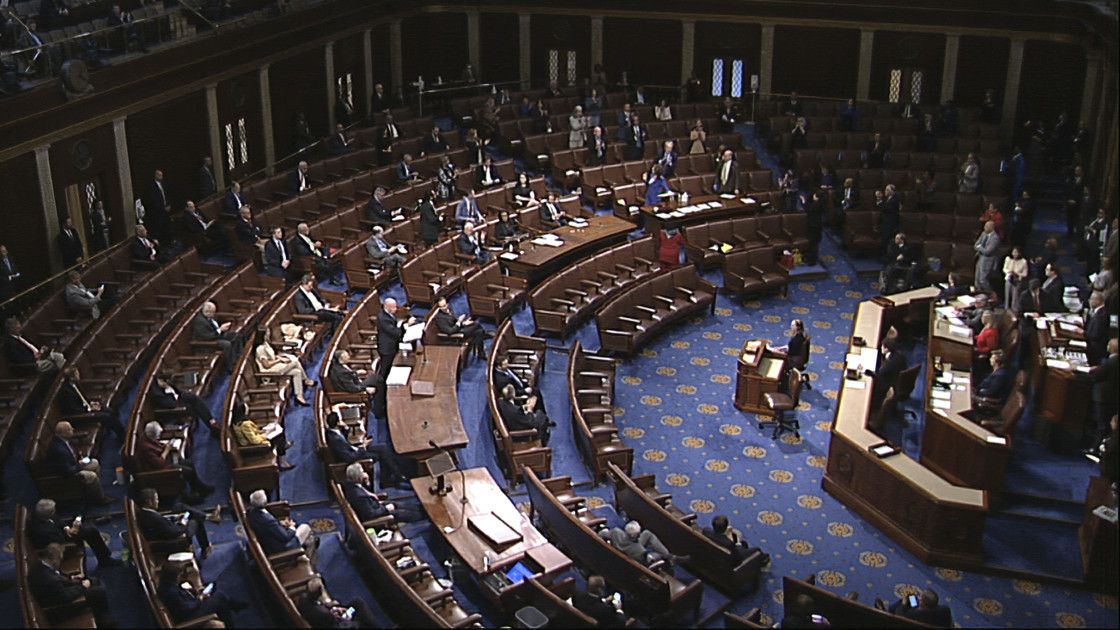
The momentum for Noem’s impeachment is colliding with a brutal mathematical reality in the House. Speaker Mike Johnson is currently managing a majority so thin that a single defection can stall any legislative counter-move. With over 110 Democrats already signed on to the resolution, the opposition needs only a handful of Republican “defectors” or absences to force a floor vote that could embarrass the administration.
The Democratic strategy appears to be a dual-track assault. While they lack the two – thirds majority in the Senate required for a conviction, the House proceedings allow them to place Secretary Noem’s “playbook of brutality” under a national microscope. By forcing a public trial, they aim to create a political cost for the administration’s use of the Alien Enemies Act and other wartime powers in domestic settings.
- The Pro-Impeachment Bloc: Now includes more than half of the Democratic caucus, including moderate members who previously hesitated to back such an extreme measure.
- The GOP Defense: Characterizes the move as a “baseless political stunt” designed to interfere with the President’s constitutional duty to enforce immigration law.
- The Swing Votes: A few remaining “Republicans in Name Only” (RINOs) in suburban districts are under intense pressure from activists to support an inquiry into the Minneapolis shootings.

Constitutional Interpretation: What is a “High Crime”?
The debate over Noem’s future ultimately rests on the interpretation of Article II, Section 4. The Founders purposely left the definition of “High Crimes and Misdemeanors” vague to allow Congress to address unique threats to the republic. However, this vagueness has led to a century – long tug-of-war between the branches.
Is it a “High Crime” to implement an aggressive policy that a state governor opposes? Or does the crime lie in the “extortionate” use of federal force to demand access to state voter rolls, as alleged in the Minnesota lawsuit? If the House determines that Noem used the DHS as a private political “army” to subvert the 10th Amendment, they may argue that she has committed a fundamental breach of the constitutional order.
The administration’s defense relies on the Supremacy Clause, arguing that federal immigration enforcement cannot be “reined in” by a state or a partisan House caucus. They contend that as long as Noem is following the President’s orders, her actions are shielded by executive privilege. This sets up a classic “Unstoppable Force vs. Immovable Object” scenario: the President’s power to execute the law versus Congress’s power to punish the executors.
The Humanitarian and Civil Rights Angle
Beyond the legal jargon, the impeachment push is fueled by the visceral imagery coming out of Minnesota. The deaths of Alex Pretti and Renee Good have become symbols of what the opposition calls the “Dystopian DHS.” By targeting Noem, Democrats are signaling that they will not tolerate a “return to the 1798 standard” of summary removals and militarized streets.
- Public Outcry: Thousands of “anti – ICE” protesters have converged on Washington, demanding Noem’s immediate resignation.
- Whistleblower Testimony: Recent disclosures from individuals like Charles Borges have added fuel to the fire, suggesting that the DHS is not just aggressive on the streets, but also “cavalier” with private citizen data.
- The “Rule of Law” Argument: Republicans argue that “true” law and order requires the removal of illegal aliens, while Democrats argue it requires the removal of “rogue” officials who ignore the Fourth Amendment.

A Precedent for the Administrative State
The outcome of this impeachment drive will define the relationship between Congress and the Administrative State for the remainder of the term. If Noem is successfully impeached by the House, it will signal a new era of “aggressive oversight” where Cabinet secretaries are held personally liable for the tactical decisions of their agents.
If the effort fails, it will likely be seen as a green light for the administration to expand Operation Metro Surge into other cities. The “James” perspective is clear: the Constitution provides the tools for accountability, but it is up to the people’s representatives to decide if they have the stomach to use them. The $1.2 trillion funding battle and the Noem impeachment are two halves of the same coin – a desperate attempt by Article I to regain control over an Article II branch that is moving at high speed.
“Democrats have no obligation to support a bill that funds the dystopian scenes we are seeing in Minneapolis,” Senator Chris Murphy noted, bridging the gap between the budget fight and the impeachment effort.
As the House Judiciary Committee prepares to draft formal articles, the nation is watching a constitutional engine under maximum pressure. The resolution against Kristi Noem is more than a list of grievances; it is a test of whether the separation of powers is a living reality or a historical relic.