
“No Kings” is not subtle branding. It reads as a constitutional argument in three syllables: America rejected monarchy in 1776, and it did not swap it for an elected version of royal power in 2026.
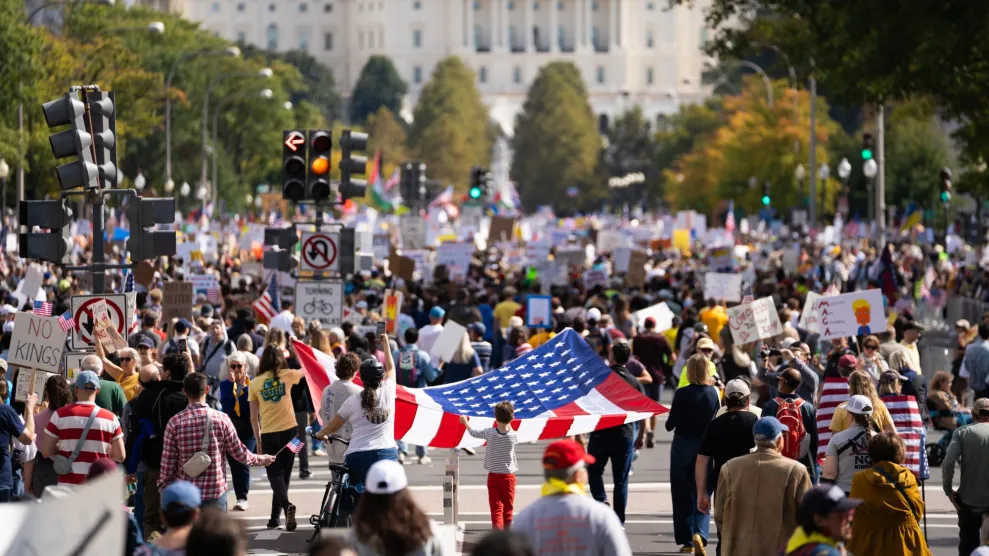
Today, that argument is spilling into streets and town squares at a scale that is hard to miss. Organizers say more than 3,100 demonstrations are planned across the country, with millions expected to attend events ranging from big-city marches to small-community gatherings from Alabama to Wyoming.
What “No Kings” is protesting
The message is broad by design, but the through line is consistent in organizers’ framing: people are rallying against President Donald Trump’s policies, the higher cost of living, and the war with Iran.
That mix matters. When a movement can hold economic pressure and foreign policy in the same frame as civil-liberties concerns, it attracts people who do not share the same single issue but do share a single fear: that the country is becoming less accountable, less predictable, and less governed by ordinary democratic constraints.
How big is it?
The raw count of planned events is striking. So is the geographic spread. These demonstrations are not pitched only to the usual political capitals.
- More than 3,100 demonstrations are planned nationwide today, according to organizers, and millions are expected to attend.
- Last October’s iteration included more than 2,700 events and drew millions of demonstrators.
- Organizers say two-thirds of people who RSVPed for this weekend live outside major urban centers, up nearly 40% compared with the first “No Kings” event in June 2025.
- Organizers also say a significant number of protests are planned in GOP strongholds like Texas and Florida.
- Texas, Florida and Ohio each have over 100 events scheduled today, and states like Idaho, Wyoming and Utah have events in the double digits, according to organizers.
That RSVPs statistic is the tell. Protest in America is often narrated as a big-city phenomenon. But a movement that is building muscle in suburbs, exurbs, and smaller communities is harder to caricature and harder to dismiss as someone else’s problem.
Where protests are happening
Events are expected in major metros and far beyond them. Organizers list locations that include:
- Minneapolis
- Boston
- Washington, DC
- New York City
- Los Angeles
- Atlanta
- Chicago
- Seattle
- Seward, Alaska
- East Glacier Park, Montana
- Waverly, Iowa
- Washington, North Carolina
- Millersburg, Ohio
- Gloucester, Virginia
- Black River Falls, Wisconsin
One of the farthest-flung demonstrations is scheduled in Kotzebue, Alaska. That detail is easy to skim past, but it captures what organizers are trying to prove: this is not confined to a handful of predictable zip codes.
The Minnesota focal point
While the day is national, the flagship rally is expected at the Minnesota State Capitol in St. Paul, where organizers anticipate at least 100,000 attendees.
The choice of Minnesota is not random. Minneapolis and St. Paul recently sat at the center of Operation Metro Surge, described as the largest immigration enforcement operation in US history, which triggered weeks of protest over the winter, particularly after federal agents fatally shot Renee Good and Alex Pretti. The crackdown included clashes where federal agents used pepper balls, tear gas and pepper spray against demonstrators.
Today’s rally is the first major demonstration since the operation wound down last month, and it is expected to take on a different tone. Musician Bruce Springsteen has said he will perform his protest anthem “Streets of Minneapolis”, a song released earlier this year in protest of federal immigration operations in the city. Springsteen dedicated the song to the city’s residents and in Good and Pretti’s memory.
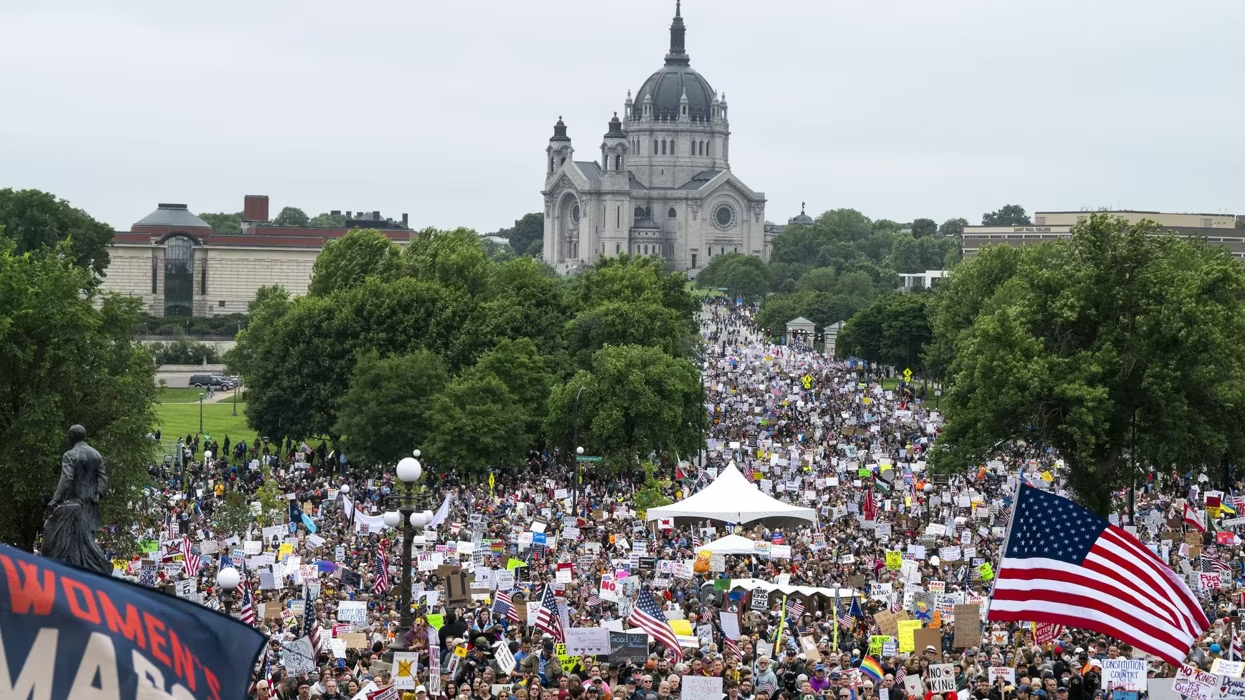
A star-studded lineup is also expected, including Joan Baez, Jane Fonda, and Maggie Rogers, along with political figures including Sen. Bernie Sanders, Minnesota Lt. Gov. Peggy Flanagan, and Minnesota Attorney General Keith Ellison.
Who’s organizing it?
The demonstrations are being coordinated by the No Kings Coalition, which includes groups such as 50501, Indivisible, AFT, MoveOn, the ACLU, Public Citizen, and SEIU.
That coalition structure is part of the strategy. It reduces the movement’s dependence on one brand, one leader, or one issue and makes it more resilient when the news cycle tries to narrow it to a single controversy.
What Trump and the White House said
The administration’s posture has been dismissive. In the past, Trump and Vice President JD Vance mocked “No Kings” protests online, including AI memes that depicted Trump wearing a crown.
After last October’s protests, Trump called the demonstrations a “joke” and described them as “very small, very ineffective,” adding that the people who participated were “whacked out.”
Asked about today’s events, White House spokesperson Abigail Jackson said Thursday: “The only people who care about these Trump Derangement Therapy Sessions are the reporters who are paid to cover them.”
The stakes behind the slogan
“No Kings” works as a protest banner because it is also a civics lesson. The Constitution does not merely limit government. It fragments power on purpose. Congress writes laws. The president executes them. Courts interpret them. States retain their own sphere. Elections supply legitimacy, but only within a system that assumes every officeholder is constrained.
So when protesters say “no kings,” they are not making a technical claim that the president literally wears a crown. They are voicing an anxiety that executive power is expanding faster than the institutions designed to check it, and that political opponents are being treated less like fellow citizens and more like obstacles to be managed.
Rev. Al Sharpton put that civic anxiety in movement terms at a Thursday news conference: “We may not all agree on some issues, but we all agree that if we do not protect the right to vote and protect democracy, it doesn’t matter where we disagree, we will all be muted and ineffective.”
The immediate disputes may be immigration enforcement, foreign policy, and economic stress. The deeper dispute is older: whether a constitutional republic can remain one when citizens start believing that power answers only to itself.
Why this moment feels different
The “No Kings” protests have happened before, including two major protest days last year that drew millions and were largely peaceful. Since then, Trump’s nationwide immigration enforcement blitz has come and gone in several major cities. Now, Americans are facing skyrocketing gas prices and a flagging economy due to the war.
Historically, large protest waves are rarely about one thing. They are about accumulated distrust. When people feel that normal channels are not hearing them, they build a louder channel. The constitutional question is what happens next: Do institutions respond by recommitting to transparency and accountability, or by treating dissent as something to be ridiculed, surveilled, or suppressed?
A republic does not collapse when citizens protest. It collapses when citizens stop believing protest can matter.