
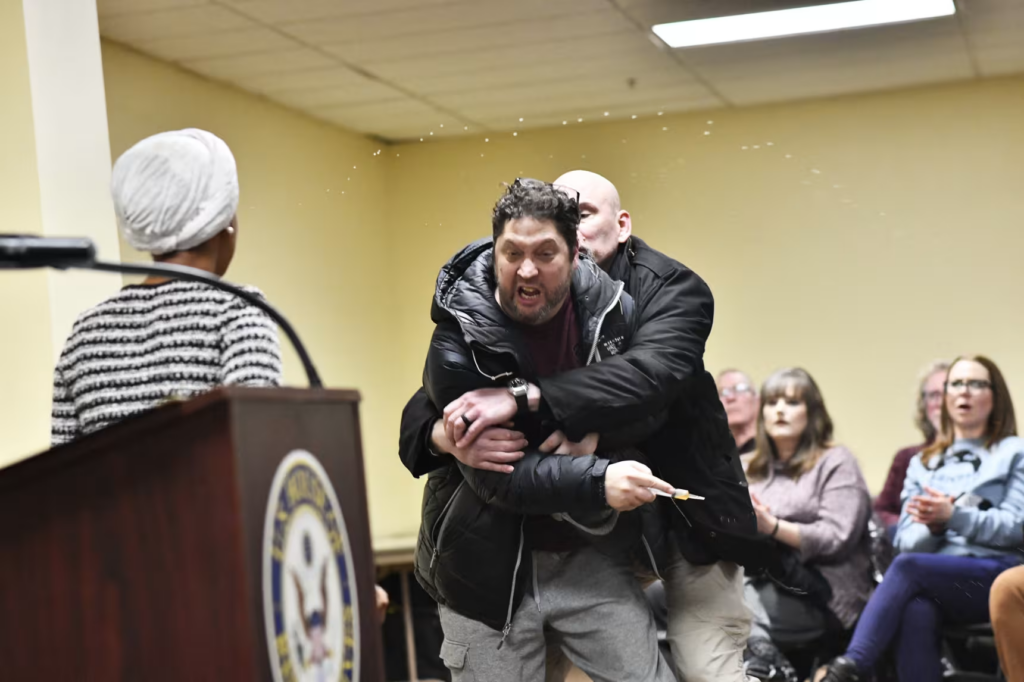
Representative Ilhan Omar (D-Minn.) was addressing a crowd of constituents, calling for the impeachment of Homeland Security Secretary Kristi Noem, when the peace of the meeting was shattered. Anthony James Kazmierczak, 55, reportedly walked down the center aisle and lunged toward the congresswoman, using a syringe to spray a liquid directly onto her clothing.
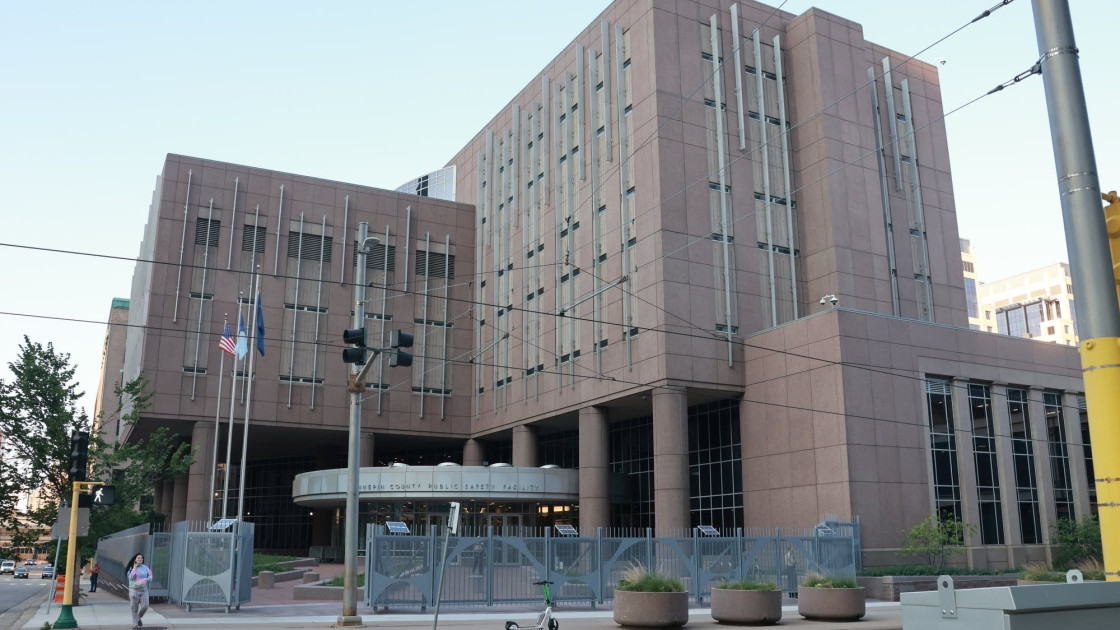
Witnesses described a “foul odor” that immediately sparked fears of a biological or chemical agent. While a hazmat team later identified the substance as apple cider vinegar, the intent to intimidate an elected official has triggered a massive law enforcement response. Kazmierczak was tackled by security personnel and later booked into the Hennepin County Jail on suspicion of third-degree assault.
The attack occurred moments after Omar had finished a scathing critique of “Operation Metro Surge,” the federal immigration crackdown that has left two citizens dead in Minneapolis this month. Despite the dousing, the congresswoman refused to leave the stage, declaring to the crowd that “these f—— a–holes are not going to get away with this.”
The Legal Threshold: Assault vs. Political Violence
While apple cider vinegar is harmless in a culinary context, its use in a coordinated attack on a federal official carries significant legal weight. Under 18 U.S.C. § 111, it is a federal crime to forcibly assault, resist, or interfere with a Member of Congress while they are engaged in their official duties.
The use of a syringe adds a layer of “aggravated” intent, as it mimics the delivery system of lethal toxins. Federal prosecutors often argue that the psychological terror induced by such an attack is equivalent to physical harm. For the “James” persona, this incident is a stark reminder that the Fourth Amendment’s promise of security extends to the public square, where officials must be able to speak without fear of physical reprisal.
- Third-Degree Assault: Under Minnesota law, this involves the infliction of substantial bodily harm or a specialized assault on a protected class.
- Federal Jurisdiction: Because the target was a Member of Congress, the FBI has taken the lead in the investigation to determine if the act constitutes a federal felony.
- The Deterrence Factor: U.S. Capitol Police have stated they are seeking the “most serious charges possible” to deter future acts of political violence.

How We Got Here: The Escalation of 2026
The attack on Rep. Omar does not exist in a vacuum; it is part of a staggering surge in threats against public officials. On the same day as the Minneapolis incident, the U.S. Capitol Police released an annual report revealing that they investigated 14,938 concerning statements and behaviors directed at members of Congress in 2025 – a massive jump from the 9,474 cases handled in 2024.
- 2024: Political tensions simmer as immigration and economic debates polarize the electorate.
- 2025: The assassination of Charlie Kirk and the killing of Minnesota House Speaker Melissa Hortman mark a turn toward lethal political violence.
- 2026: The frequency of physical confrontations, including the recent punching of Rep. Maxwell Frost at the Sundance Film Festival, suggests a breakdown in the “civic truce” that traditionally governs American politics.
This rising tide of vitriol is frequently linked to the rhetoric of the executive branch. Just days before the attack, President Trump mocked Omar at a rally, questioning her loyalty to the United States. While the President’s supporters argue this is mere “political theater,” critics contend it provides the “green light” for individuals like Kazmierczak to take matters into their own hands.
The Profile of the Assailant
Court records reveal that Anthony James Kazmierczak is no stranger to the legal system, though his previous offenses were largely related to substance abuse and traffic violations. His record includes two DUI convictions (2009 and 2010) and a 1989 conviction for unauthorized use of a motor vehicle.
At the time of his arrest, Kazmierczak was reportedly receiving disability insurance benefits and had been unemployed for several years. This profile – a middle-aged man with a history of minor criminal activity and social isolation – is common among those who engage in “lone wolf” political outbursts.
The question for federal investigators is whether Kazmierczak acted alone or if he was part of an organized effort to disrupt the town hall. The use of apple cider vinegar suggests a desire to humiliate rather than kill, but in the current high-stakes environment of Minneapolis, such distinctions offer little comfort to those in the line of fire.
The “James” Perspective: Protecting the Forum
From a constitutional standpoint, the town hall is a sacred space. It is the physical manifestation of the First Amendment’s right to “petition the Government for a redress of grievances.” When that space is violated by violence – even non-lethal violence – the entire democratic process is undermined.
If members of Congress cannot meet with their constituents without being subjected to chemical dousings or physical lunges, the “cooling saucer” of the Senate and the “people’s house” of the House will eventually retreat behind bulletproof glass and remote video feeds. This would represent a fundamental loss of access for the average citizen.
“I survived war,” Omar told reporters after the event. “I’m definitely going to survive intimidation… because I’m built that way.”
While Omar’s personal resilience is notable, the structural integrity of the American forum is less certain. The FBI’s investigation into the “vinegar attack” is about more than a foul-smelling shirt; it is about reinforcing the boundaries of civilized dissent.
A City Under Pressure
Minneapolis remains a powder keg. With the deaths of Renee Good and Alex Pretti still fresh, and the “Operation Metro Surge” continuing to deploy thousands of agents, the city is caught between federal force and local rebellion. The attack on Omar is a symptom of a city where the “monopoly on force” is being contested every night on the street.
As the Jan. 30 government shutdown deadline approaches, the pressure on lawmakers to find a resolution is immense. If the “Power of the Purse” cannot be used to de-escalate the situation, the vinegar in the syringe may soon be replaced by something far more dangerous.