
Few envelopes trigger as much immediate bargaining as a jury summons. You scan it as if it were a parking ticket. You check the date. You do the math. You start asking everyone you know: “Can I get out of this?”
But jury duty is not a random civic chore invented to ruin your week. It is one of the few places where ordinary citizens directly operate the machinery of constitutional government. The judge runs the courtroom. The lawyers argue. Court staff and court reporters (or digital systems) create and keep the record. But the community decides facts. That is the point.
This guide is for the most common question in America’s legal search bar: I got a jury summons. What do I do now?
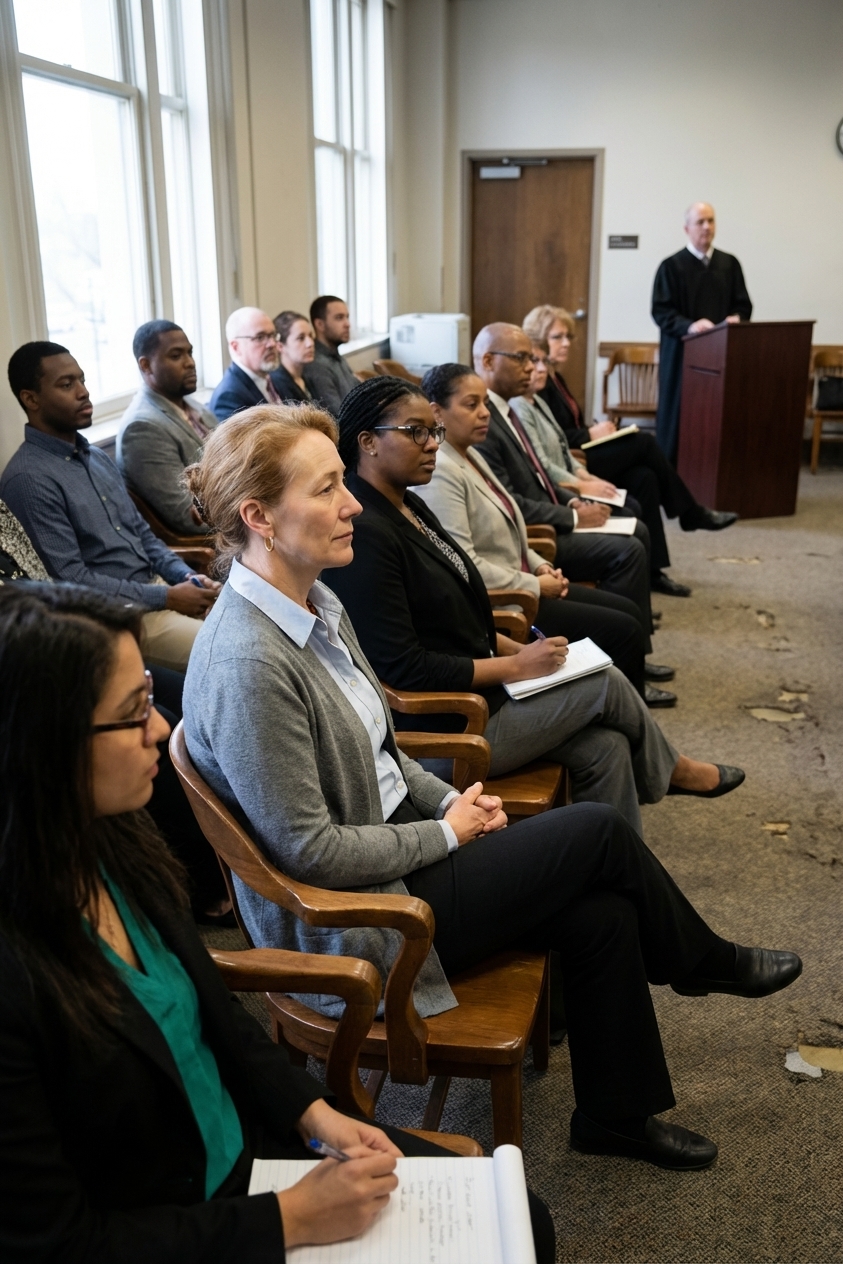
Trial jury vs. grand jury
Before you plan your week, figure out what kind of jury you were summoned for. Many people assume “jury duty is jury duty.” It is not.
- Trial (petit) jury: The group that hears a civil or criminal trial and returns a verdict (or a decision on liability and damages). Service is often one day or one trial, depending on the court.
- Grand jury: A larger group, used mostly in criminal matters, that hears evidence presented by prosecutors to decide whether charges should move forward (for example, an indictment). Grand jury service can involve repeated reporting dates over weeks or months in some jurisdictions, and the process is different than a trial.
Your summons usually says which one it is. If it does not, call the number on the notice and ask.
Why you were picked
Juries are supposed to be drawn from a broad cross-section of the community, not just people who are already plugged into the legal system. That is why most courts build jury lists from large, routinely updated government databases.
Common source lists
- Voter registration rolls
- DMV records (driver’s licenses and state IDs)
- State tax or unemployment records in some jurisdictions
- Other state databases authorized by statute
Each state does this a little differently, and federal courts have their own jury plans. But the core idea is the same: courts are trying to produce a pool that resembles the community, not a self-selected club of volunteers.
If you are wondering whether this has anything to do with the Constitution, it does. The Sixth Amendment promises an “impartial jury” in criminal cases, and the Supreme Court has interpreted that to include a jury selected from a fair cross-section of the community.
What to do now
Read the entire summons. Then read it again. Most jury duty mistakes happen because people assume every county runs the same system. They do not.
Quick checklist
- Respond by the deadline
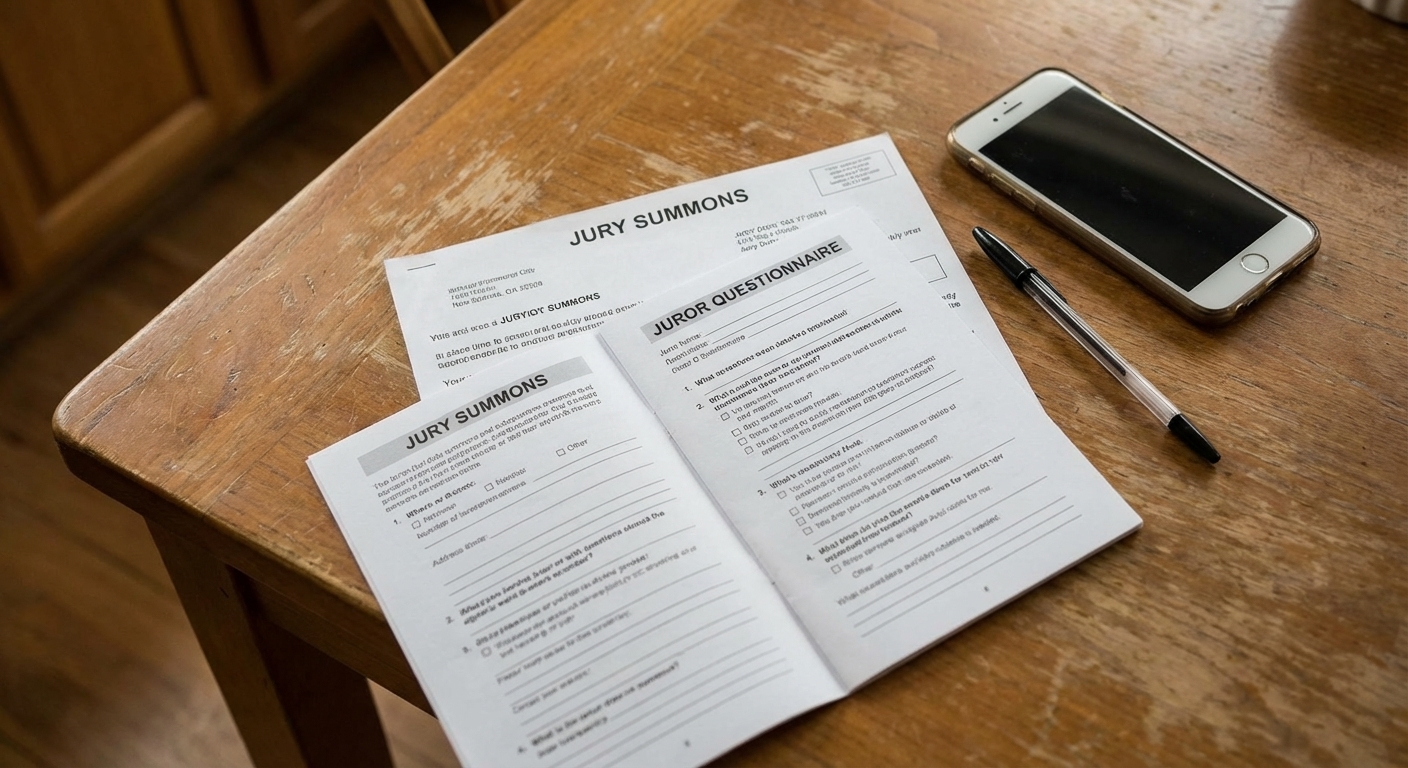
- Complete the questionnaire
- Confirm whether you are on call or must report
- Gather documents (summons, ID, work note if needed)
- Request any accommodations early
Your usual next steps
- Respond by the deadline. Many courts require you to confirm online, mail back a form, or call an automated line.
- Complete the questionnaire. This may ask about citizenship, residency, prior felony convictions, language ability, and availability.
- Check whether you are on call. Some courts use a standby system where you call in the night before to see if you must report.
- Ask about accommodations early. If you need a disability accommodation, do not wait until you are in the building. Language eligibility and language access rules for jurors vary widely, so if language is a barrier, follow the summons instructions and ask the court what applies in your jurisdiction.
If you missed your date: Call the jury office or clerk immediately and explain what happened. In many courts, being proactive leads to a simple reschedule rather than a penalty.
Ignore a summons and you can trigger escalating consequences, from a stern follow-up letter to a possible contempt proceeding. Most courts would rather reschedule you than punish you, but the system cannot function if everyone treats summonses as optional.
Eligibility basics
The exact rules vary by state, but eligibility usually tracks a few recurring requirements.
- U.S. citizenship
- Residency in the county or federal district
- Minimum age (usually 18)
- Ability to understand English as required by many jurisdictions for jury service
- No disqualifying criminal status (often related to felony convictions, depending on state law)
One important clarification: being summoned does not mean you will serve. It means you are part of the pool the court might need.
Show-up day
Most jury service begins with waiting. You arrive, pass security, check in, and sit in a jury assembly room with dozens or hundreds of other people who also rearranged their schedules for this.
Bring and plan for the basics
- Your summons and any required ID
- Something to read or do quietly
- A charger (outlets may be limited)
- Snacks if permitted, and water if allowed
- Time, because the schedule is not built around you
Expect courthouse security rules. Many courthouses restrict phone use in courtrooms, and some limit laptops, cameras, or recording devices. Leave anything that looks like a weapon at home. If you are unsure, check the court website before you go.
Dress codes tend to be “business casual” in spirit. The safe approach is simple and respectful. Avoid clothing with inflammatory slogans. In some courthouses, hats are not allowed.
Parking and transit can matter more than you think. If the summons mentions a garage, validation, or public transit options, read that part closely. Courthouses are not famous for easy last-minute parking.
Once called, you will be escorted to a courtroom, sworn as a group, and introduced to the basics of the case. Then comes the part people always hear about and rarely understand until they see it: voir dire.

Voir dire
Voir dire is the question-and-answer process used to select an impartial jury. It is not a trivia test. It is a bias-detection tool. Lawyers and judges are trying to determine whether you can evaluate evidence fairly and follow the law as instructed.
What you may be asked
- Whether you know anyone involved: the parties, attorneys, witnesses, or judge
- Whether you have prior experiences that would make it hard to be impartial
- Whether you can follow legal instructions even if you dislike them
- Basic life background relevant to the case: work, family obligations, past jury service
How people get removed
- For cause: If the judge agrees a juror cannot be fair, cannot follow the law, or has a disqualifying conflict.
- Peremptory strikes: Each side gets a limited number of removals without stating a reason, but they cannot be used in a discriminatory way (for example, based on race or sex) under Supreme Court precedent. Enforcement is real, but it is not perfect.
Your job in voir dire is not to convince anyone you are the “ideal juror.” It is to answer honestly. If you lie on the questionnaire or in court after being sworn, you can face consequences, including being removed from the jury and, in some circumstances, contempt or other penalties.
If you are selected
Serving on a jury is a mix of everyday discipline and unusual responsibility. You will spend much of your time listening, taking notes (if allowed), and watching how evidence comes in.
Your core responsibilities
- Show up on time and follow court instructions
- Evaluate evidence, not rumors or outside research
- Keep an open mind until deliberations
- Deliberate in good faith with other jurors
Common rules during trial
- Do not research the case, the law, or the people involved
- Do not discuss the case with anyone, including family or other jurors outside deliberations
- Avoid news and social media about anything related to the trial
- Report outside contact if someone tries to influence you
These restrictions are not about mistrusting you. They are about protecting both sides’ right to a fair trial. Courtroom evidence is screened through rules designed to filter out unreliable or prejudicial material. The internet is not.

Your rights as a juror
Jury duty comes with obligations, but you are not powerless. Courts also have responsibilities toward you.
- The right to be treated respectfully and have basic procedures explained
- The right to request an accommodation for disability access where provided by law
- The right to ask the court for clarification on instructions through the approved process
- Employment protections in many states against being fired for serving, even if your employer is not thrilled
If you need proof for work, ask the jury office for a service letter or attendance confirmation. Many employers want documentation, and courts are used to providing it.
Compensation is usually modest. Some employers pay normal wages during service, others do not. Many courts pay a daily fee and may reimburse mileage, and sometimes parking, but the rules vary widely. Your summons or court website will spell out the local details.
Exemptions and deferrals
Most people who “get out of jury duty” are not escaping. They are deferring. Courts know that a functioning jury system depends on people being able to serve at a time when serving will not cause real harm.
Legitimate reasons often accepted
- Prepaid travel that cannot be changed
- Medical issues with documentation when required
- Caregiving responsibilities that make attendance impossible
- Active duty military service or other statutory exemptions
- Full-time student conflicts in some jurisdictions
- Extreme financial hardship in limited circumstances
Reasons that usually do not work
- “I do not like courts.”
- “I am too busy at work.”
- “I have strong opinions about crime.”
- “I know the system is broken.”
Hardship standards vary, and many old profession-based exemptions have been narrowed over time. If you truly cannot serve, follow the instructions in the summons and be direct. Courts are used to these requests. What they are not used to is people vanishing without replying.
What the Constitution guarantees
The Constitution does not guarantee that jury duty will be convenient. It guarantees something more specific: in defined situations, it protects a right to have ordinary citizens serve as the fact-finders, rather than leaving everything to the government alone. Those rights can be limited, and they can often be waived, but the baseline idea matters.
Sixth Amendment
The Sixth Amendment guarantees that “in all criminal prosecutions, the accused shall enjoy the right to a speedy and public trial, by an impartial jury” in serious criminal cases. It also includes related trial rights like confronting witnesses and having counsel.
Two practical takeaways:
- The jury right belongs to the defendant. The public serves, but the protection is for the accused against the government.
- In many minor offenses, there may be no constitutional right to a jury trial. A common rule of thumb is that offenses carrying no more than six months of potential incarceration are treated as “petty,” though the details can get technical.
Seventh Amendment
The Seventh Amendment preserves the right to a jury trial in many federal civil cases where the value in controversy exceeds twenty dollars. That number has never been updated, which tells you something about how old this guarantee is and how symbolic the text can be.
Important nuance: the Seventh Amendment applies to federal civil trials, and even there, the right can be waived. State civil jury rights are governed mostly by state constitutions and state law, although states commonly provide civil juries too.
Deliberations and verdicts
When the evidence is done, the judge instructs the jury on the law. Then jurors go to a private room to deliberate.
What happens in the jury room
- Jurors choose a foreperson in most cases
- They review exhibits and testimony as permitted
- They take votes, talk through disagreements, and work toward a verdict
Rules about unanimity vary depending on whether the case is criminal or civil, and whether it is in federal or state court. Many criminal verdicts require unanimity. Civil cases often allow less than unanimous verdicts under state rules.
Deliberations can be calm or tense, quick or painfully slow. If you are selected, you will see something rare in modern life: strangers trying to reason together under shared rules, without the option to block or scroll past each other.
After service
Courts vary in how they handle post-trial communication. Often, jurors are free to discuss their experience, but they are warned not to disclose certain confidential information or to harass parties. Some judges ask jurors not to speak with the media, or they set limits on how jurors may be contacted.
If you are unsure, ask the judge or clerk before you leave.
A final reality check
Jury duty is inconvenient because citizenship is inconvenient. A system that relies on citizen participation cannot run only on people who have free time, flexible jobs, and no caregiving obligations. It has to pull from real life.
So if you have been summoned, do the practical things first: respond, show up, be honest, ask for a deferral if you need one. Then notice the larger thing happening around you. You are being asked, briefly, to stand in for the public and to make the promise of trial by jury real.