
A federal judge has ordered construction on the proposed White House ballroom to pause unless and until Congress authorizes the project, turning a high-profile renovation fight into a civics lesson about who controls federal building decisions and, more importantly, federal dollars.
The order matters well beyond one controversial addition to the Executive Mansion. It puts a bright spotlight on a core separation-of-powers principle: the president may manage the executive branch, but Congress holds the power of the purse.
Join the Discussion
What the judge ordered
On March 31, 2026, U.S. District Court Judge Richard Leon ruled that work on President Trump’s White House ballroom “must stop until Congress authorizes its completion.” He issued the decision while granting a preliminary injunction, meaning the court is pressing pause while the lawsuit proceeds.
Leon indicated the plaintiff, the National Trust for Historic Preservation in the United States, is likely to succeed on key legal claims. In unusually pointed language, he wrote: “The President of the United States is the steward of the White House for future generations of First Families. He is not, however, the owner!”
Two practical details are important for understanding what happens next:
- A short delay: Leon delayed enforcement of the injunction for 14 days, anticipating an immediate appeal.
- Safety and security carve-out: He signaled construction may continue to the extent necessary for “the safety and security of the White House,” referencing a secure bunker being built under the complex.
The ballroom plan, in plain terms
The proposed ballroom is a long-discussed Trump project designed to seat 1,000 guests. President Trump has estimated the cost at at least $300 million. It has drawn significant criticism, in part because of its scale and because it affects one of the country’s most symbolically and historically significant public buildings.
In the administrative review process, the plan recently received approval from the Commission of Fine Arts, an architectural review body. That approval came even though the commission had not seen the final design. The project also generated substantial public feedback: staff reported receiving more than 2,000 public comments, with 99% of them negative.
Another key body, the National Capital Planning Commission, is scheduled to vote on the project at a Thursday meeting, adding yet another layer of oversight separate from the court fight.
Why this is a separation-of-powers story
When people hear “separation of powers,” they often think about courts striking down laws or Congress investigating the executive branch. But the Constitution’s most consistent, everyday check on presidential action is often budgetary.
Congress controls spending
Article I gives Congress the authority to raise revenue and to decide how federal money is spent. Even when the executive branch has broad responsibility to run federal facilities, large projects typically depend on appropriations and authorizations set by statute.
That is why the judge’s framing is so revealing. The opinion treats the White House not as personal property that a president can remodel at will, but as a public institution held in trust. That stewardship concept fits the constitutional structure: presidents come and go, but federal property and federal obligations remain.
Executive control is not the same as ownership
The president has real authority over executive operations, including the use of the White House for official functions. Still, controlling day-to-day use is different from unilaterally committing the federal government to major construction, major contracts, or major long-term changes to a national landmark.
In constitutional terms, the dispute is about lines. How far does managerial discretion extend before it becomes an end-run around Congress’s spending power and Congress’s ability to set conditions on federal projects?
What the lawsuit is really testing
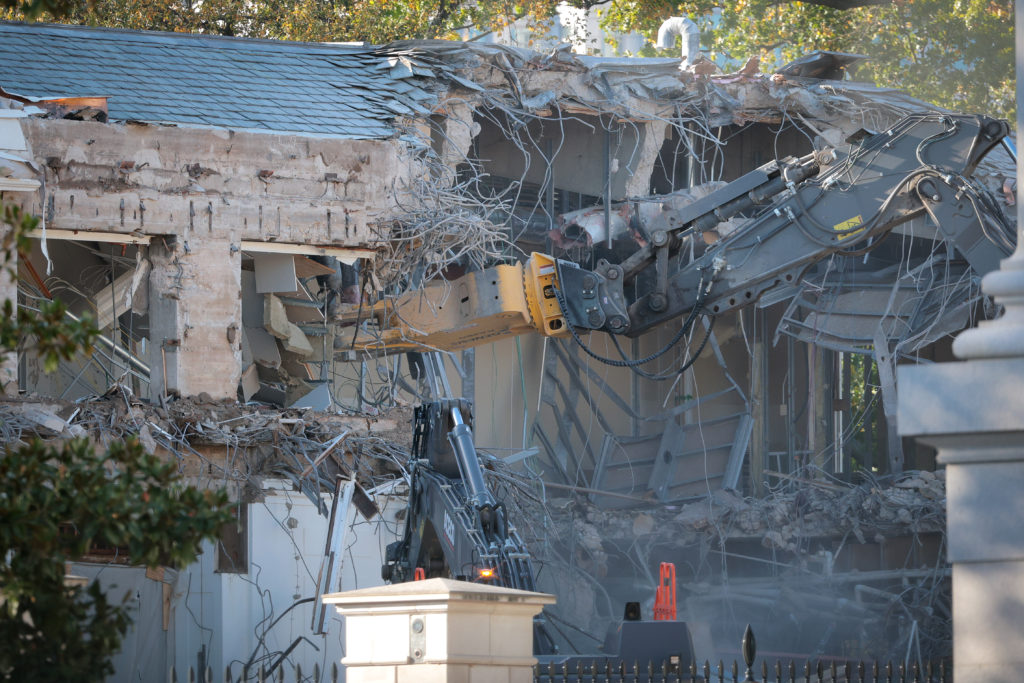
Earlier in the case, Leon allowed construction to continue while signaling the legal questions were substantial and worth closer review if the complaint were refined. Since then, the case has sharpened around procedural and funding concerns, including whether the administration followed required steps in demolishing the East Wing and whether the financing approach can proceed without congressional approval.
The preliminary injunction posture is also worth translating. The judge is not issuing a final ruling on who ultimately wins. He is deciding whether the challengers have shown enough likelihood of success and enough risk of harm to justify hitting pause now. For a project that could irreversibly alter a historic site, “pause first, sort it out in court” can be the most consequential decision in the entire case.
The president’s response
President Trump criticized the lawsuit in a social media post, framing the project as an improvement effort and portraying the challengers as unfairly targeting his building plans while other national problems persist.
“So, the White House Ballroom, and The Trump Kennedy Center, which are under budget, ahead of schedule, and will be among the most magnificent Buildings of their kind anywhere in the World, gets sued by a group that was cut off by Government years ago, but all of the many DISASTERS in our Country are left alone to die. Doesn't make much sense, does it?” he wrote.
What to watch next
- An appeal: Because the judge delayed enforcement for 14 days, the next immediate question is whether a higher court narrows, pauses, or upholds the injunction.
- Congressional action: The ruling’s central premise is simple: if Congress authorizes the project, the legal landscape changes. That could come through explicit authorization, appropriations language, or other statutory direction.
- Administrative approvals: The National Capital Planning Commission vote can shape what is permitted from a planning perspective, even while the funding and authority questions continue in court.
- The security exception: Any continued work justified as necessary for “safety and security” will likely become a factual battleground, especially if demolition and construction are intertwined.
For readers who want the constitutional takeaway, here it is: disputes about buildings can be disputes about power. When a project costs hundreds of millions of dollars and alters a public landmark, the Constitution’s design expects more than one branch of government to have a say.