
There are two constitutional off-ramps for a president who should not keep wielding presidential power. One is punishment. The other is triage.
Impeachment is Congress accusing and trying a president for serious misconduct. It is designed for abuses of power, corruption, and betrayal of public trust.
The Twenty-Fifth Amendment, Section 4 is the vice president and Cabinet temporarily transferring power because the president cannot perform the job. It is designed for incapacity, especially when a president cannot or will not admit it.
They can both result in the president losing power. But they work differently, start with different actors, move on different clocks, and answer different questions.

Quick facts
| Feature | Impeachment | 25th Amendment Section 4 |
|---|---|---|
| Constitutional source | Article I, Sections 2 and 3 (plus Article II, Section 4) | 25th Amendment, Section 4 |
| Core question | Did the president commit impeachable misconduct? | Is the president unable to discharge the powers and duties of the office? |
| Who initiates | House of Representatives | Vice president + a majority of the principal officers of the executive departments (the Cabinet), or another body Congress designates by law (Congress has never created this alternate body) |
| Who decides | House impeaches by majority; Senate convicts by two-thirds | Vice president and Cabinet trigger the transfer; Congress decides only if the president contests and the vice president and Cabinet reassert, and then it takes two-thirds votes in both Houses to keep the vice president as Acting President |
| Immediate effect | No removal from office upon impeachment itself | Vice president becomes Acting President immediately upon transmission of the declaration |
| Vote thresholds | House: simple majority to impeach; Senate: two-thirds to convict | To keep the vice president as Acting President over the president's objection: two-thirds of both the House and the Senate |
| Timeline | Variable and often slow, built around investigation and trial | Fast at the start; then structured deadlines if the president contests |
| Reversible? | Conviction removes the president; reversal would require new political events, not a built-in undo button | Yes, power can move back and forth if declarations change and Congress does not sustain the vice president |
| Historical use on a president | Presidents impeached: Andrew Johnson, Bill Clinton, Donald Trump (twice). None convicted. | Section 4 has never been used to transfer power from a president |
Impeachment in plain English
Impeachment is often talked about like a constitutional guillotine. In reality, it is a two-stage process: accusation in the House, then trial in the Senate.
Step 1: The House impeaches
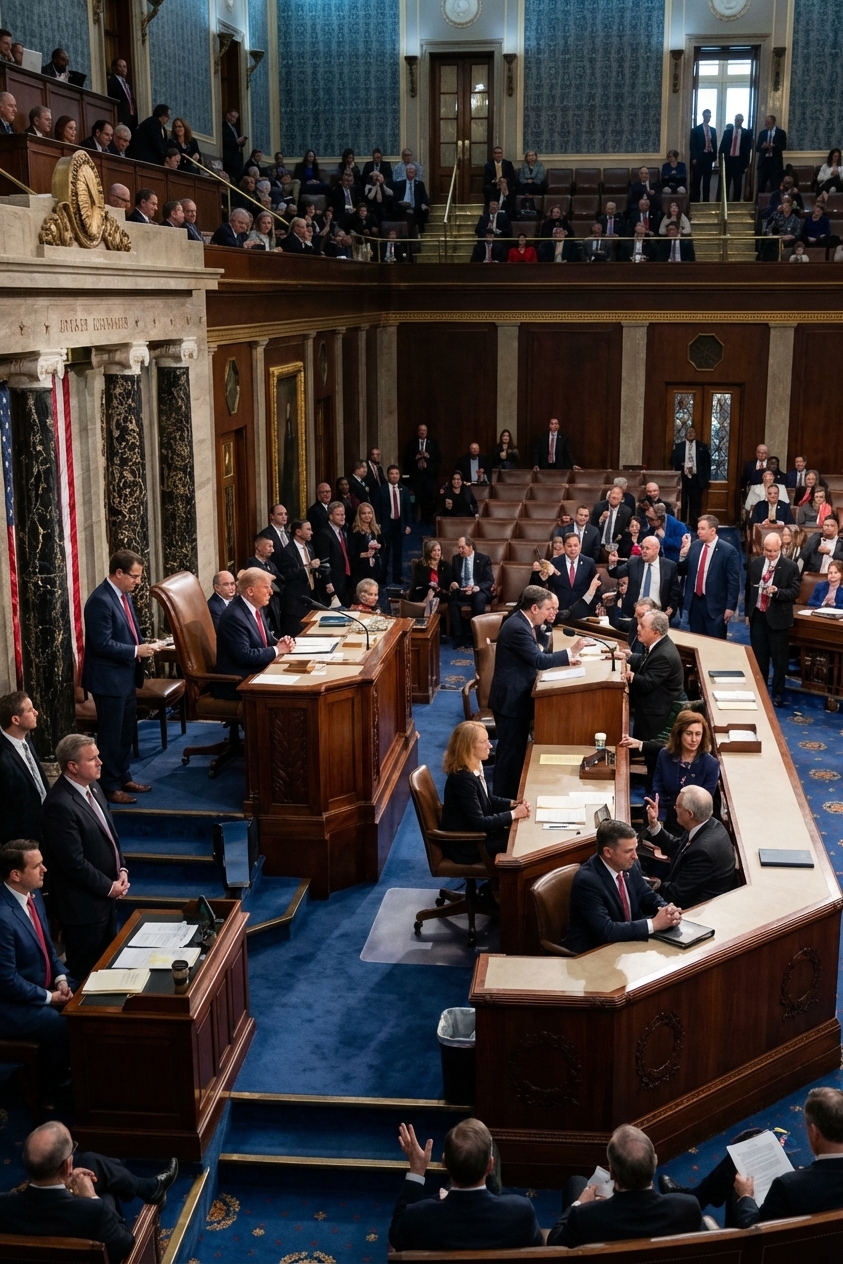
Under Article I, Section 2, the House of Representatives has the sole power of impeachment. In practice, the House investigates, drafts articles of impeachment, and then votes.
- Vote needed: a simple majority of members present and voting.
- What impeachment means: formal charges. It does not remove the president.
Step 2: The Senate tries and convicts or acquits
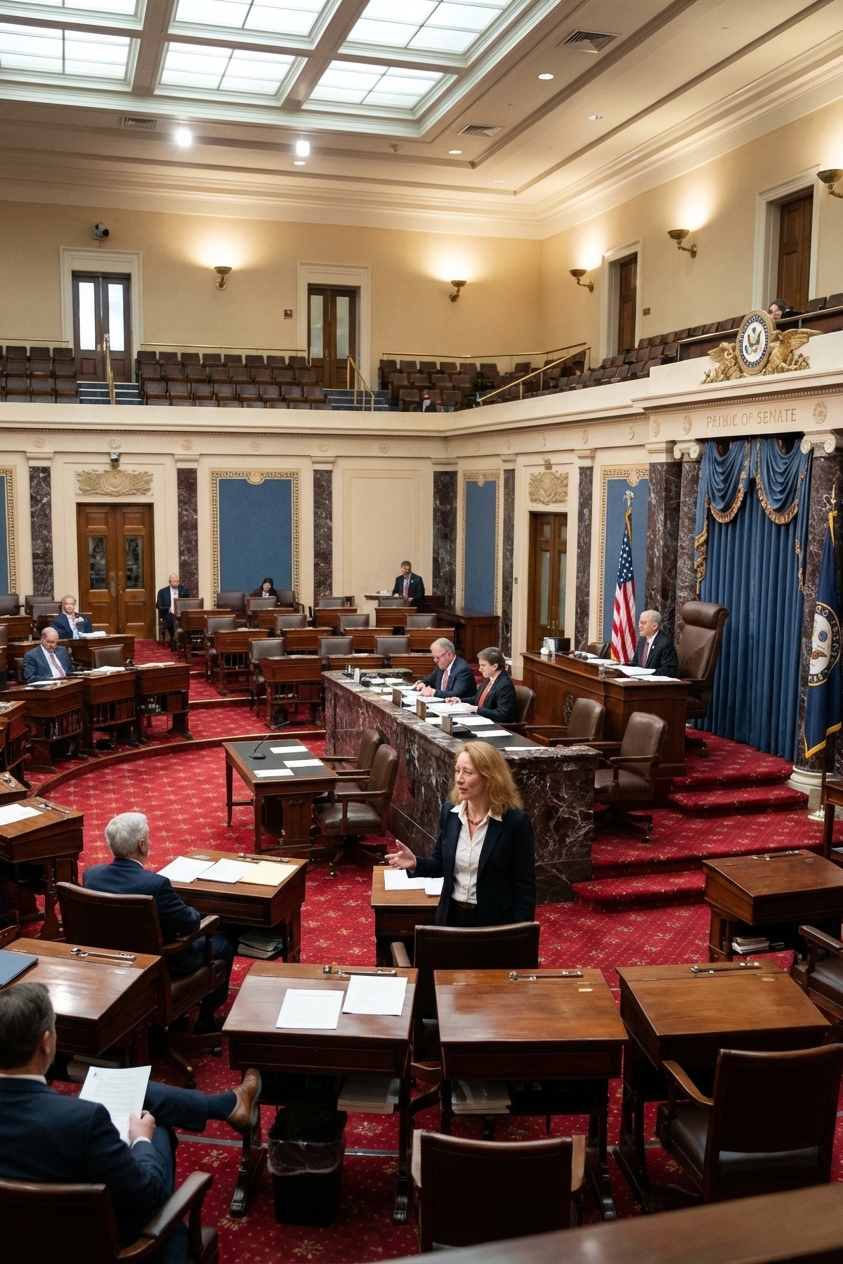
Under Article I, Section 3, the Senate has the sole power to try impeachments. When the president is tried, the Chief Justice presides. Senators act as jurors. House members serve as prosecutors, called managers.
- Vote needed to convict: two-thirds of senators present.
- Effect of conviction: removal from office.
- Possible extra penalty: the Senate may also vote to disqualify the person from holding future federal office (a separate vote, historically treated as requiring a simple majority).
What counts as an impeachable offense?
Article II, Section 4 lists: treason, bribery, or other high crimes and misdemeanors. That last phrase is the battlefield. It does not mean “ordinary crimes only,” and it does not mean “whatever Congress dislikes.” Historically, it is best understood as serious abuses of official power or profound breaches of public trust.
Impeachment is not only for presidents. It applies to other civil officers as well, including judges.
The 25th Amendment Section 4 in plain English
Section 4 of the 25th Amendment is the Constitution’s emergency protocol for a president who is unable to do the job, but will not or cannot step aside voluntarily.
How it starts
The vice president and a majority of the Cabinet can send a written declaration to the President pro tempore of the Senate and the Speaker of the House stating that the president is unable to discharge the powers and duties of office. (The amendment also allows an alternate body Congress creates by law, but Congress has never created one. In practice, it is the vice president plus the Cabinet.)
- Immediate effect: the vice president becomes Acting President as soon as that declaration is transmitted. No congressional vote is required for this initial transfer.
If the president disputes it
The president can send a written declaration saying no inability exists. At that point, power returns to the president unless the vice president and a majority of the Cabinet send a second declaration within four days reaffirming the inability.
Congress becomes the referee
If the vice president and Cabinet reassert and the dispute continues, Congress must decide. The amendment sets a fast-track:
- Congress must assemble within 48 hours if not in session.
- Congress has 21 days to decide the issue.
- During that 21-day window, the vice president remains Acting President.
- Vote needed to keep the vice president as Acting President: two-thirds of both the House and the Senate.
What “unable” means, and why the word matters
Section 4 does not define unable. That ambiguity is intentional and risky at the same time. It is meant to cover true incapacity, such as coma, severe cognitive breakdown, or other conditions where the president cannot reliably perform the office. But because the standard is not a medical checklist, every real-world attempt would become a constitutional argument about facts, motives, and legitimacy.

Historical examples
Impeachment: used, but never finished with conviction for a president
- Andrew Johnson (1868): Impeached by the House largely over Reconstruction clashes and alleged violations of the Tenure of Office Act. Acquitted in the Senate by one vote.
- Bill Clinton (1998): Impeached for perjury and obstruction of justice related to a civil deposition. Acquitted in the Senate.
- Donald Trump (2019 and 2021): Impeached first for abuse of power and obstruction of Congress related to Ukraine, and second for incitement of insurrection related to January 6. Acquitted both times.
The 25th Amendment: Section 4 never invoked
Section 4 has never been used to transfer power away from a president. That is not because presidential incapacity is unimaginable. It is because Section 4 is politically explosive and requires the vice president and Cabinet to confront the president directly. It has been publicly discussed in modern administrations, but never formally used.
Parts of the 25th Amendment have been used in less controversial ways. Section 3 allows a president to voluntarily transfer power temporarily, such as during medical procedures. Presidents have used that mechanism to make the vice president Acting President for short periods. But that is a different section with a different trigger: the president chooses it.
Key differences
1) Misconduct vs. incapacity
Impeachment asks whether a president’s behavior is so serious that removal is warranted. The 25th asks whether a president can function. You can be morally unfit but fully capable, and you can be physically incapacitated without committing any wrongdoing.
2) Who pulls the first lever
Impeachment begins in Congress, usually after public controversy, investigations, or whistleblower reports. Section 4 begins inside the executive branch, led by the vice president and Cabinet. That makes Section 4 both faster and harder to start.
3) What happens immediately
Impeachment is an indictment, not a switch. A president remains president after being impeached.
Section 4 is a switch. The vice president becomes Acting President immediately upon the declaration.
4) The voting math
Impeachment has two hurdles: a House majority to impeach, then a two-thirds Senate vote to convict. The Senate supermajority is the highest bar, but it only comes after the House acts.
Section 4, in a contested case, requires two-thirds of both the House and Senate to keep the vice president as Acting President. That is an even higher bar across the entire Congress.
5) Reversibility and the back-and-forth problem
Impeachment is not designed for toggling. Once convicted, the president is removed.
Section 4 is built for reversibility. A president can reclaim power by declaring no inability exists, and the vice president and Cabinet can challenge again. If political actors are divided, the country can end up in a constitutional tug-of-war at the worst possible moment.
6) What each process is good at
- Impeachment is best at addressing wrongdoing, especially wrongdoing that uses the presidency itself as a tool.
- Section 4 is best at immediate continuity of government when time matters and the problem is functional inability.
Which tool fits?
In real life, the hardest cases are the gray ones, where health, judgment, and misconduct blur together. Still, the Constitution gives you two tools because it assumes two different kinds of emergencies.
When impeachment fits
- Corruption and bribery, including selling official acts.
- Abuse of power, such as using federal agencies to punish opponents.
- Serious obstruction of lawful oversight, investigations, or elections.
- Betrayal of national interests that rises to the level of high crimes and misdemeanors.
When the 25th Amendment Section 4 fits
- Medical incapacity where the president cannot communicate or make decisions.
- Severe cognitive impairment that makes the basic duties of the office unworkable.
- Acute crisis where immediate transfer of authority is needed and the president cannot or will not step aside voluntarily.
When neither is a clean fit
If the complaint is essentially “the president is making terrible decisions,” that is usually a political problem with political remedies: elections, party pressure, resignations, or Cabinet turnover. The Constitution is deliberately reluctant to convert policy disagreement into removal, because that is how parliamentary systems work, not presidential ones.
Common misconceptions
The 25th Amendment is not a backdoor impeachment
Section 4 is not designed to punish, and it does not require proving misconduct. It is a continuity mechanism. Using it as a substitute for impeachment would invite the exact legitimacy crisis it was meant to prevent.
Impeachment does not mean automatic removal
People often speak as though impeachment is the final step. Constitutionally, it is the beginning of the Senate trial.
The vice president does not become president under Section 4
The vice president becomes Acting President unless and until the presidency becomes vacant through death, resignation, or removal, or until Congress and the constitutional process settle the dispute.
Why the difference matters
Impeachment and Section 4 reflect two fears shared across American constitutional history: the fear of a lawless president, and the fear of a powerless one.
Impeachment is the Framers’ answer to the first fear: no one, not even a president, is above accountability.
Section 4 is later reformers’ answer to the second fear: the country cannot wait for a trial if the person holding the country’s most urgent executive powers cannot function.
Both mechanisms are intentionally hard. That is not a design flaw. It is an admission that removing a president is not just a legal act, it is a national stress test.
Bottom line
If you remember only one thing, make it this: impeachment is about misconduct, and the 25th Amendment Section 4 is about inability.
One is a constitutional prosecution. The other is a constitutional handoff.
They can both end with a president losing power. But they start in different places, run on different clocks, and serve different constitutional purposes. Knowing which is which is not trivia. It is how you tell the difference between a crisis of ethics and a crisis of capacity.