
A government shutdown is often described like a weather event, something that simply arrives and then passes. But constitutionally, it is not weather. It is a choice. And this week, the choice hardened into a familiar shape: the House and Senate moving in opposite directions, each insisting the other holds the obvious key to the lock.
Late Friday, the House approved a new stopgap plan to temporarily fund the Department of Homeland Security, even as the shutdown hit day 43. The measure extends DHS funding for roughly two months. It is, in form, a clean extension with no policy riders. In function, it is also a message to the Senate: we are not accepting your approach, and we are not negotiating with ourselves.
But the bill does not end the shutdown on its own. Without Senate action, it remains a House statement more than a solution.
Join the Discussion
Two chambers, two paths
The Senate had already passed its own DHS funding bill in the early hours of Friday morning and then left Washington for a two-week Easter recess. That timing matters because, in the Senate, even a straightforward funding bill still runs into the 60-vote reality of cloture. A handful of Democrats must agree to move anything to final passage.
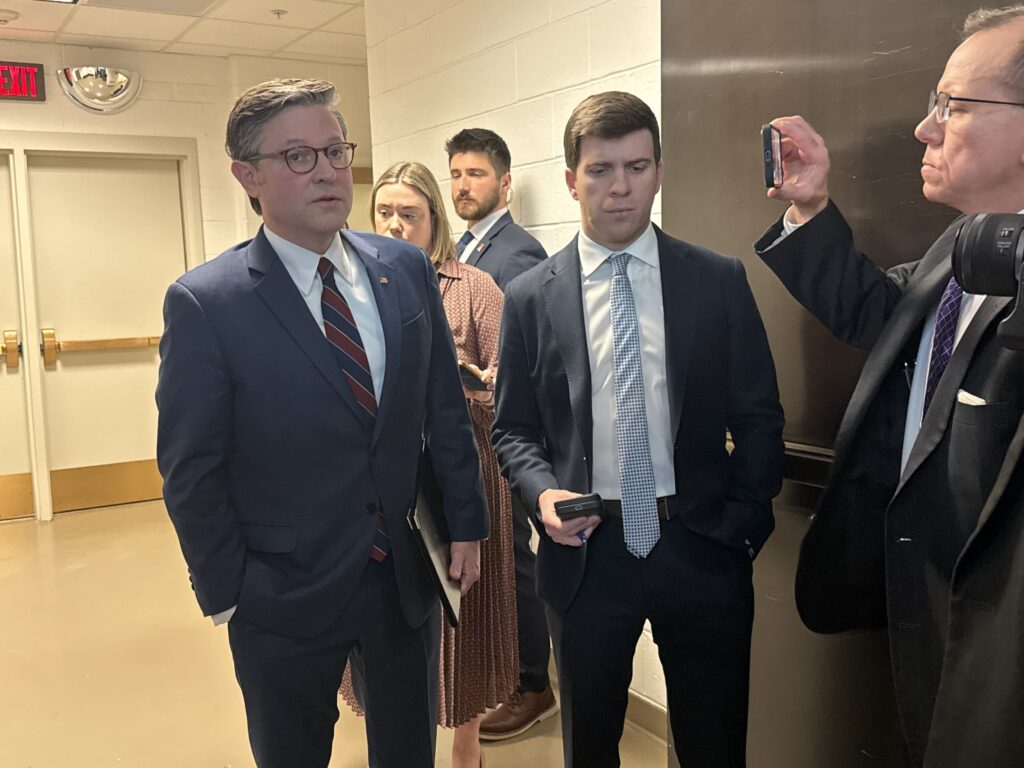
House leaders, however, treated the Senate’s bill as something worse than inadequate. Speaker Mike Johnson said the House would not accept a framework that separates major components of border and immigration enforcement. “We’re not going to split apart two of the most important agencies in the government and leave them hanging like that,” Johnson told reporters Friday night. “We just couldn’t do it.”
Earlier Friday, Johnson argued the Senate approach would undercut enforcement. “House Republicans will have no part in reopening the border and stopping illegal immigration enforcement,” he said.
Democrats responded by arguing the political ownership is now unmistakable. House Minority Leader Hakeem Jeffries called the House effort “a partisan spending bill” and said Republicans had “taken the decision to own this shutdown decisively.”
What the House passed
The House-passed bill is a short-term patch, designed to temporarily fund DHS for about two months while longer negotiations continue. It contains no partisan policy riders and is a clean extension of government funding.
But clean does not mean viable. In the Senate, the practical question is not whether a bill has riders. The question is whether it can hit 60 votes. With senators already gone for recess, the House can pass bills all weekend and still be legislating into a closed door.
Complicating the politics further, President Donald Trump also came out against the House-passed bill Friday afternoon.
That is why House Republicans have shifted from persuading Democrats to pressuring the Senate itself to return to Washington. Conference Chair Lisa McClain urged senators to come back and vote, calling it “pretty sad” to remain on recess while workers miss paychecks. Republican Study Committee Chairman August Pfluger likewise called for the Senate to return “immediately” to take up the House measure.
The costs hit workers first
This is where civics gets painfully tangible. The Constitution does not say “TSA agents must be paid on time,” but it does give Congress control over appropriations. When funding lapses, the consequences land on real people long before they land on institutions.
Roughly 50,000 TSA agents have missed two full paychecks during the funding lapse, leading hundreds to quit their jobs and forcing others to grapple with mounting financial distress. Senior officials have warned of long-term impacts due to more than 500 agents quitting during the funding lapse.
On Friday, President Donald Trump signed an executive action directing DHS to pay TSA employees using existing funds. The move is aimed at preventing deeper disruption at security checkpoints and easing the immediate pressure on workers who have continued reporting for duty.
But the executive action only goes so far. Other DHS personnel, including employees at the Federal Emergency Management Agency, the Cybersecurity and Infrastructure Security Agency, the U.S. Coast Guard, and certain support staff working for ICE and CBP, are still left without pay until Congress restores funding.
Why immigration keeps colliding with funding
DHS funding bills are not just about salaries and paperclips. They sit directly on the country’s most combustible set of policy questions: border enforcement, detention, deportation, and the scope of federal power at the border.
Democrats have pushed for changes to how immigration enforcement operates, including tighter warrant requirements and prohibiting agents from wearing masks. Those reforms are not in the House’s short-term extension. Senate Majority Leader John Thune suggested that Democrats’ leverage on such demands has faded, saying, “I mean, I think that ship has sailed, and they kind of kissed that opportunity goodbye by failing to provide funding for those agencies.”
That blunt assessment captures the paradox. In a shutdown, each side believes the other will absorb more blame. But leverage is not only public relations. It is timing, votes, and the procedural choke points that let a minority stop a bill from moving.
Appropriations are policy
Shutdown fights are routinely framed as Washington dysfunction. That is true, but it is also incomplete. The Appropriations Clause is one of the Constitution’s most practical tools for self-government. It forces priorities into the open. It makes Congress say yes or no to the machinery of government, and it gives the minority real tools to slow or stop what the majority wants to do.
In a system built to make lawmaking hard, the easiest thing for Congress to do is nothing. The hardest thing is to agree. And when the dispute centers on immigration enforcement, the distance between “agree” and “move on” can be measured in missed paychecks, resignations, and agencies running on fumes.
For now, the House has passed a new plan and dared the Senate to show up. The Senate has left town after passing its own. The shutdown, as a result, remains less a moment than a standoff.