
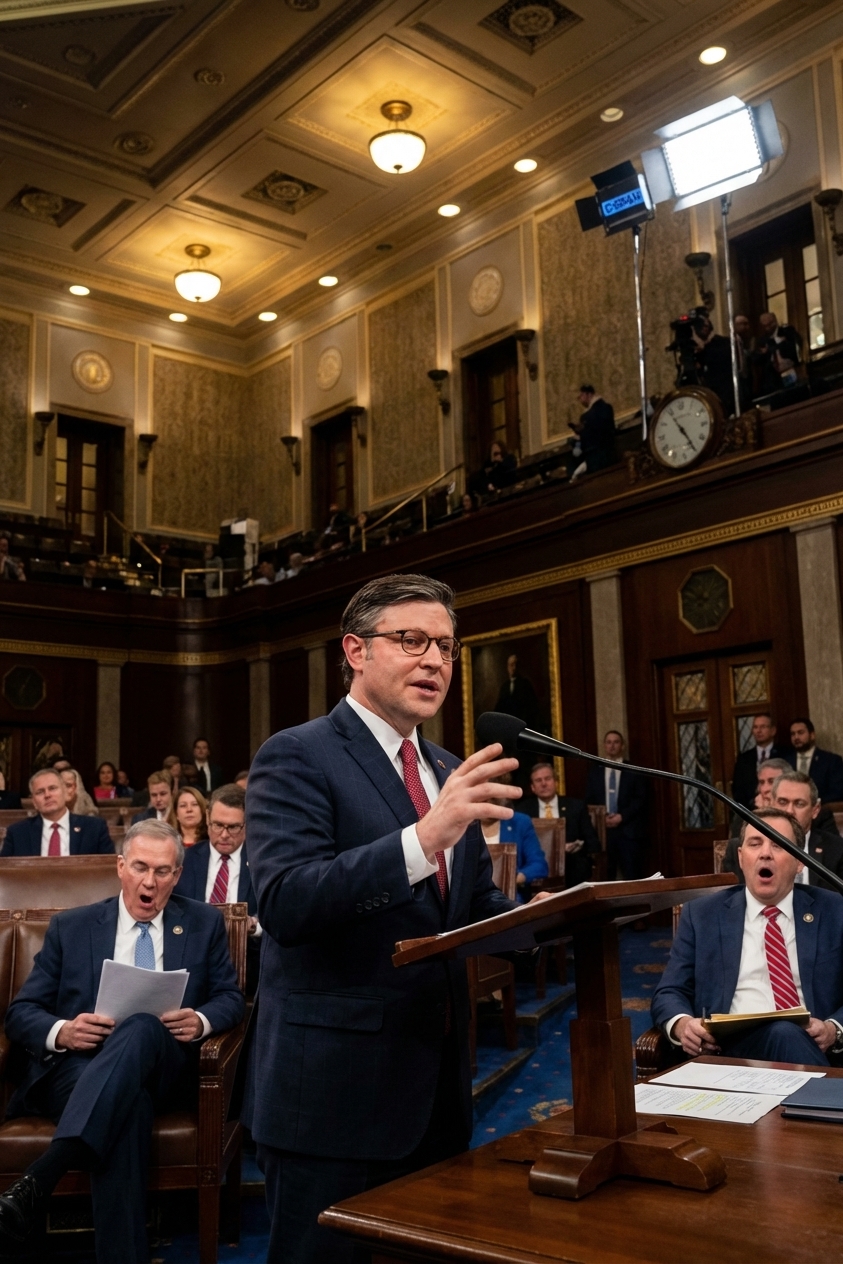
Washington has reached that familiar point where procedure starts to look like punishment. Late Friday, House Republicans approved a short-term funding extension for the Department of Homeland Security, a move meant to break a standoff that has already stretched into a 42-day partial shutdown. The problem is not what the House did. The problem is what happens next, in the Senate, where this fight is set up to bog down.
The vote was 213-203, mostly along party lines. Reps. Don Davis of North Carolina, Marie Gluesenkamp Perez of Washington, and Henry Cuellar of Texas crossed party lines to support the measure. More than a dozen members did not vote. The bill would keep DHS funded for roughly two months, buying time without actually resolving the argument that caused the shutdown in the first place.
Shutdown civics
In civics class, I used to ask students a blunt question: who is Congress when it cannot pass a budget? The Constitution gives the legislature the power of the purse for a reason. It is supposed to be the branch that forces compromise by necessity. A shutdown flips that logic. Instead of compromise being the requirement, pain becomes the negotiating tool.
The shutdown began on Feb. 14, when DHS funding lapsed. Now both chambers are scheduled to leave Washington for an Easter recess without a deal. If nothing changes, the shutdown is positioned to become the longest in U.S. history. That is not just trivia. It is a sign that the normal pressures that once ended shutdowns are not working like they used to.
House yes, Senate wall
The House plan is a stopgap. It keeps DHS afloat temporarily while negotiators claim they will “figure this out” later. Speaker Mike Johnson framed the extension as a chance to negotiate reforms while maintaining baseline national security operations. On television Friday night, Johnson said, "In those eight weeks, we will figure this out with Democrats and figure out a couple of reforms or whatever they need to make sure that we do this right, but we are going to protect the homeland. We have to."
But the Senate has been the wall for this kind of approach. The House-passed measure faces long odds there, where Senate Democrats have filibustered GOP-authored DHS measures that include immigration funding for the past six weeks. Earlier Friday, the Senate passed a different deal unanimously, funding most DHS sub-agencies but leaving out ICE and parts of Customs and Border Protection. House GOP leadership and the House Freedom Caucus rejected that plan outright, and the House moved its own patch instead.
ICE at the center
This shutdown is not really about a line item. It is about whether DHS can be funded without fully funding Immigration and Customs Enforcement and major parts of Customs and Border Protection. The Senate advanced an approach that funded much of DHS while leaving out ICE and parts of CBP. House Republicans treated that as an unacceptable retreat from federal immigration enforcement.
President Donald Trump also dismissed the Senate’s approach. "It wasn’t good. It wasn’t appropriate," he said of the Senate agreement, adding, "You can’t have a bill that’s not going to fund ICE."
Democrats, meanwhile, are not hiding the fact that they see ICE funding as the pressure point. House Minority Leader Hakeem Jeffries argued Republicans are prolonging the shutdown to keep immigration enforcement running at full tilt without changes, saying, "House Republicans have decided that they would rather inconvenience you, create chaos for you and for your families so that they can continue to jam their extreme right-wing ideology down the throats of the American people so they can continue to spend billions of dollars for ICE to brutalize and kill American citizens."
One more piece of the politics landed late Friday: the National Border Patrol Council endorsed the House bill, arguing the Senate’s failure to fund all of DHS is "completely unacceptable and should not stand."
Here is what that tells you, civics-wise. Both sides are using the appropriations process to force outcomes the ordinary legislative process cannot produce. That is legal. It is also a warning sign. When budgets become stand-ins for substantive lawmaking, the government does not merely run out of money. It runs out of trust.
The pressure valve

The most visible damage from this shutdown has been at airports. Staffing shortages at TSA checkpoints have produced long waits, missed flights, and a public that does not care which chamber is to blame.
To relieve that pressure, Trump issued an executive order directing DHS to pay more than 50,000 TSA personnel who have been working without pay since the shutdown began. Those workers are expected to receive their first full paychecks in more than six weeks on Monday.
Here is the uncomfortable civics lesson: when Congress deadlocks, presidents reach for workarounds. Some are mundane. Some are sweeping. But the pattern is the same. Legislative paralysis invites executive improvisation. Over time, improvisation starts to look like a normal way of governing.
What to watch
- Senate math, not Senate speeches. If the House bill cannot clear the Senate’s procedural hurdles, it is not a solution. It is a signal.
- Whether a second bill becomes the real plan. Senate Republicans have teased a second "big, beautiful" bill to add immigration enforcement funding for ICE and the Border Patrol. Election-year margins make that a steep climb.
- Whether “temporary” becomes routine. A two-month patch may keep DHS funded, but it also normalizes governing by short extensions and brinkmanship.
The Constitution does not promise efficient government. It promises accountable government. Right now, the country is watching an accountability test play out in slow motion. The question is not just how long the shutdown lasts. The question is what habits of power we are building while it drags on.