
The Fourteenth Amendment sounds simple until you reach the phrase that does all the work.
“All persons born or naturalized in the United States, and subject to the jurisdiction thereof, are citizens of the United States.”
For more than a century, Americans have mostly treated that sentence as a clean rule: if you are born here, you are one of us, with a short list of narrow exceptions. The current legal fight over President Donald Trump’s executive order limiting birthright citizenship is not really about the word “born.” It is about what it means to be “subject to the jurisdiction thereof.”
Join the Discussion
The case at the center
In April 1880, an Omaha election official named Charles Wilkins refused to register a man named John Elk to vote. The reason was stark: Elk was Native American, and the local official treated that as disqualifying him from citizenship.
Elk, believed to have been a member of what is now known as the Winnebago Tribe of Nebraska, objected, saying he had severed all ties with his tribe and had willingly subjected himself to the authority of the United States. He also made an argument that feels familiar today: because he was born within U.S. territory, he said, he was a citizen from birth.
The Supreme Court rejected that claim in Elk v. Wilkins (1884). The Court concluded that Native Americans born in the United States were not automatically citizens under the Fourteenth Amendment’s Citizenship Clause. The opinion compared their status to “the children of subjects of any foreign government born within the domain of that government,” treating tribal affiliation as a separate political allegiance that kept a person outside full constitutional membership unless citizenship was granted through another mechanism.
The executive order and the theory
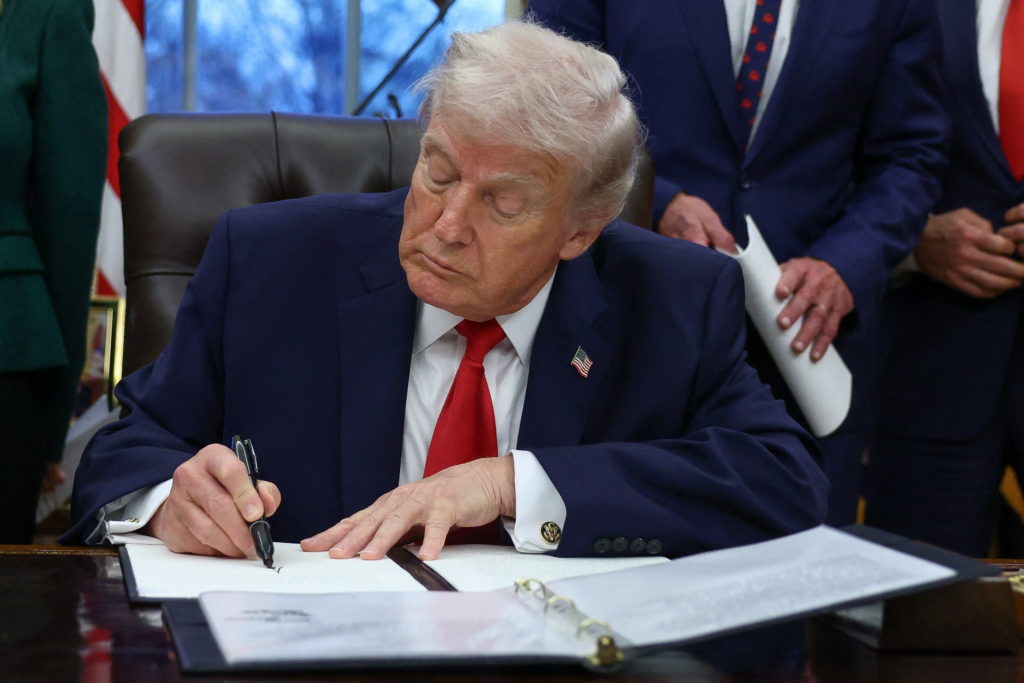
Trump’s executive order, issued on the first day of his second term, would narrow automatic citizenship at birth. Under the order’s approach, a child born in the United States would receive citizenship only if at least one parent is a U.S. citizen or a lawful permanent resident.
The order is not in effect; lower courts have blocked it. The Supreme Court is set to hear oral arguments on Wednesday.
In court papers, Solicitor General D. John Sauer cited Elk while arguing that the Court has “squarely rejected the premise that anyone born in U.S. territory, no matter the circumstances, is automatically a citizen so long as the federal government can regulate them.” White House spokeswoman Abigail Jackson said the case gives the Court the chance to “restore the meaning of citizenship in the United States to its original public meaning.”
The government’s move is to treat “jurisdiction” as something thicker than ordinary legal authority, closer to “political jurisdiction,” meaning full allegiance and membership. Under this reading, undocumented immigrants and many temporary visa holders are physically present and regulated by U.S. law, but their children are not necessarily born “subject to the jurisdiction” in the constitutional sense.
Why the analogy is contested
Legal experts who specialize in federal Indian law have warned that pulling Elk out of its historical context risks importing a doctrine built for tribal sovereignty into immigration law, where it does not fit.
Leonard Fineday, general counsel of the National Congress of American Indians, put the objection plainly: “We believe the reliance on Elk to deny birthright citizenship to children of undocumented immigrants is misplaced. It’s a misreading and a misunderstanding.” He added that the Elk decision rests solely on the specific nature of “quasi-sovereign tribal government” and is limited to that context.
Monte Mills of the University of Washington School of Law, who directs a Native American law center, described the reliance on Elk in blunt terms: “It does betray a lack of understanding and awareness or willingness to acknowledge the nuance of Native American law.” Another lawyer who works on Native American issues warned that the history is “anomalous” and urged caution about importing lessons from that setting into other fields.
One reason Native American tribes and organizations have largely stayed out of the case is practical: since 1924, Native Americans have been guaranteed birthright citizenship via statute, so they do not have the same stake in the outcome. Another is political reality: there are more than 500 tribes, and their views can differ, including on whether Trump’s executive order is good policy.
The obstacle: Wong Kim Ark
If Elk is the administration’s historical hook, United States v. Wong Kim Ark (1898) is the precedent that sits in the middle of the road.
In Wong Kim Ark, the Court held that a man born in San Francisco to parents who were Chinese nationals living in the United States was a citizen at birth. That case has long served as the anchor for the modern understanding that the Fourteenth Amendment constitutionalized a broad form of birthright citizenship.
The detail that makes today’s strategy especially delicate is that both majority opinions were written by the same justice, Horace Gray. And in Wong Kim Ark, Gray explicitly distinguished his earlier Elk opinion, explaining that Elk concerned “only members of Indian tribes within the United States and had no tendency to deny citizenship to children born in the United States” who were not Native American.
In his brief, Sauer downplayed Wong Kim Ark, arguing it recognized birthright citizenship only for children of citizens and those born to immigrants who were permanent residents. Ilan Wurman, a professor at the University of Minnesota Law School who filed a brief backing Trump, summed up the government’s use of Elk this way: “The bottom line is that the case is helpful to the government, but it’s ambiguous.”
What “jurisdiction” can mean
The Supreme Court has always recognized that some people born in the United States are not citizens at birth. The classic examples are children of accredited diplomats and children of foreign invaders, situations where the United States lacks full sovereign authority over the parents.
The current fight asks whether undocumented presence or temporary lawful presence belongs in that same category. The administration’s approach effectively argues that immigration status limits the kind of jurisdiction the Fourteenth Amendment requires.
The challengers, led by the American Civil Liberties Union, describe the dispute in more direct terms. ACLU lawyer Cody Wofsy said, “At a fundamental level, this case is about an attempt to strip citizenship from the children of immigrants who have always been citizens of the U.S.”
Those two visions of “jurisdiction” produce radically different constitutional universes. One treats jurisdiction as territorial sovereignty: if you are born where U.S. law runs, you are in. The other treats jurisdiction as political membership: if your parents are outside the political community, your birth does not complete the entry.
What the Court must decide
This case is not just another immigration dispute. It is a test of how the Court reads constitutional text when the text contains both a broad promise and a qualifying phrase.
If the Court elevates Elk into a general theory of limited birthright citizenship, it will be doing something bigger than ruling on one executive order. It will be redefining the default rule of American membership, potentially shifting citizenship from an automatic constitutional status into a conditional outcome tied to parental category.
If the Court keeps Elk confined to the law of quasi-sovereign tribal government, it will likely reinforce the traditional reading of the Fourteenth Amendment and treat Wong Kim Ark as controlling for children born to noncitizen parents who are living under ordinary U.S. civil and criminal authority.
Either way, the justices will have to answer a question that sounds technical but is deeply civic: when the Constitution says “subject to the jurisdiction thereof,” is it describing who must obey our laws, or who fully belongs to our political community from the first breath?
A civic takeaway
The Citizenship Clause is only one sentence, but it carries the weight of an entire national identity. It was ratified in 1868 in the aftermath of the Civil War and the end of slavery to cement the status of freed slaves and to prevent states from inventing new categories of people who live here but do not belong.
That history does not automatically decide today’s case, but it should inform our instincts about what the Fourteenth Amendment was designed to prevent: a political system where citizenship can be narrowed by ordinary politics rather than protected by constitutional principle.
The Court’s decision will tell us whether birthright citizenship remains a constitutional baseline or becomes a battlefield of definitions.