
Washington loves to talk about “national security” in the abstract. But the Department of Homeland Security shutdown has a way of stripping the abstraction off. When the White House has to reach for existing funds to keep about 50,000 TSA agents from missing yet another paycheck, you are not watching a budget disagreement. You are watching a constitutional stress test in real time.
This standoff has now dragged on for 43 days. The House has passed a two-month stopgap to temporarily fund DHS, and the Senate has already passed a competing measure of its own. Both sides insist they are offering the “way out.” Meanwhile, tens of thousands of DHS employees are working unpaid, and the pressure is felt where the public can see it: airports, ports, and the border.
What a shutdown is
A shutdown is often described like a storm. It “hits,” it “slams,” it “paralyzes.” That language is convenient because it makes the damage seem natural. But this is not weather. This is an elected failure to enact appropriations.
Under the Constitution, Congress holds the purse strings. Article I is not shy about it. The executive branch cannot spend what Congress has not appropriated. In plain English, DHS runs on money that must be voted on, negotiated, and enacted. When that process fails, core functions still continue because the law says they must, and then the bill shows up in the form of withheld paychecks until lawmakers decide to stop playing chicken.
The 60-vote wall
The House passed a clean, short-term extension to fund DHS for about two months. Clean here matters. No partisan policy riders in the text.
But the Senate is not built for simple majorities on big fights. In today’s Senate, most funding legislation must clear the practical hurdle of 60 votes to move, which means any House plan that cannot attract at least a handful of Democrats is likely dead on arrival.
To make it messier, the Senate passed its own DHS funding measure in the early morning hours Friday and then left Washington for a two-week Easter recess. House lawmakers are also scheduled to be out for two weeks. The result is a shutdown with a calendar built to endure it.

Immigration at the center
Budget battles are rarely just about numbers. They are about policy control. Here, the center of gravity is immigration enforcement: what gets funded, what gets constrained, and who takes the blame.
House Speaker Mike Johnson framed the dispute as a refusal to accept a Senate deal that, in the House GOP’s view, would “split apart two of the most important agencies in the government and leave them hanging like that.” Johnson also blasted the Senate approach for stopping short of funding Immigration and Customs Enforcement (ICE) and portions of U.S. Customs and Border Protection (CBP), saying earlier that House Republicans would have no part in “reopening the border and stopping illegal immigration enforcement.”
Democrats, for their part, have demanded reforms for six weeks to rein in immigration enforcement, including tightening warrant requirements and prohibiting agents from wearing masks. Those demands are not included in the House stopgap.
So the shutdown becomes a substitute legislature. Instead of debating immigration policy on its merits and voting up or down, the parties rerun the argument through the appropriations process, using paychecks and public anxiety as fuel.
TSA pay and executive action
One of the most revealing moves in this standoff is not coming from Congress. It is coming from the White House.
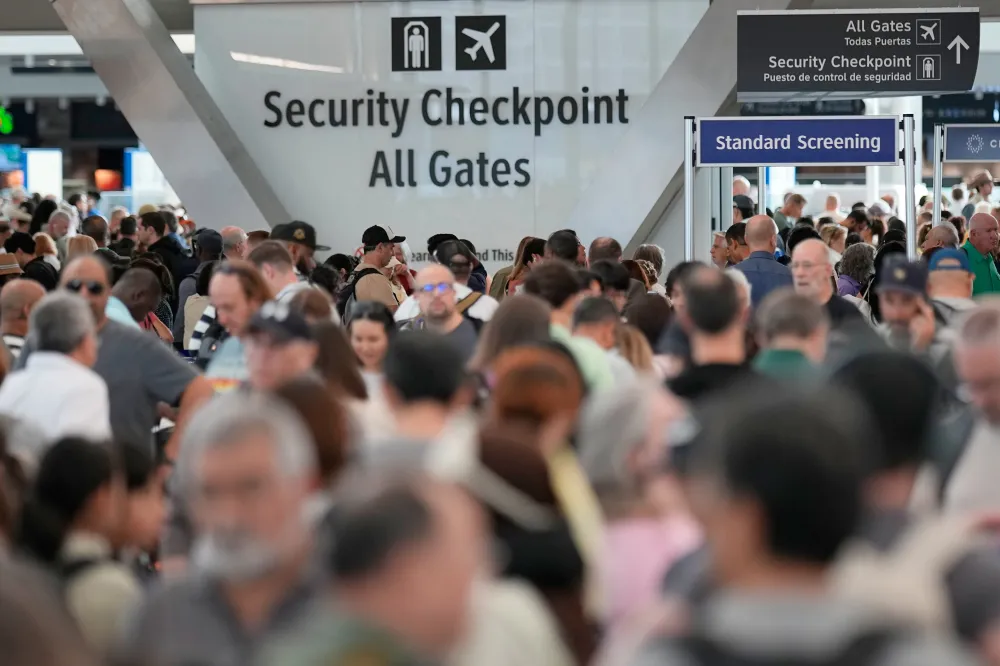
President Donald Trump directed DHS to pay TSA employees with existing funds during the lapse. The immediate aim is practical: avoid worsening staffing gaps and the long lines that follow. The roughly 50,000 agents have missed two full paychecks, leading hundreds to quit and prompting warnings of long-term impacts due to more than 500 agents quitting during the funding lapse.
The political picture, however, is not clean either. Trump also came out against the House bill Friday afternoon in an interview with Fox News, a reminder that even the “patch” can become part of the fight rather than the exit ramp.
From a constitutional perspective, the deeper issue is this: when Congress fails to fund, the President is always tempted to “solve” the problem unilaterally. Sometimes the fix looks humane. Sometimes it looks efficient. It is still a workaround.
The Constitution does not give the executive a blank check because the consequences are ugly. It gives Congress the power of the purse precisely because consequences are ugly. That ugliness forces negotiation. When presidents find ways to soften the pain selectively, they also change the negotiating terrain. Who feels the shutdown, and who does not, becomes a political choice rather than the direct result of legislative failure.
Workers in the middle
TSA is only one slice of DHS. Other personnel are still stuck in the shutdown’s undertow, including employees tied to FEMA, CISA, the U.S. Coast Guard, and certain support staff for ICE and CBP. Some functions continue because the law says they must. The paycheck does not always follow.
This is where the civics textbook meets real life. We tell students that public servants “serve the country.” Then we build a system where service can become involuntary, at least temporarily, because the political branches want more leverage.
The question to ask
Here is the hard question that never gets asked loudly enough: What is a shutdown for?
If it is a constitutional tool to force compromise, then both parties should admit what they are doing. They are using pain, strategically distributed, to extract policy concessions. If it is a failure, then we should stop treating it like a normal bargaining chip and start treating it like a breakdown in basic governance. A republic that cannot reliably pay its own workers is not “tough.” It is unstable.
House and Senate leaders are already laying down markers. House Minority Leader Hakeem Jeffries argued that Republicans have “taken the decision to own this shutdown decisively.” Republicans have countered that Democrats have blocked continuing resolutions for weeks and urged the Senate to return from recess to vote. Senate Majority Leader John Thune has warned that nobody wins in a shutdown, and has suggested Democrats are now less likely to secure their requested immigration enforcement limits than they were at the start of the lapse.
And if the lesson lawmakers take from this episode is that presidents can patch over the worst consequences by executive action, then the long-term shift is obvious. Congress loses leverage. The presidency grows. The next shutdown becomes easier to trigger, because the political cost can be managed with selective relief.
The Founders did not design the appropriations power as a decorative tradition. They designed it as a leash. Every time we normalize the leash snapping, we should expect the dog to run farther the next time.