
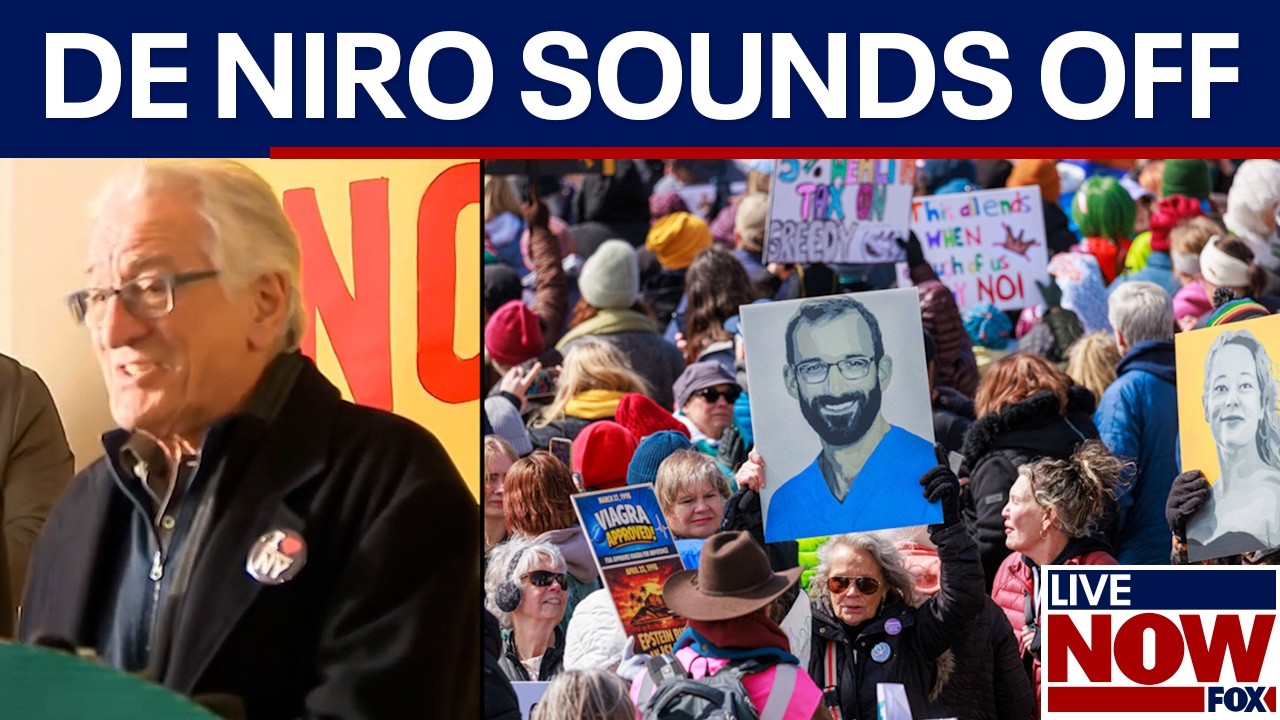
Actor Robert De Niro and musician Bruce Springsteen appeared at separate “No Kings” rallies and spoke to crowds, as shown in circulating video. Their appearances added celebrity attention to a protest slogan that different participants and viewers can interpret in different ways.
What is concrete here is the visual record: each man is seen addressing rallygoers. Beyond that, much of the meaning people attach to these moments comes from how they read the slogan, the crowd energy, and the broader political context they bring with them.
Join the Discussion
What happened
Videos shared online show De Niro speaking at one “No Kings” rally and Springsteen speaking at another. Each addresses attendees directly, placing a well-known voice in the middle of a protest scene that can be easily recorded and reshared.
For many viewers, the footage may be the main takeaway: a short, shareable clip with a chant, a backdrop of signs, and a recognizable figure on a microphone. Depending on the audience, it can read as anything from simple presence to a more explicit public alignment with the rally’s theme.
Specifics such as the full remarks, exact locations, and timing are not established here beyond what appears in the circulating videos.
What “No Kings” means
“No Kings” is not a single, official platform so much as a compact message that people use in different ways. Some supporters frame it as a reminder that no public official should be treated as beyond scrutiny. Others treat it as a broader warning about concentrated power or a political culture that shifts toward loyalty to a person rather than institutions.
Read that way, the slogan is often associated with familiar democratic instincts like public criticism, protest, and demands for accountability. That association is not one-size-fits-all, and the same phrase can be heard as principled dissent by one person and as provocation by another.
De Niro at a rally
De Niro is seen addressing rallygoers at a “No Kings” event, speaking into a microphone in front of protesters. In clips like these, a celebrity appearance can function as a signal boost: a recognizable face showing up in person, helping a local moment travel farther online.
How that lands depends on the audience. Some viewers read it as solidarity. Some see it as performance. Some react to it as a challenge. The consistent through-line is visibility: cameras gravitate toward fame, and the slogan gains reach.
Springsteen at a rally
Springsteen is also seen speaking at a separate “No Kings” rally in circulating video. His presence can carry cultural weight for people who already associate him with debates about American identity, ideals, and where the country falls short.
In that context, some supporters may read his appearance as a cultural version of the slogan’s core sentiment: that dissent can be part of civic life, not proof of disloyalty. Others may simply see another high-profile figure stepping into a political moment.
The civics angle
Protest slogans work because they compress a big idea into a few words. When people chant “No Kings,” they are often understood to be pushing back, in general terms, against the idea of personal rule or unchecked authority. That is an interpretation of the slogan’s use, not a verified statement of what every attendee believes.
Three common themes
- Speech and assembly: The right to protest and criticize leaders is widely treated as a basic feature of American civic life, including when the criticism is blunt.
- Checks and balances: Many people interpret “No Kings” as shorthand for the idea that power should be limited and contested, not treated as absolute.
- Accountability: Some rallygoers use the phrase to emphasize oversight, elections, and public scrutiny as nonviolent tools for keeping leaders answerable.
In other words, the slogan can be read as a claim about norms: that authority is conditional, and that public pushback is part of how a system corrects itself.
What celebrity changes
When well-known people join a protest, the immediate effect is attention, and attention is a form of power. Supporters may see the visibility as helpful. Critics may dismiss it as performative. Either way, the moment tends to spread faster because the speaker is famous.
De Niro and Springsteen have the same speech rights as anyone else, plus a larger megaphone. In a moment when “No Kings” clips are circulating widely online, that megaphone helps explain how a rally speech can become part of a wider political conversation.